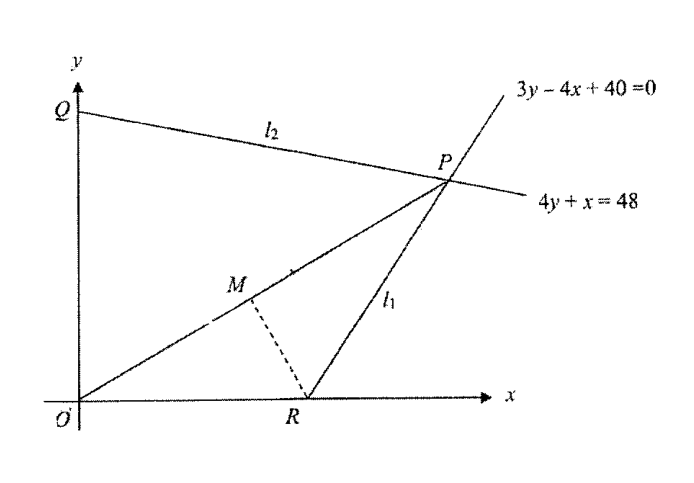
The diagram shows lines l1l_1 and l2l_2 intersecting at PP. Line l1l_1 has equation 3y−4x+40=03y - 4x + 40 = 0 and l2l_2 has equation 4y+x=484y + x = 48. The point MM is the midpoint of OPOP. The line l2l_2 intersects the yy-axis at QQ and the line l1l_1 intersects the xx-axis at RR.

  1. (a)

    Show that OPOP is perpendicular to MRMR.

  2. (b)

    Find the area of ORPQORPQ.

Work through it with AI →

It won't just hand you the answer — it asks where you're stuck.How the checker works

Worked solution

11(a)

1. Find the coordinates of $P$ by solving the simultaneous equations for $l_1$ and $l_2$.

From l2l_2, x=48−4yx = 48 - 4y.
Substitute into l1l_1:
3y−4(48−4y)+40=03y - 4(48 - 4y) + 40 = 0
3y−192+16y+40=03y - 192 + 16y + 40 = 0
19y=15219y = 152
y=8y = 8
Substitute y=8y = 8 back to find xx:
x=48−4(8)=16x = 48 - 4(8) = 16
So, PP is (16,8)(16, 8).

2. Find the coordinates of $M$, the midpoint of $OP$.

M=(16+02,8+02)=(8,4)M = \left( \frac{16 + 0}{2}, \frac{8 + 0}{2} \right) = (8, 4)

3. Find the coordinates of $R$, the $x$-intercept of $l_1$.

Substitute y=0y = 0 into l1l_1:
3(0)−4x+40=03(0) - 4x + 40 = 0
4x=404x = 40
x=10x = 10
So, RR is (10,0)(10, 0).

4. Calculate the gradients of $OP$ and $MR$ and show their product is $-1$.

Gradient of OPOP, mOP=8−016−0=12m_{OP} = \frac{8 - 0}{16 - 0} = \frac{1}{2}
Gradient of MRMR, mMR=0−410−8=−42=−2m_{MR} = \frac{0 - 4}{10 - 8} = \frac{-4}{2} = -2
Product of gradients =mOP×mMR=12×(−2)=−1= m_{OP} \times m_{MR} = \frac{1}{2} \times (-2) = -1
Since the product of their gradients is −1-1, OPOP is perpendicular to MRMR.

Answer

Since mOP×mMR=−1m_{OP} \times m_{MR} = -1, OPOP is perpendicular to MRMR.

11(b)

1. Find the coordinates of the intersection point $P$ by solving the simultaneous equations for $l_1$ and $l_2$.

From l2l_2: x=48−4yx = 48 - 4y
Substitute into l1l_1:
3y−4(48−4y)+40=03y - 4(48 - 4y) + 40 = 0
3y−192+16y+40=03y - 192 + 16y + 40 = 0
19y=152  ⟹  y=819y = 152 \implies y = 8
x=48−4(8)=16x = 48 - 4(8) = 16
So, P=(16,8)P = (16, 8).

2. Find the coordinates of $Q$ and $R$.

For QQ (on yy-axis), substitute x=0x = 0 into l2l_2:
4y+0=48  ⟹  y=124y + 0 = 48 \implies y = 12
So, Q=(0,12)Q = (0, 12).

For RR (on xx-axis), substitute y=0y = 0 into l1l_1:
3(0)−4x+40=0  ⟹  4x=40  ⟹  x=103(0) - 4x + 40 = 0 \implies 4x = 40 \implies x = 10
So, R=(10,0)R = (10, 0).

3. Calculate the area of quadrilateral $ORPQ$ using the shoelace formula.

The vertices in counter-clockwise order are O(0,0)O(0,0), R(10,0)R(10,0), P(16,8)P(16,8), and Q(0,12)Q(0,12).
Area=12∣0101600008120∣\text{Area} = \frac{1}{2} \left| \begin{matrix} 0 & 10 & 16 & 0 & 0 \\ 0 & 0 & 8 & 12 & 0 \end{matrix} \right|
Area=12∣(0×0+10×8+16×12+0×0)−(0×10+0×16+8×0+12×0)∣\text{Area} = \frac{1}{2} |(0 \times 0 + 10 \times 8 + 16 \times 12 + 0 \times 0) - (0 \times 10 + 0 \times 16 + 8 \times 0 + 12 \times 0)|
Area=12∣80+192−0∣\text{Area} = \frac{1}{2} |80 + 192 - 0|
Area=12(272)=136\text{Area} = \frac{1}{2} (272) = 136

Answer

136 units2136 \text{ units}^2

AI analysis — may contain mistakes.

Worked this one out on paper? Snap your steps and Gigle's AI math checker will circle the step where it went wrong.

More questions on this topic

  1. 1A curve has the equation y=2x−33x+4y = \frac{2x - 3}{3x + 4}, where x≠−43x \ne -\frac{4}{3}. The normal to the point PP on the cur…
  2. 2The normal to the curve y=2tan⁡3x−1y = 2\tan 3x - 1 at point P(π3,−1)P\left(\frac{\pi}{3}, -1\right) crosses the yy-axis at point AA…
  3. 3The point PP lies on the curve y=ln⁡(x+1x−1)y = \ln\left(\frac{x+1}{x-1}\right) for x>1x > 1. The normal to the curve at PP is par…
  4. 4The figure shows part of the curve y=g(x)y = g(x). (2,8)(2, 8) and (6,1)(6, 1) are two points on the curve. Given that ∫26y dx=32\int_{2}^{6} y \text{ } dx = 32…
  5. 5The diagram shows part of the curve y=3e−12x−6y = 3e^{-\frac{1}{2}x} - 6 which crosses the xx-axis at PP and the yy-axis at QQ…