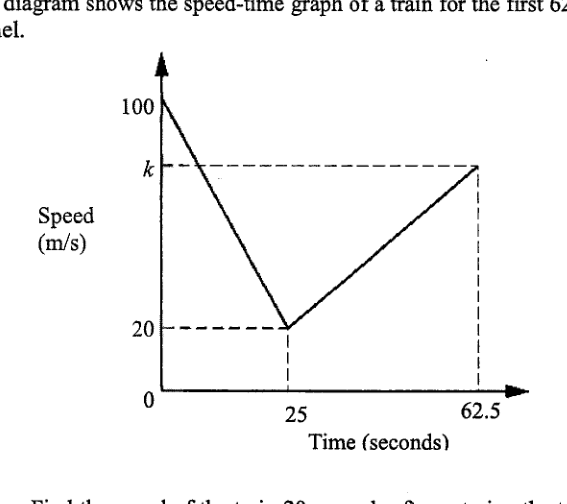
The diagram shows the speed-time graph of a train for the first 62.5 seconds after entering a tunnel.
- (a)
Find the speed of the train 20 seconds after entering the tunnel. Give your answer in kilometres per hour.
Answer ... km/h
- (b)
Calculate the distance travelled by the train for the first 25 seconds after entering the tunnel.
Answer ... m
- (c)
The deceleration of the train for the first 25 seconds after entering the tunnel is twice the acceleration of the train after 25 seconds in the tunnel. Find the value of k.
Answer k = ...
It won't just hand you the answer — it asks where you're stuck.How the checker works
Worked solution
19(a)
1. Find the constant rate of change of speed on the first straight-line segment.
From to , the speed decreases from to .
2. Find the speed after 20 seconds in m/s.
At ,
3. Convert the speed from m/s to km/h.
Since ,
19(b)
1. Identify distance as the area under the speed-time graph from $t=0$ to $t=25$.
Distance travelled area under the speed-time graph.
From to seconds, the graph forms a trapezium with parallel sides and , and width .
2. Calculate the area of the trapezium.
19(c)
1. Find the deceleration during the first 25 seconds.
From to , the speed decreases from m/s to m/s.
2. Use the given relationship to find the acceleration after 25 seconds and calculate $k$.
The deceleration is twice the acceleration after seconds.
From to , the time taken is
So
AI analysis — may contain mistakes.
Worked this one out on paper? Snap your steps and Gigle's AI math checker will circle the step where it went wrong.
More questions on this topic
- 1The diagram shows the positions of a harbour, H, a lighthouse, L, and two buoys P and Q. HPQ is a straight line. The bea…
- 2A piece of wood which was 50 cm long, was in the shape of a uniform cylinder. A prism is cut out from the wood such that…
- 3A map has a scale of 1 : 150 000. The length of a road on the map is 6.4 cm. Calculate the actual length, in kilometres,…
- 4The diagrams show the speed-time graph and the corresponding distance-time graph of a car. The car travelled from a poin…
- 5The marked price of a mobile phone is $1288. After selling the mobile phone at 15% discount, the shop owner still makes…