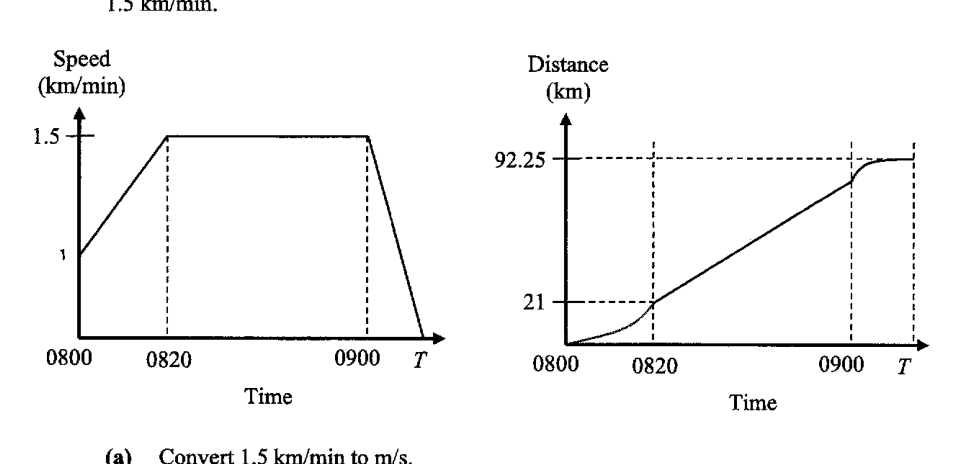
The diagrams show the speed-time graph and the corresponding distance-time graph of a car. The car travelled from a point P to Q and in the journey, its greatest speed attained was 1.5 km/min.
- ((a))
Convert 1.5 km/min to m/s.
Answer ...…m/s
- ((b))
Show that v, the initial speed, was 0.6 km/min.
- ((c))
Find the speed of the car, in m/s, at 0812.
Answer ...…m/s
- ((d))
The total distance travelled by the car is 92.25 km.
Find the time, , when it comes to a complete stop.
It won't just hand you the answer — it asks where you're stuck.How the checker works
Worked solution
26((a))
1. Convert $1.5\text{ km/min}$ to metres per second.
26((b))
1. Relate the distance travelled from 0800 to 0820 to the area under the speed-time graph.
From 0800 to 0820, time taken min.
The distance travelled is km, so
Since the graph is a trapezium,
2. Solve the resulting linear equation for the initial speed $v$.
Hence, , as required.
26((c))
1. Find the speed at 0812 using the linear increase from 0800 to 0820.
From part (b), the speed at 0800 was .
From 0800 to 0820, the speed increases uniformly from to .
0812 is minutes after 0800, so
2. Convert the speed from km/min to m/s.
26((d))
1. Find the distance travelled by 0900 and hence the remaining distance after 0900.
From 0820 to 0900, the car travels at for minutes.
Distance from 0820 to 0900:
Distance from 0800 to 0820 is .
Distance travelled by 0900:
Remaining distance after 0900:
2. Use the triangular area under the deceleration part of the speed-time graph to find when the car stops.
After 0900, the speed decreases linearly from to , so the area under the speed-time graph is a triangle.
Let the time taken after 0900 be minutes.
So the car stops minutes after 0900.
AI analysis — may contain mistakes.
Worked this one out on paper? Snap your steps and Gigle's AI math checker will circle the step where it went wrong.
More questions on this topic
- 1The diagram shows the positions of a harbour, H, a lighthouse, L, and two buoys P and Q. HPQ is a straight line. The bea…
- 2A piece of wood which was 50 cm long, was in the shape of a uniform cylinder. A prism is cut out from the wood such that…
- 3A map has a scale of 1 : 150 000. The length of a road on the map is 6.4 cm. Calculate the actual length, in kilometres,…
- 4The marked price of a mobile phone is $1288. After selling the mobile phone at 15% discount, the shop owner still makes…
- 5张叔叔骑着电动车去15km外的农村办事,他的电动车车轮的外直径是40cm,平均转速是每分钟200转,他能在一个小时内到达目的地吗?