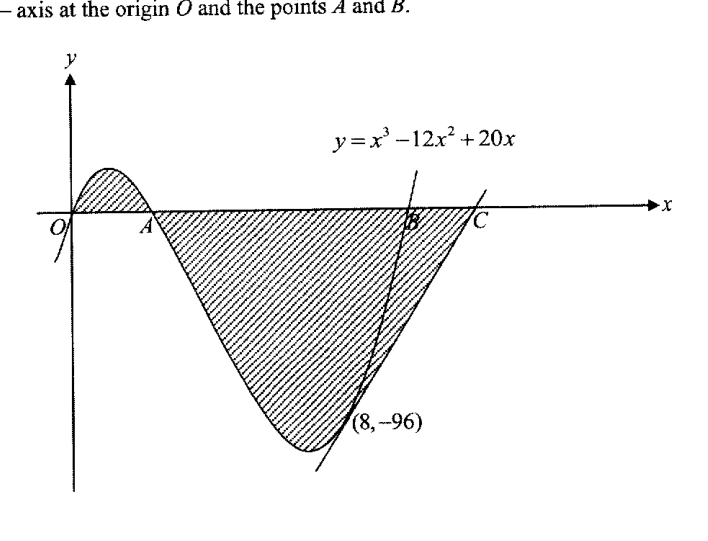
The diagram below shows the curve y=x3−12x2+20xy = x^3 - 12x^2 + 20x, which crosses the xx-axis at the origin OO and the points AA and BB. The tangent to the curve at the point (8,−96)(8, -96) crosses the xx-axis at the point CC.

  1. (i)

    Find the coordinates of AA and BB.

  2. (ii)

    Find the equation of the tangent and hence, the coordinates of CC.

  3. (iii)

    Find the area of the shaded region.

Work through it with AI →

It won't just hand you the answer — it asks where you're stuck.How the checker works

Worked solution

8(i)

1. Set $y = 0$ to find the $x$-intercepts and factorise the cubic expression

x3−12x2+20x=0x^3 - 12x^2 + 20x = 0
x(x2−12x+20)=0x(x^2 - 12x + 20) = 0

2. Factorise the quadratic factor and solve for $x$

x(x−2)(x−10)=0x(x - 2)(x - 10) = 0
x=0 or x=2 or x=10x = 0 \text{ or } x = 2 \text{ or } x = 10

3. Identify the coordinates of $A$ and $B$ from the graph

From the graph, AA and BB are the positive xx-intercepts, with AA being closer to the origin.
Therefore, AA is (2,0)(2, 0) and BB is (10,0)(10, 0).

Answer

A(2,0)A(2, 0), B(10,0)B(10, 0)

8(ii)

1. Differentiate the equation of the curve to find the gradient function

y=x3−12x2+20xy = x^3 - 12x^2 + 20x
dydx=3x2−24x+20\frac{dy}{dx} = 3x^2 - 24x + 20

2. Find the gradient of the tangent at $x = 8$

At x=8x = 8,
dydx=3(8)2−24(8)+20\frac{dy}{dx} = 3(8)^2 - 24(8) + 20
=192−192+20=20= 192 - 192 + 20 = 20

3. Find the equation of the tangent

Using y−y1=m(x−x1)y - y_1 = m(x - x_1) with point (8,−96)(8, -96) and m=20m = 20:
y−(−96)=20(x−8)y - (-96) = 20(x - 8)
y+96=20x−160y + 96 = 20x - 160
y=20x−256y = 20x - 256

4. Find the coordinates of $C$ by setting $y = 0$

At CC, the tangent crosses the xx-axis, so y=0y = 0.
0=20x−2560 = 20x - 256
20x=25620x = 256
x=12.8x = 12.8
Coordinates of CC are (12.8,0)(12.8, 0).

Answer

Equation of tangent: y=20x−256y = 20x - 256
Coordinates of CC: (12.8,0)(12.8, 0)

8(iii)

1. Find the coordinates of $A$, $B$, and $C$ from earlier parts

From (i), x3−12x2+20x=0  ⟹  x(x−2)(x−10)=0x^3 - 12x^2 + 20x = 0 \implies x(x-2)(x-10) = 0, so AA is (2,0)(2, 0) and BB is (10,0)(10, 0).
From (ii), dydx=3x2−24x+20\frac{dy}{dx} = 3x^2 - 24x + 20. At x=8x=8, gradient is 2020.
Equation of tangent: y−(−96)=20(x−8)  ⟹  y=20x−256y - (-96) = 20(x - 8) \implies y = 20x - 256.
At y=0y=0, 20x=256  ⟹  x=12.820x = 256 \implies x = 12.8. So CC is (12.8,0)(12.8, 0).

2. Calculate the area of the shaded region above the $x$-axis (from $x=0$ to $x=2$)

Area1=∫02(x3−12x2+20x) dx\text{Area}_1 = \int_0^2 (x^3 - 12x^2 + 20x) \, dx
=[x44−4x3+10x2]02= \left[ \frac{x^4}{4} - 4x^3 + 10x^2 \right]_0^2
=(164−4(8)+10(4))−0= \left( \frac{16}{4} - 4(8) + 10(4) \right) - 0
=4−32+40=12= 4 - 32 + 40 = 12

3. Calculate the area of the shaded region below the $x$-axis bounded by the curve (from $x=2$ to $x=8$)

Area2=∣∫28(x3−12x2+20x) dx∣\text{Area}_2 = \left| \int_2^8 (x^3 - 12x^2 + 20x) \, dx \right|
=∣[x44−4x3+10x2]28∣= \left| \left[ \frac{x^4}{4} - 4x^3 + 10x^2 \right]_2^8 \right|
=∣(40964−4(512)+10(64))−12∣= \left| \left( \frac{4096}{4} - 4(512) + 10(64) \right) - 12 \right|
=∣(1024−2048+640)−12∣= |(1024 - 2048 + 640) - 12|
=∣−384−12∣=∣−396∣=396= |-384 - 12| = |-396| = 396

4. Calculate the area of the shaded region bounded by the tangent line and the $x$-axis (from $x=8$ to $x=12.8$)

This region is a right-angled triangle with vertices at (8,0)(8, 0), (12.8,0)(12.8, 0), and (8,−96)(8, -96).
Area3=12×base×height\text{Area}_3 = \frac{1}{2} \times \text{base} \times \text{height}
=12×(12.8−8)×96= \frac{1}{2} \times (12.8 - 8) \times 96
=12×4.8×96=230.4= \frac{1}{2} \times 4.8 \times 96 = 230.4

5. Calculate the total shaded area

Total Area=Area1+Area2+Area3\text{Total Area} = \text{Area}_1 + \text{Area}_2 + \text{Area}_3
=12+396+230.4=638.4= 12 + 396 + 230.4 = 638.4

Answer

638.4638.4

AI analysis — may contain mistakes.

Worked this one out on paper? Snap your steps and Gigle's AI math checker will circle the step where it went wrong.

More questions on this topic

  1. 1The expression f(x)=ax3+(a−3b)x2+3bx+cf(x) = ax^3 + (a - 3b)x^2 + 3bx + c is exactly divisible by x2+3xx^2 + 3x. When f(x)f(x) is divided by x+2x + 2…
  2. 2The equation of a curve is y=16−ax−x2y=16-ax-x^{2}, where aa is positive constant. Given that yy can be expressed in the form…
  3. 3Show that 1 is a solution of the equation x3−5x2=2−6xx^3 - 5x^2 = 2 - 6x. Hence solve the equation x3−5x2=2−6xx^3 - 5x^2 = 2 - 6x complete…
  4. 4It is given that f(x)=x3+ax2+bx+5f(x)=x^3+ax^2+bx+5, where aa and bb are constants, has a factor of x−1x-1 and leaves a remainder of…
  5. 5It is given that 2x×32(2x)8x+1=9(52x)−52x+15x−5x−1\frac{2^x \times 32(2^x)}{8^{x+1}} = \frac{9(5^{2x}) - 5^{2x+1}}{5^x - 5^{x-1}}. Evaluate 10x10^x with…