W = {0, {0}}.
- (a)
Find n(W).
- (b)
List all possible subsets of W.
- (c)
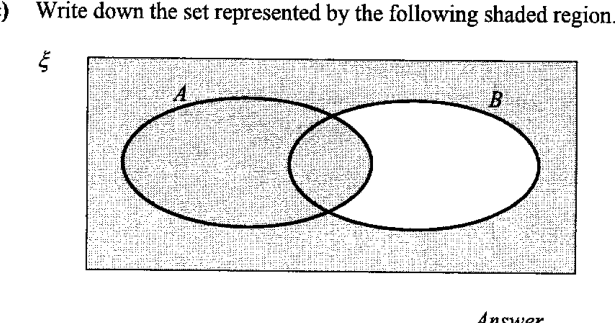
Write down the set represented by the following shaded region.
It won't just hand you the answer — it asks where you're stuck.How the checker works
Worked solution
14(a)
1. Count the number of distinct elements in $W$
has two distinct elements: and .
Therefore, .
Answer
14(b)
1. Identify the elements of $W$ and list all subsets systematically
has two distinct elements: and .
The possible subsets are
Answer
14(c)
1. Recognise the shaded region as outside both circles $A$ and $B$
The shaded region is in but not in or .
So it is the complement of .
Answer
AI analysis — may contain mistakes.
Worked this one out on paper? Snap your steps and Gigle's AI math checker will circle the step where it went wrong.