A rectangular piece of paper was folded at two of its corners F and H as shown.
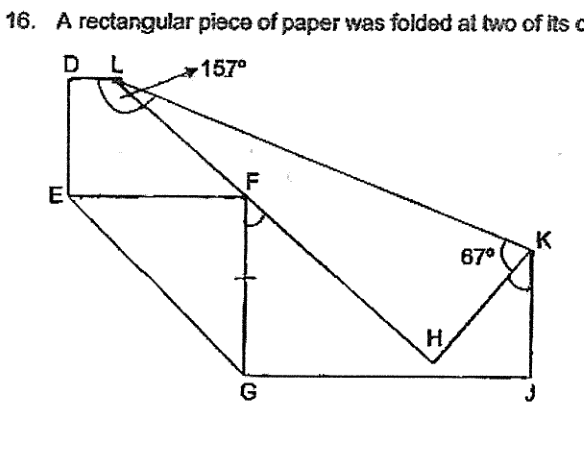
- (a)
Find .
- (b)
Find .
- (c)
Find .
- (d)
Circle the words that describe DEFL correctly in the following statement:
DEFL ( is / is not ) a trapezium because DL ( is / is not ) parallel to EF.
It won't just hand you the answer — it asks where you're stuck.How the checker works
Worked solution
16(a)
1. Identify the relationship between the angles at corner K before and after folding.
When the corner of the rectangular paper at is folded, the crease line is . The original corner angle is folded over.
Since the corner is folded along , the angle is equal to the original unfolded angle .
Therefore, .
2. Calculate the angle $\angle HKJ$.
We are given that the angle between the fold line and the vertical edge is .
Since the corner of the rectangle is , we have:
Since the fold is symmetric, the angle .
Thus, we can find :
(Alternative approach):
Let the crease line be . The total angle at of the unfolded sheet is .
When folded, the angle (which is ) is folded over to become .
Thus, .
16(b)
1. Calculate $\angle DLF$ using angles on a straight line
Since D, L, and K lie on the straight top edge of the rectangular paper, DLK is a straight line (partially folded but the edge line remains straight before the crease). The angle given is (or the angle between the top horizontal edge and the crease/line is ). Thus, the adjacent angle on the straight line is calculated by:
16(d)
1. Identify the definition of a trapezium and check the parallel conditions of DEFL.
A trapezium is a quadrilateral with at least one pair of parallel sides.
- is a segment along the horizontal top edge .
- is a diagonal line segment connecting the left edge to the top edge, so it is not horizontal and thus not parallel to .
- is a segment along the vertical left edge .
- is part of the line which is slanted and not vertical, so it is not parallel to .
Since no pair of opposite sides in is parallel, is not a trapezium because is not parallel to (and is not parallel to ).
is not, is not
AI analysis — may contain mistakes.
Worked this one out on paper? Snap your steps and Gigle's AI math checker will circle the step where it went wrong.
More questions on this topic
- 1The figure below is made up of 2 squares, ABCD and DEFG. X is a point on GD and Y is a point on DE. BC = 7 cm, FE = 6 cm…
- 2The net drawn for the solid shown below is incorrect. Name the solid. Ans: (a)___ Shade a triangular face on the net tha…
- 3In the figure below, ABCD is a trapezium and AD = BC. Each of the statements is either true, false or not possible to te…
- 4In the figure, WXYZ is a trapezium and AXYB is a rhombus. XBC and XAZ are straight lines. WX // ZY, BC = BY, …
- 5The figure below shows 12 identical squares. What is the least number of such squares that must be added to the figure s…