A piping bag is in the shape of a cone with radius 20 cm and height 30 cm. A baker filled the piping bag with frosting to a depth of and radius . When piping, the frosting is squeezed out from the tip of the piping bag at a constant rate of .
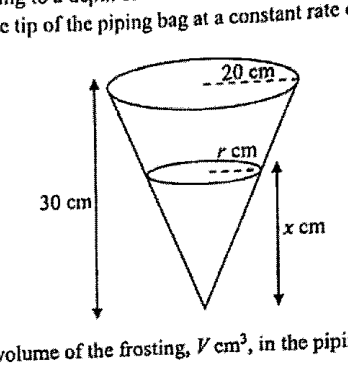
- (i)
Show that the volume of the frosting, , in the piping bag is given by
- (ii)
Find the rate of change of the depth of the frosting when .
- (iii)
Hence, find the rate of change of the radius of the frosting when .
It won't just hand you the answer — it asks where you're stuck.How the checker works
Worked solution
7(i)
1. Express the radius of the frosting, $r$, in terms of its depth, $x$, using similar triangles.
By similar triangles,
2. Substitute $r$ into the formula for the volume of a cone and simplify.
The volume of the frosting is given by:
Substitute :
(Shown)
7(ii)
1. Find the depth $x$ when $r = 12$ using similar triangles.
By similar triangles,
When ,
2. Differentiate the volume $V$ with respect to $x$.
3. Apply the chain rule to relate the rates of change.
By the chain rule,
4. Substitute the known values to find the rate of change of the depth.
Since the frosting is squeezed out, the volume is decreasing, so .
7(iii)
1. Calculate the value of $x$ when $r = 12$ using similar triangles.
From the dimensions of the cone, by similar triangles:
When , .
2. Find the rate of change of depth, $\frac{dx}{dt}$, when $r = 12$ (result from part ii).
Given , we have .
When , .
Using the chain rule and given :
3. Use the relationship between $r$ and $x$ to find $\frac{dr}{dt}$.
Since , differentiating with respect to gives:
(to 3 s.f.)
(or )
AI analysis — may contain mistakes.
Worked this one out on paper? Snap your steps and Gigle's AI math checker will circle the step where it went wrong.
More questions on this topic
- 1The diagram shows a greenhouse built on a rectangular base. of polyethene is used to build the curved r…
- 2In the triangle , , and angle . If is increasing…
- 3A curve has the equation , where . The normal to the point on the cur…
- 4Find the gradient function of the curve . The curve touches the positive -axis at point . Fi…
- 5The normal to the curve at point crosses the -axis at point …