Five discs numbered 1, 3, 4, 6 and 7 are placed in a bag. Two disc are taken out of the bag at random without replacement.
- ((a))
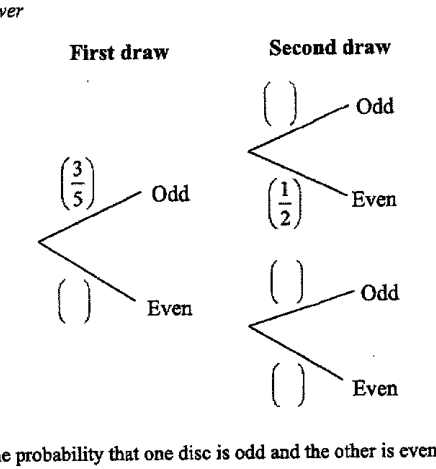
Complete the tree diagram to show the probabilities of the possible outcome.
- ((b))
Find the probability that one disc is odd and the other is even.
Answer ...
- ((c))
Peter thinks that there is more than 10% chance that both numbers drawn is less than 4.
Is he correct or wrong? Explain your answer.
Answer ...
...
- ((d))
Calculate the probability where the sum of both numbers drawn is a prime number.
Answer ...
It won't just hand you the answer — it asks where you're stuck.How the checker works
Worked solution
3((a))
1. Find the probabilities for the first draw
There are odd discs: , and even discs: .
Total number of discs .
So
2. Find the conditional probabilities for the second draw without replacement
If the first disc is odd, there are discs left: odd and even.
So
If the first disc is even, there are discs left: odd and even.
So
First draw: , .
If first draw is Odd: , .
If first draw is Even: , .
3((b))
1. Add the probabilities of the two favourable outcomes
One disc is odd and the other is even means either:
or .
3((c))
1. Find and compare the probability that both numbers drawn are less than 4
The numbers less than are and .
So it is exactly , not more than . Peter is wrong.
Peter is correct, since , so the chance is not more than .
[Note: If interpreting “more than 10%” strictly, Peter is wrong because it is exactly , not more than .]
3((d))
1. List all possible pairs and identify those with a prime sum
There are possible pairs.
The pairs with a prime sum are
Their sums are respectively .
Since is not prime, the favourable pairs are
So there are favourable ordered outcomes, or equivalently favourable unordered pairs.
2. Calculate the probability of a prime sum
Using ordered outcomes, there are possible outcomes.
The favourable unordered pairs give favourable ordered outcomes.
AI analysis — may contain mistakes.
Worked this one out on paper? Snap your steps and Gigle's AI math checker will circle the step where it went wrong.
More questions on this topic
- 1The masses of two batches of 400 steel bars produced by factory A and B were measured and recorded. The cumulative frequ…
- 2A bag contains 4 black coins, 7 red coins and 11 white coins. Two coins are drawn from the bag at random, one after anot…
- 3A bag contains 12 balls. 2 of the balls are red, n are green balls and the rest are blue balls. Eunice takes two balls f…
- 4A survey was carried out to find out the number of emails received in a week by each of a group of students. The table b…
- 5The cumulative frequency curve shows the marks obtained by the 120 students in a recent Mathematics Test. The maximum ma…