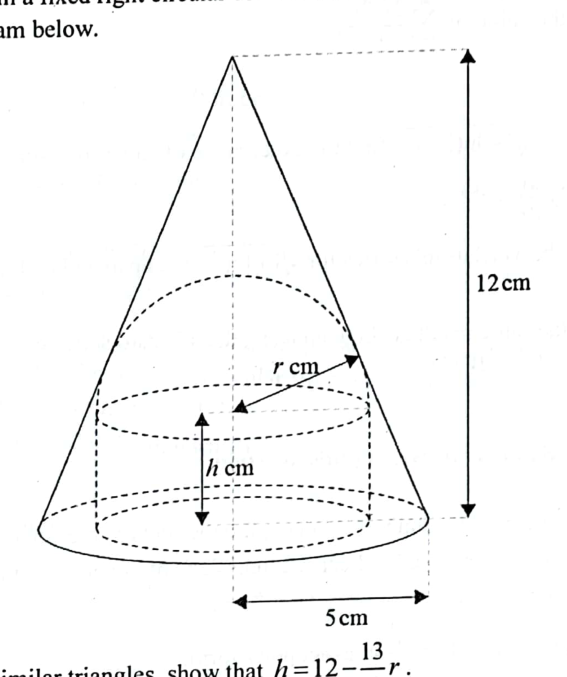
A closed container is made up of a cylinder of base radius cm and height cm, and a hemispherical top with the same radius . It is inscribed within a fixed right circular cone of base radius 5 cm and height 12 cm, as shown in the diagram below.
- (i)
By using similar triangles, show that .
Determine the exact range of possible values of length .
- (ii)
Find the total volume of the closed container in terms of .
By differentiation, find the exact value of that produces the maximum container volume , as varies.[Volume of a sphere with radius is .]
It won't just hand you the answer — it asks where you're stuck.How the checker works
Worked solution
4(i)
1. Determine the slant height of the cone from its cross-section.
Let be the vertex of the cone, be the centre of its base, and be a point on the perimeter of the base.
Consider the vertical cross-section , which is right-angled at .
The vertical height and base radius .
By Pythagoras' theorem, the slant edge is:
2. Set up a similarity relationship between the cone and the inscribed container.
Let be the centre of the hemispherical top. It lies on such that , giving .
The hemisphere is tangent to the slant edge at a point . Thus, the radius to the point of tangency is perpendicular to the slant edge () and .
In and :
- (common angle)
Therefore, is similar to .
Using the ratio of corresponding sides:
3. Rearrange to show the required expression for $h$ and determine the exact range of $r$.
For the container to be physically composed of a cylinder and a hemisphere, its dimensions must be strictly positive.
Since :
Since is a length, . Therefore, the exact range of possible values for is:
4(ii)
1. Express the total volume $V$ of the closed container in terms of $r$.
The container consists of a cylinder and a hemisphere.
Substitute from part (i):
2. Differentiate $V$ with respect to $r$.
3. Set the derivative to zero and solve for the optimal value of $r$.
To find the stationary point, set :
Since for a valid physical container, we reject :
4. Verify that this value of $r$ produces a maximum volume using the second derivative test.
Substitute :
Since , the volume is indeed maximized at .
AI analysis — may contain mistakes.
Worked this one out on paper? Snap your steps and Gigle's AI math checker will circle the step where it went wrong.
More questions on this topic
- 1[The volume of a cone of base radius and height is given by .] A manufacturer makes a…
- 2A sector of angle radians and radius is used to form the curved surface of a right circular co…
- 3As part of an Art Project, a student designed a lantern in the shape of an octahedron as shown in the diagram. The frame…
- 4The following diagram shows the dimensions of a trapezoidal prism with fixed volume units, with varia…
- 5[The volume of a right circular cone of radius and height is .] A student makes a printer…