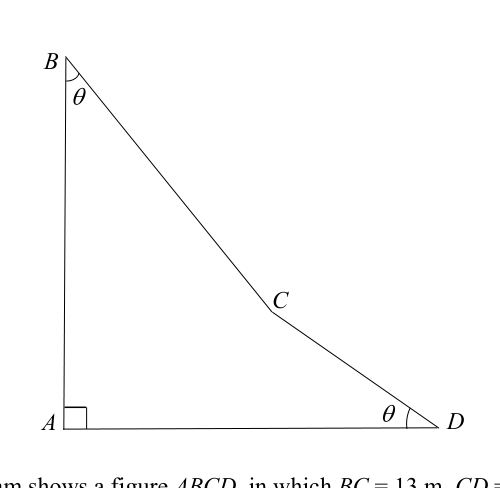
The diagram shows a figure ABCDABCD, in which BC=13 mBC=13\ \text{m}, CD=6 mCD=6\ \text{m}, angle BAD=90∘BAD = 90^\circ and angle ADC=ADC = angle ABC=θABC = \theta.

  1. (a)

    Show that the perimeter, LL metres, of ABCDABCD is given by

    L=19+19cos⁡θ+19sin⁡θ.L = 19 + 19\cos\theta + 19\sin\theta.

  2. (b)

    By expressing LL in the form of 19+Rcos⁡(θ−α)19 + R\cos(\theta - \alpha), where R>0R > 0 and α\alpha is acute, find the maximum possible perimeter of ABCDABCD.

  3. (c)

    Find the values of θ\theta for which L=45 mL = 45\ \text{m}.

Work through it with AI →

It won't just hand you the answer — it asks where you're stuck.How the checker works

Worked solution

11(a)

1. Express the lengths of $AB$ and $AD$ in terms of $\theta$ by drawing perpendiculars from $C$.

Let EE be the foot of the perpendicular from CC to ABAB, and FF be the foot of the perpendicular from CC to ADAD.
In △BCE\triangle BCE, ∠BEC=90∘\angle BEC = 90^\circ and ∠EBC=θ\angle EBC = \theta:
BE=13cos⁡θBE = 13\cos\theta
CE=13sin⁡θCE = 13\sin\theta

In △CDF\triangle CDF, ∠CFD=90∘\angle CFD = 90^\circ and ∠FDC=θ\angle FDC = \theta:
CF=6sin⁡θCF = 6\sin\theta
DF=6cos⁡θDF = 6\cos\theta

2. Find the lengths of $AB$ and $AD$.

Since AECFAECF forms a rectangle, AE=CFAE = CF and AF=CEAF = CE.
AB=AE+BE=CF+BE=6sin⁡θ+13cos⁡θAB = AE + BE = CF + BE = 6\sin\theta + 13\cos\theta
AD=AF+DF=CE+DF=13sin⁡θ+6cos⁡θAD = AF + DF = CE + DF = 13\sin\theta + 6\cos\theta

3. Calculate the total perimeter $L$.

L=AB+BC+CD+ADL = AB + BC + CD + AD
L=(6sin⁡θ+13cos⁡θ)+13+6+(13sin⁡θ+6cos⁡θ)L = (6\sin\theta + 13\cos\theta) + 13 + 6 + (13\sin\theta + 6\cos\theta)
L=19+19cos⁡θ+19sin⁡θL = 19 + 19\cos\theta + 19\sin\theta (shown)

Answer

L=19+19cos⁡θ+19sin⁡θL = 19 + 19\cos\theta + 19\sin\theta

11(b)

1. Find the value of $R$ for the expression $19\cos\theta + 19\sin\theta$

R=192+192=722=192R = \sqrt{19^2 + 19^2} = \sqrt{722} = 19\sqrt{2}

2. Find the value of $\alpha$

tan⁡α=1919=1\tan\alpha = \frac{19}{19} = 1
α=tan⁡−1(1)=45∘\alpha = \tan^{-1}(1) = 45^\circ

3. Express $L$ in the required form

L=19+192cos⁡(θ−45∘)L = 19 + 19\sqrt{2}\cos(\theta - 45^\circ)

4. Find the maximum possible perimeter

The maximum value of cos⁡(θ−45∘)\cos(\theta - 45^\circ) is 11.
Maximum perimeter =19+192(1)=19+192≈45.9 m= 19 + 19\sqrt{2}(1) = 19 + 19\sqrt{2} \approx 45.9\text{ m}

Answer

19+192 m19 + 19\sqrt{2}\text{ m} (or 45.9 m45.9\text{ m})

11(c)

1. Express $L$ using the $R$-formula result from part (b)

From part (b), 19cos⁡θ+19sin⁡θ=Rcos⁡(θ−α)19\cos\theta + 19\sin\theta = R\cos(\theta - \alpha).
R=192+192=192R = \sqrt{19^2 + 19^2} = 19\sqrt{2}
tan⁡α=1919=1  ⟹  α=45∘\tan\alpha = \frac{19}{19} = 1 \implies \alpha = 45^\circ
So, L=19+192cos⁡(θ−45∘)L = 19 + 19\sqrt{2}\cos(\theta - 45^\circ)

2. Set up the equation for $L = 45$ and isolate the cosine term

19+192cos⁡(θ−45∘)=4519 + 19\sqrt{2}\cos(\theta - 45^\circ) = 45
192cos⁡(θ−45∘)=2619\sqrt{2}\cos(\theta - 45^\circ) = 26
cos⁡(θ−45∘)=26192≈0.96761\cos(\theta - 45^\circ) = \frac{26}{19\sqrt{2}} \approx 0.96761

3. Solve for $\theta$

Basic angle =cos⁡−1(26192)≈14.62∘= \cos^{-1}\left(\frac{26}{19\sqrt{2}}\right) \approx 14.62^\circ
θ−45∘=−14.62∘ or 14.62∘\theta - 45^\circ = -14.62^\circ \text{ or } 14.62^\circ
θ=45∘−14.62∘ or 45∘+14.62∘\theta = 45^\circ - 14.62^\circ \text{ or } 45^\circ + 14.62^\circ
θ=30.38∘ or 59.62∘\theta = 30.38^\circ \text{ or } 59.62^\circ
θ≈30.4∘ or 59.6∘\theta \approx 30.4^\circ \text{ or } 59.6^\circ (to 1 d.p.)

Answer

θ=30.4∘,59.6∘\theta = 30.4^\circ, 59.6^\circ

AI analysis — may contain mistakes.

Worked this one out on paper? Snap your steps and Gigle's AI math checker will circle the step where it went wrong.

More questions on this topic

  1. 1Solve the equation 2cot⁡22x=1−5sin⁡2x2 \cot^2 2x = 1 - \frac{5}{\sin 2x} for −180∘≤x≤180∘-180^\circ \le x \le 180^\circ.
  2. 2已知sin⁡(α+π12)=55\sin (α+ \dfrac {π}{12} )= \dfrac { \sqrt {5}}{5},则sin⁡(π3−2α)=(    )\sin ( \dfrac {π}{3} -2α)= (\:\:\:\:) A. 45 \dfrac {4}{5}…
  3. 38.8.设△ABC\triangle ABC的内角AA,BB,CC所对的边分别为aa,bb,cc,若bcos⁡C+ccos⁡B=asin⁡Ab\cos C+c\cos B=a\sin A,则△ABC\triangle ABC的形状为…
  4. 4Prove that sin⁡3xsec⁡2x+sin⁡x=tan⁡xsec⁡x\sin^{3} x\sec^{2} x + \sin x = \tan x\sec x. Solve the equation sin⁡3xsec⁡2x+sin⁡x=5\sin^{3} x\sec^{2} x + \sin x = 5 for 0≤x≤360∘0 \le x \le 360^\circ…
  5. 5Given that cos⁡x=−45\cos x = -\frac{4}{5} and tan⁡x>0\tan x > 0, find sin⁡2x\sin 2x, cos⁡x2\cos \frac{x}{2}.