MI PU2 Promo 9758/2019/02/Q1 Town A, Town B and Town C are located in Wakandi Country. The distance between Town A and Town B is 60 km and the distance between Town B and Town C is 20 km. A railroad connects Town A to Town B (see diagram). A manufacturer plans to deliver a certain number of containers of its goods daily from Town A to Town C. To support this plan, the Wakandi government decides to build Interchange Station S and a road connecting this station to Town C (see diagram). Once the road is built, the goods manufacturer can deliver its containers from Town A to Town C by a combination of rail and road via Interchange Station S. The cost to deliver the containers daily by rail is $200 per km and the cost to deliver the containers daily by road is $300 per km.
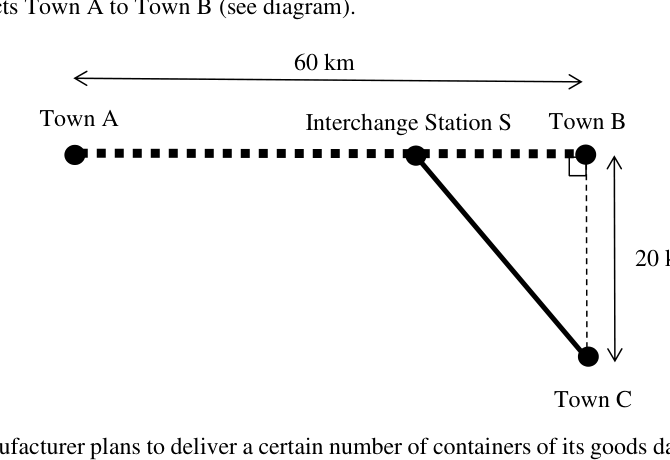
- (i)
Show that the daily total delivery cost, $T, of the containers from Town A to Town C is given by
where km is the distance between Town A and Interchange Station S. - (ii)
Hence use differentiation to find the value of that gives a stationary value of , giving your answer correct to 2 decimal places. Show that is a minimum for this value of .
It won't just hand you the answer — it asks where you're stuck.How the checker works
Worked solution
7(i)
1. Find the road distance $SC$ in terms of $x$ using Pythagoras' theorem.
From the diagram, the distance from Interchange Station S to Town B is .
Since , we use Pythagoras' theorem in right-angled :
2. Formulate the total delivery cost $T$ using the given rates for rail and road.
The total daily delivery cost is the sum of the cost by rail (for distance ) and the cost by road (for distance ).
Since :
T = 200x + 300\sqrt{x^2 - 120x + 4000}
7(ii)
1. Find the first derivative $\frac{\mathrm{d}T}{\mathrm{d}x}$ using the chain rule.
2. Set the derivative to zero and rearrange to isolate the square root.
For a stationary value, :
3. Square both sides to form a quadratic equation and solve for $x$.
Using the quadratic formula:
4. Reject the extraneous root and state the valid value of $x$.
From the equation , the right side is negative (since the principal square root is positive). This requires , so .
Alternatively, S lies between Town A and B, so .
Therefore, we reject .
5. Use the first derivative test to verify that the value of $x$ gives a minimum $T$.
Let . We test values slightly below and above this point:
When :
When :
Since changes sign from negative to positive as increases through the stationary point, is a minimum.
AI analysis — may contain mistakes.
Worked this one out on paper? Snap your steps and Gigle's AI math checker will circle the step where it went wrong.
More questions on this topic
- 1[The volume of a cone of base radius and height is given by .] A manufacturer makes a…
- 2A sector of angle radians and radius is used to form the curved surface of a right circular co…
- 3As part of an Art Project, a student designed a lantern in the shape of an octahedron as shown in the diagram. The frame…
- 4The following diagram shows the dimensions of a trapezoidal prism with fixed volume units, with varia…
- 5[The volume of a right circular cone of radius and height is .] A student makes a printer…