The diagram shows the map of a park in the shape of a quadrilateral ABCD. The scale of the map is 1 cm to 10 m.
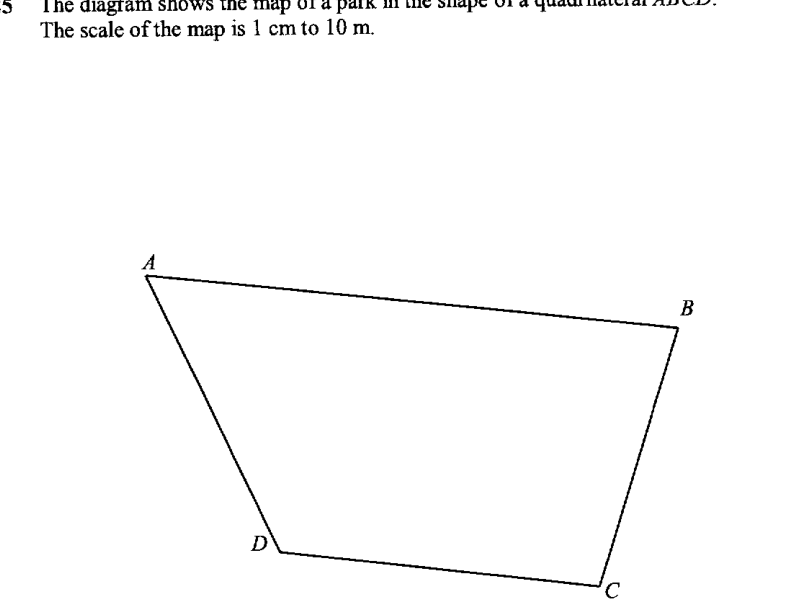
- (a)
Construct the bisector of angle ABC.
- (b)
Construct the perpendicular bisector of AB.
- (c)
Shade the region inside ABCD that is closer to AB than to BC and closer to B than to A.
- (d)
A tree T is located inside the park ABCD such that it is 30 m from D and equidistant from A and B. Mark and label the exact position of T.
It won't just hand you the answer — it asks where you're stuck.How the checker works
Worked solution
25(a)
1. Construct equal reference points on the two arms of the angle.
With centre , draw an arc cutting and at two points, say and , respectively.
2. Locate a point equidistant from the two arms of the angle and draw the bisector.
Using the same compass radius, draw arcs from and to meet inside at . Draw the straight line ray . This ray bisects .
The angle bisector of is the constructed ray from through the intersection point of the two equal-radius arcs inside .
25(b)
1. Construct two equal-radius arc intersections from endpoints $A$ and $B$.
Set the compass radius to more than half of . With centre , draw arcs above and below . Without changing the compass radius, with centre , draw arcs cutting the first pair of arcs at two points.
2. Draw the perpendicular bisector of $AB$.
Use a ruler to join the two arc-intersection points. This line is the perpendicular bisector of .
The perpendicular bisector of is the constructed straight line through the two arc-intersection points, meeting at its midpoint at .
25(c)
1. Identify and shade the required intersection of the two locus regions.
The boundary for points closer to than to is the angle bisector of . Since the region must be closer to , choose the side of this bisector containing side .
The boundary for points closer to than to is the perpendicular bisector of . Since the region must be closer to , choose the side of this perpendicular bisector containing .
Shade the overlap of these two chosen regions inside .
Shade the part of that is on the side of the angle bisector of and on the side of the perpendicular bisector of .
25(d)
1. Convert the real distance from $D$ to the map distance.
Scale: represents .
Therefore represents
2. Construct the two required loci and mark their intersection inside the park.
Draw a circle with centre and radius .
Since is equidistant from and , must lie on the perpendicular bisector of constructed in part (b).
Mark the point where the circle intersects the perpendicular bisector of inside , and label it .
Mark and label at the intersection inside of the perpendicular bisector of and the circle with centre and radius .
AI analysis — may contain mistakes.
Worked this one out on paper? Snap your steps and Gigle's AI math checker will circle the step where it went wrong.
More questions on this topic
- 1In this scale drawing, A, B and C are three corners of a park ABCD with C due north of B. Construct the perpendicular bi…
- 2In the scale drawing, PQRS represents a plot of land, which is to be used for a park. Scale 1 cm to 0.5 km Find the actu…
- 3The diagram shows a line segment PQ. Construct the perpendicular bisector of PQ, showing your constructions clearly. Ans…
- 4The diagram shows a quadrilateral PQRS. construct the perpendicular bisector of SR such that it meets PQ at point Z. Mar…
- 5已知三个点,,,则的外心的纵坐标是 A. B. C. …