Fig. 1 shows a piece of card, , in the form of a rhombus of sides cm. The card is made up of 2 identical equilateral triangles and . Kite shapes are cut from each corner, to give the shape shown in Fig. 2. The remaining card in Fig. 2 is folded along the dotted lines, to form an open rhombus shaped prism of height shown in Fig. 3.
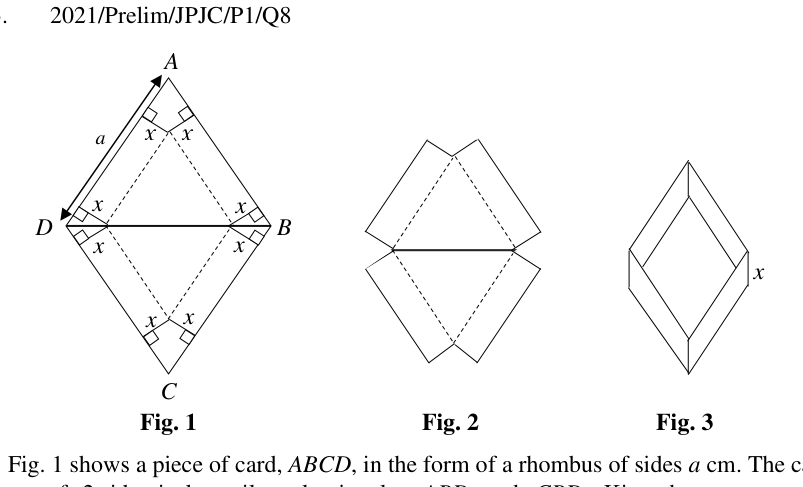
- ((i))
Show that the volume of the prism is given by
$V=\dfrac{\sqrt{3},x}{2}\left(a-\dfrac{4x}{\sqrt{3}}\right)^{2}.
- ((ii))
Use differentiation to find, in terms of , the maximum value of , proving that it is a maximum.
- ((iii))
The prism is then filled with sand, evenly distributed through a sieve, at a constant rate of cm/s. Find in terms of , the rate of increase of the depth of the sand when the depth of the sand in the prism is cm.
It won't just hand you the answer — it asks where you're stuck.How the checker works
Worked solution
13((i))
1. Determine the interior angles of the rhombus and the perpendicular distance from the folded edge to the original edge.
Since the original rhombus is formed by two identical equilateral triangles, its interior angles are and .
When the card is folded along the dotted lines to form vertical walls of height , the perpendicular distance from each edge of the original rhombus to the corresponding parallel edge of the new inner base is exactly .
2. Calculate the reduction in side length at each corner using trigonometry.
At each end of an original side of length , the length is reduced by the portions forming the cut kites (which become the folded flaps).
At a corner, the angle bisector is . The side length reduction is .
At a corner, the angle bisector is . The side length reduction is .
3. Find the side length of the inner base rhombus.
The side length of the new base rhombus is the original side length minus the reductions at both ends:
4. Calculate the area of the base and the volume of the prism to complete the proof.
The base is a rhombus with interior angles and .
The volume is the base area multiplied by the height :
V = \dfrac{\sqrt{3},x}{2}\left(a-\dfrac{4x}{\sqrt{3}}\right)^{2} \quad \text{(shown)}
13((ii))
1. Expand the volume expression into a polynomial in terms of $x$.
2. Differentiate $V$ with respect to $x$ and set it to zero to find the stationary points.
Set :
Multiply by to clear the fraction:
3. Solve the quadratic equation to find the possible values of $x$.
Using the quadratic formula:
or
4. Use the second derivative test to prove which value of $x$ gives a maximum.
When :
(Minimum)
When :
Since is a side length, , so .
This proves that is a maximum when .
5. Substitute the optimum $x$ back into $V$ to find the maximum volume.
13((iii))
1. Expand $V$ and differentiate to obtain $\frac{dV}{dx}$
From part (i), .
Expanding:
Differentiating with respect to :
2. Evaluate $\frac{dV}{dx}$ at the given depth
Substitute :
3. Apply the chain rule and solve for $\frac{dx}{dt}$
By the chain rule:
With :
cm/s
AI analysis — may contain mistakes.
Worked this one out on paper? Snap your steps and Gigle's AI math checker will circle the step where it went wrong.
More questions on this topic
- 1[The volume of a cone of base radius and height is given by .] A manufacturer makes a…
- 2A sector of angle radians and radius is used to form the curved surface of a right circular co…
- 3As part of an Art Project, a student designed a lantern in the shape of an octahedron as shown in the diagram. The frame…
- 4The following diagram shows the dimensions of a trapezoidal prism with fixed volume units, with varia…
- 5[The volume of a right circular cone of radius and height is .] A student makes a printer…