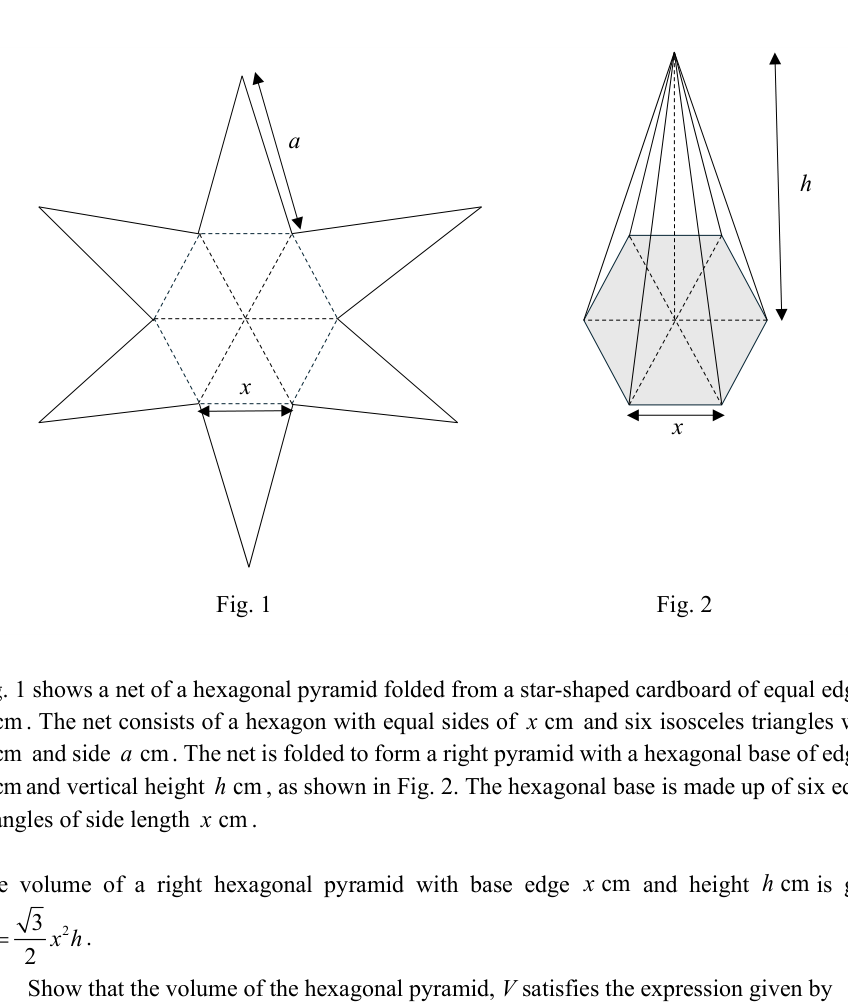
Fig. 1 shows a net of a hexagonal pyramid folded from a star-shaped cardboard of equal edge length . The net consists of a hexagon with equal sides of and six isosceles triangles with base and side . The net is folded to form a right pyramid with a hexagonal base of edge length and vertical height , as shown in Fig. 2. The hexagonal base is made up of six equilateral triangles of side length .
The volume of a right hexagonal pyramid with base edge and height is given by
- (a)
Show that the volume of the hexagonal pyramid, satisfies the expression given by
- (b)
Find, in terms of , the maximum possible volume of the hexagonal pyramid. You need not show that this value is a maximum.
- (c)
Find, in terms of , the total surface area of the hexagonal pyramid when the volume is a maximum.
It won't just hand you the answer — it asks where you're stuck.How the checker works
Worked solution
3(a)
1. Relate the vertical height $h$, base radius $x$, and slant edge $a$ using Pythagoras' theorem.
The base of the pyramid is a regular hexagon made up of six equilateral triangles of side length . Thus, the distance from the centre of the base to any of its vertices is exactly .
Consider the right-angled triangle formed by the vertical height , the distance from the centre to a base vertex , and the slant edge :
2. Square the volume formula and substitute $h^2$ to obtain the required expression.
Given the volume ,
Square both sides:
Substitute into the equation:
3(b)
1. Differentiate the given expression for $V^2$ with respect to $x$.
Let .
To find the turning point, we differentiate with respect to :
2. Equate the derivative to zero and solve for $x^2$.
For maximum volume, .
Since is a length, , so we can divide by :
3. Substitute $x^2$ back into the equation for $V^2$ to find the maximum squared volume.
Substitute into the expression for :
4. Calculate the maximum volume $V$ by taking the square root.
Since and ,
3(c)
1. Find the relationship between $x$ and $a$ for maximum volume.
Let .
To find the maximum volume, we set :
Since , dividing by gives:
2. Calculate the area of the hexagonal base in terms of $a$.
The hexagonal base is composed of 6 equilateral triangles of side length .
Substituting :
3. Calculate the slant height and the area of the six isosceles triangular faces.
Let be the perpendicular slant height of each of the 6 isosceles triangular faces.
Using Pythagoras' theorem on a triangular face:
Substituting :
4. Calculate the total surface area.
AI analysis — may contain mistakes.
Worked this one out on paper? Snap your steps and Gigle's AI math checker will circle the step where it went wrong.
More questions on this topic
- 1[The volume of a cone of base radius and height is given by .] A manufacturer makes a…
- 2A sector of angle radians and radius is used to form the curved surface of a right circular co…
- 3As part of an Art Project, a student designed a lantern in the shape of an octahedron as shown in the diagram. The frame…
- 4The following diagram shows the dimensions of a trapezoidal prism with fixed volume units, with varia…
- 5[The volume of a right circular cone of radius and height is .] A student makes a printer…