[ The volume of a cone of base radius and height is given by . ] A disposable cup for water dispenser, in the form of a cone, is made from a circular piece of paper of radius 8 cm with negligible thickness. A sector is cut off from the piece of paper as shown in Fig. 1. The rest of the paper is then folded to form a cone with slant height 8 cm, base radius cm and height cm as shown in Fig. 2.
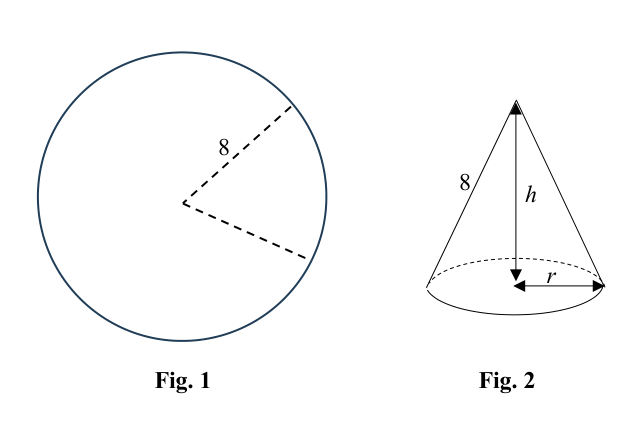
- (i)
Find the maximum volume of the cone, giving your answer in exact form.
- (ii)
Show that when the volume of the cone is a maximum.
- (iii)
The cone with the volume found in (i) is then inverted and is held with its axis vertical and vertex downwards. Water from the dispenser flows into the cone at a rate of per second. At time seconds after the start, the radius of the water surface is as shown in Fig. 3. Find the rate of change of the height of the water in the cone after 6 seconds.
It won't just hand you the answer — it asks where you're stuck.How the checker works
Worked solution
11(i)
1. Express the square of the base radius $r^2$ in terms of the height $h$.
\text{By Pythagoras' theorem, } r^2 + h^2 = 8^2 \implies r^2 = 64 - h^2
2. Substitute $r^2$ into the volume formula to express $V$ as a function of $h$.
V = \frac{1}{3}\pi r^2 h \
V = \frac{1}{3}\pi (64 - h^2) h \
V = \frac{1}{3}\pi (64h - h^3)
3. Differentiate the volume $V$ with respect to $h$.
\frac{\text{d}V}{\text{d}h} = \frac{1}{3}\pi (64 - 3h^2)
4. Set the derivative to zero to find the height that gives the stationary point.
\text{For stationary points, } \frac{\text{d}V}{\text{d}h} = 0: \
\frac{1}{3}\pi (64 - 3h^2) = 0 \
3h^2 = 64 \
h^2 = \frac{64}{3} \
h = \frac{8}{\sqrt{3}} \quad (\text{since } h > 0)
5. Verify the stationary point is a maximum using the second derivative test.
\frac{\text{d}^2V}{\text{d}h^2} = \frac{1}{3}\pi (-6h) = -2\pi h \
\text{When } h = \frac{8}{\sqrt{3}}, \frac{\text{d}^2V}{\text{d}h^2} = -2\pi \left(\frac{8}{\sqrt{3}}\right) < 0 \text{, so } V \text{ is a maximum.}
6. Substitute the optimal height back into the volume formula to find the exact maximum volume.
\text{Max } V = \frac{1}{3}\pi \left(64\left(\frac{8}{\sqrt{3}}\right) - \left(\frac{8}{\sqrt{3}}\right)^3\right) \
= \frac{1}{3}\pi \left(\frac{512}{\sqrt{3}} - \frac{512}{3\sqrt{3}}\right) \
= \frac{1}{3}\pi \left(\frac{1024}{3\sqrt{3}}\right) \
= \frac{1024\pi}{9\sqrt{3}} \
= \frac{1024\sqrt{3}\pi}{27}
11(ii)
1. Re-establish the geometric relationship and the condition for maximum volume from part (i).
By Pythagoras' theorem on the cone with slant height 8 cm:
Expressing the volume in terms of :
For maximum volume, :
2. Substitute the condition back into the geometric relationship to show the result.
Substitute into the expression for :
Since and are positive lengths, taking the square root gives:
(shown)
11(iii)
1. Establish the relationship between the radius of the water surface $x$ and the water height $y$.
Let be the vertical height of the water in the cone.
From part (ii), we know that the dimensions of the given cone satisfy .
By similar triangles, the water forms a smaller cone with dimensions proportional to the full cone, so the ratio of radius to height is constant:
2. Formulate an equation for the volume of the water $V$ purely in terms of its height $y$.
The volume of the water at any given time is:
Substitute :
3. Calculate the volume and height of the water at $t = 6$ seconds.
Since water flows in at a constant rate of , the volume of water after seconds is:
Equating this to the volume formula to find the instantaneous height :
4. Use the chain rule to find the rate of change of the water height.
Differentiating with respect to time using the chain rule:
Substitute the instantaneous height :
AI analysis — may contain mistakes.
Worked this one out on paper? Snap your steps and Gigle's AI math checker will circle the step where it went wrong.
More questions on this topic
- 1[The volume of a cone of base radius and height is given by .] A manufacturer makes a…
- 2A sector of angle radians and radius is used to form the curved surface of a right circular co…
- 3As part of an Art Project, a student designed a lantern in the shape of an octahedron as shown in the diagram. The frame…
- 4The following diagram shows the dimensions of a trapezoidal prism with fixed volume units, with varia…
- 5[The volume of a right circular cone of radius and height is .] A student makes a printer…