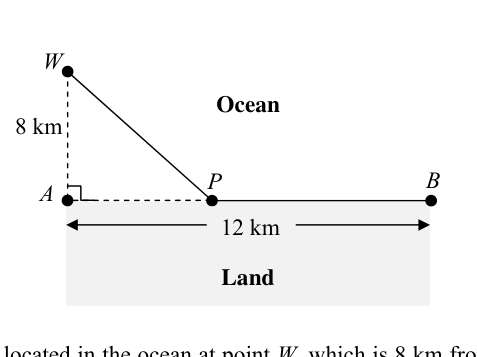
An offshore oil well is located in the ocean at point , which is 8 km from point on land as shown in the figure above. Oil is to be piped to point , which is 12 km from point , using a straight pipe laid underwater from to some point between and , and then on to point via another straight pipe laid on land. If the cost of laying a pipe is $60 000 per km underwater and $45 000 per km on land, how far should point lie from point to minimise the cost of laying the pipe?
It won't just hand you the answer — it asks where you're stuck.How the checker works
Worked solution
1
1. Formulate an equation for the total cost of laying the pipe based on the position of point $P$.
Let the distance be km, where .
By Pythagoras' theorem, the length of the underwater pipe is km.
The length of the pipe on land is km.
The total cost (in $) is given by:
2. Differentiate the cost function with respect to $x$ to find the stationary point.
To find the minimum cost, we differentiate with respect to and set :
3. Solve the algebraic equation to find the value of $x$.
Dividing by 15000:
Squaring both sides:
Since distance ,
4. Verify that this stationary point results in a minimum cost.
Use the second derivative test:
Since for all valid , the cost is definitively minimised when km.
9.07 \text{ km}
AI analysis — may contain mistakes.
Worked this one out on paper? Snap your steps and Gigle's AI math checker will circle the step where it went wrong.
More questions on this topic
- 1[The volume of a cone of base radius and height is given by .] A manufacturer makes a…
- 2A sector of angle radians and radius is used to form the curved surface of a right circular co…
- 3As part of an Art Project, a student designed a lantern in the shape of an octahedron as shown in the diagram. The frame…
- 4The following diagram shows the dimensions of a trapezoidal prism with fixed volume units, with varia…
- 5[The volume of a right circular cone of radius and height is .] A student makes a printer…