A cone-shaped cup is made of paper of negligible thickness to hold of liquid. The open inverted cone has radius and height as shown in the diagram above. The external surface area of the cup is denoted by . The manufacturer wants to reduce the cost of production by minimizing the value of .
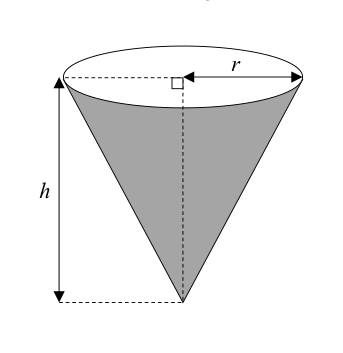
- (a)
Find in terms of .
- (b)
By considering or otherwise, show that
- (c)
Find the exact value of that gives the minimum value of , proving that is a minimum.
Find also the ratio of the radius to the height, , giving your answer in terms of , where is a constant to be determined.
- (d)
The manufacturer decides to make paper cups at minimum external surface area using the ratio found in part (c).
The cup is being filled completely with water. However, there is a small hole at the bottom of the cup that causes water to leak out at the rate of per second. Find the rate of decrease of the depth of the water at the instant when the depth is .
It won't just hand you the answer — it asks where you're stuck.How the checker works
Worked solution
10(a)
1. Equate the formula for the volume of a cone to the given volume.
2. Make $h$ the subject of the equation.
10(b)
1. Express $A^2$ entirely in terms of $r$.
From part (a), the volume is , which gives .
The external surface area is .
Squaring both sides:
Substituting :
2. Differentiate $A^2$ implicitly with respect to $r$.
Differentiating both sides with respect to :
3. Divide by 2 to obtain the final expression.
Dividing the entire equation by 2:
(Shown)
10(c)
1. Set the given derivative to zero to find the stationary value of $r$.
For a stationary value, .
Since (external surface area), we have .
Using the result from part (b):
2. Use the first derivative test to prove that this value of $r$ gives a minimum area.
We test the sign of around the exact value .
Since is positive, the sign of is determined by the term .
- For : , so .
- For : , so .
Since the gradient of changes from negative to positive at , is a minimum.
3. Express the ratio $\frac{r}{h}$ in terms of $r$ using the volume formula.
From the volume of the cone given in the question stem, :
The ratio is therefore:
4. Evaluate the exact ratio using the stationary value found.
Since at the minimum, we can find by taking the square root:
Substitute this into our expression for the ratio:
(This matches the required form with .)
10(d)
1. Find the minimum ratio $\frac{r}{h}$ using the result from part (c).
From part (a), .
For minimum , .
Thus, the required ratio is .
2. Formulate the volume of water $V$ in terms of its depth $x$.
Let the depth of water be and the radius of the water's surface be .
By similar triangles, the ratio of radius to depth is constant:
The volume of water is:
3. Apply the chain rule to relate the rates of change of volume and depth.
Differentiating with respect to time :
4. Substitute the given values to find the rate of decrease of the depth.
The water leaks out at , so .
At the instant when :
Since is negative, the rate of decrease of the depth is .
AI analysis — may contain mistakes.
Worked this one out on paper? Snap your steps and Gigle's AI math checker will circle the step where it went wrong.
More questions on this topic
- 1[The volume of a cone of base radius and height is given by .] A manufacturer makes a…
- 2A sector of angle radians and radius is used to form the curved surface of a right circular co…
- 3As part of an Art Project, a student designed a lantern in the shape of an octahedron as shown in the diagram. The frame…
- 4The following diagram shows the dimensions of a trapezoidal prism with fixed volume units, with varia…
- 5[The volume of a right circular cone of radius and height is .] A student makes a printer…