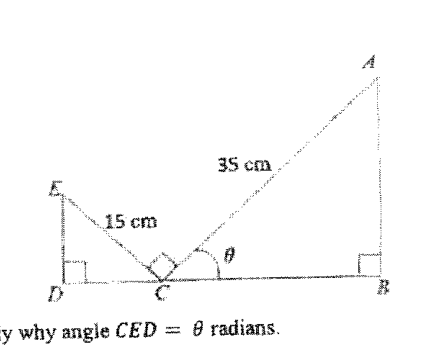
In the diagram, AC=35 cmAC = 35\text{ cm}, EC=15 cmEC = 15\text{ cm} and angle ACB=θACB = \theta radians. EDED and ABAB are perpendicular to DBDB.

  1. (i)

    Explain clearly why angle CED=θCED = \theta radians.

  2. (ii)

    Show that the sum of the perimeters, P cmP\text{ cm}, of triangles DECDEC and CABCAB is given by P=acos⁡θ+bsin⁡θ+cP = a\cos\theta + b\sin\theta + c where aa, bb and cc are constants.

  3. (iii)

    Express PP in the form of Rcos⁡(θ−α)+cR \cos(\theta - \alpha) + c, where R>0R > 0 and 0<α<π20 < \alpha < \frac{\pi}{2}.
    Hence find the maximum value of PP and the corresponding value of θ\theta.

  4. (iv)

    Express A cm2A\text{ cm}^2, the sum of the areas of triangles DECDEC and CABCAB in terms of θ\theta, giving your answer in the simplest form.

  5. (v)

    Explain, stating your reasons, why AA is maximum when PP is a maximum.

Work through it with AI →

It won't just hand you the answer — it asks where you're stuck.How the checker works

Worked solution

11(i)

1. Find angle DCE using angles on a straight line

Since D,C,BD, C, B lie on a straight line,
∠DCE+∠ECA+∠ACB=π\angle DCE + \angle ECA + \angle ACB = \pi
∠DCE+π2+θ=π\angle DCE + \frac{\pi}{2} + \theta = \pi
∠DCE=π2−θ\angle DCE = \frac{\pi}{2} - \theta

2. Find angle CED using the angle sum of a triangle

In △DEC\triangle DEC, the sum of angles is π\pi.
∠CED+∠CDE+∠DCE=π\angle CED + \angle CDE + \angle DCE = \pi
∠CED+π2+(π2−θ)=π\angle CED + \frac{\pi}{2} + \left(\frac{\pi}{2} - \theta\right) = \pi
∠CED+π−θ=π\angle CED + \pi - \theta = \pi
∠CED=θ\angle CED = \theta (shown)

Answer

Shown clearly in the working.

11(ii)

1. Express the lengths of the sides of triangle $CAB$ in terms of $\theta$.

In △CAB\triangle CAB:
sin⁡θ=AB35  ⟹  AB=35sin⁡θ\sin\theta = \frac{AB}{35} \implies AB = 35\sin\theta
cos⁡θ=CB35  ⟹  CB=35cos⁡θ\cos\theta = \frac{CB}{35} \implies CB = 35\cos\theta
Perimeter of △CAB=35+35sin⁡θ+35cos⁡θ\triangle CAB = 35 + 35\sin\theta + 35\cos\theta

2. Express the lengths of the sides of triangle $DEC$ in terms of $\theta$.

From (i), ∠CED=θ\angle CED = \theta.
In △DEC\triangle DEC:
sin⁡θ=DC15  ⟹  DC=15sin⁡θ\sin\theta = \frac{DC}{15} \implies DC = 15\sin\theta
cos⁡θ=ED15  ⟹  ED=15cos⁡θ\cos\theta = \frac{ED}{15} \implies ED = 15\cos\theta
Perimeter of △DEC=15+15sin⁡θ+15cos⁡θ\triangle DEC = 15 + 15\sin\theta + 15\cos\theta

3. Find the sum of the perimeters and simplify to the required form.

P=(35+35sin⁡θ+35cos⁡θ)+(15+15sin⁡θ+15cos⁡θ)P = (35 + 35\sin\theta + 35\cos\theta) + (15 + 15\sin\theta + 15\cos\theta)
P=50+50sin⁡θ+50cos⁡θP = 50 + 50\sin\theta + 50\cos\theta
P=50cos⁡θ+50sin⁡θ+50P = 50\cos\theta + 50\sin\theta + 50 (Shown)

Answer

P=50cos⁡θ+50sin⁡θ+50P = 50\cos\theta + 50\sin\theta + 50

11(iii)

1. Find the expression for $P$ from part (ii)

In △CAB\triangle CAB, AB=35sin⁡θAB = 35\sin\theta and BC=35cos⁡θBC = 35\cos\theta.
Perimeter of △CAB=35+35sin⁡θ+35cos⁡θ\triangle CAB = 35 + 35\sin\theta + 35\cos\theta.
In △DEC\triangle DEC, CD=15sin⁡θCD = 15\sin\theta and ED=15cos⁡θED = 15\cos\theta.
Perimeter of △DEC=15+15sin⁡θ+15cos⁡θ\triangle DEC = 15 + 15\sin\theta + 15\cos\theta.
P=(35+35sin⁡θ+35cos⁡θ)+(15+15sin⁡θ+15cos⁡θ)P = (35 + 35\sin\theta + 35\cos\theta) + (15 + 15\sin\theta + 15\cos\theta)
P=50cos⁡θ+50sin⁡θ+50P = 50\cos\theta + 50\sin\theta + 50

2. Express $50\cos\theta + 50\sin\theta$ in the form $R\cos(\theta - \alpha)$

Let 50cos⁡θ+50sin⁡θ=Rcos⁡(θ−α)=Rcos⁡θcos⁡α+Rsin⁡θsin⁡α50\cos\theta + 50\sin\theta = R\cos(\theta - \alpha) = R\cos\theta\cos\alpha + R\sin\theta\sin\alpha.
Comparing coefficients:
Rcos⁡α=50R\cos\alpha = 50
Rsin⁡α=50R\sin\alpha = 50
R=502+502=5000=502R = \sqrt{50^2 + 50^2} = \sqrt{5000} = 50\sqrt{2}
tan⁡α=5050=1  ⟹  α=π4\tan\alpha = \frac{50}{50} = 1 \implies \alpha = \frac{\pi}{4}
So, P=502cos⁡(θ−π4)+50P = 50\sqrt{2}\cos\left(\theta - \frac{\pi}{4}\right) + 50

3. Find the maximum value of $P$ and the corresponding $\theta$

The maximum value of cos⁡(θ−π4)\cos\left(\theta - \frac{\pi}{4}\right) is 11.
Maximum P=502(1)+50=502+50P = 50\sqrt{2}(1) + 50 = 50\sqrt{2} + 50
This occurs when cos⁡(θ−π4)=1\cos\left(\theta - \frac{\pi}{4}\right) = 1
θ−π4=0  ⟹  θ=π4\theta - \frac{\pi}{4} = 0 \implies \theta = \frac{\pi}{4}

Answer

P=502cos⁡(θ−π4)+50P = 50\sqrt{2} \cos\left(\theta - \frac{\pi}{4}\right) + 50
Maximum value of P=502+50P = 50\sqrt{2} + 50
Corresponding θ=π4\theta = \frac{\pi}{4}

11(iv)

1. Express the lengths of the sides of triangles $DEC$ and $CAB$ in terms of $\theta$.

In △CAB\triangle CAB:
AB=35sin⁡θAB = 35 \sin \theta
CB=35cos⁡θCB = 35 \cos \theta

In △DEC\triangle DEC:
Since ∠CED=θ\angle CED = \theta,
DC=15sin⁡θDC = 15 \sin \theta
ED=15cos⁡θED = 15 \cos \theta

2. Formulate the expression for the sum of the areas of the two triangles.

Area of △CAB=12(35cos⁡θ)(35sin⁡θ)=12252sin⁡θcos⁡θ\triangle CAB = \frac{1}{2} (35 \cos \theta)(35 \sin \theta) = \frac{1225}{2} \sin \theta \cos \theta
Area of △DEC=12(15sin⁡θ)(15cos⁡θ)=2252sin⁡θcos⁡θ\triangle DEC = \frac{1}{2} (15 \sin \theta)(15 \cos \theta) = \frac{225}{2} \sin \theta \cos \theta

A=12252sin⁡θcos⁡θ+2252sin⁡θcos⁡θA = \frac{1225}{2} \sin \theta \cos \theta + \frac{225}{2} \sin \theta \cos \theta
A=14502sin⁡θcos⁡θ=725sin⁡θcos⁡θA = \frac{1450}{2} \sin \theta \cos \theta = 725 \sin \theta \cos \theta

3. Simplify the expression using the double angle identity.

Using the identity sin⁡2θ=2sin⁡θcos⁡θ\sin 2\theta = 2 \sin \theta \cos \theta:
A=725(12sin⁡2θ)A = 725 \left( \frac{1}{2} \sin 2\theta \right)
A=362.5sin⁡2θA = 362.5 \sin 2\theta

Answer

A=362.5sin⁡2θA = 362.5 \sin 2\theta

AI analysis — may contain mistakes.

Worked this one out on paper? Snap your steps and Gigle's AI math checker will circle the step where it went wrong.

More questions on this topic

  1. 1The triangle ABC is such that its area is 16+7102 cm2\dfrac{16 + 7\sqrt{10}}{2}\ \text{cm}^2, the length of AB is (32+5) cm(3\sqrt{2} + \sqrt{5})\ \text{cm}…
  2. 2如果三角形的两条边分别为4和6,那么连结该三角形三边中点所得的周长可能是下列数据中的【 】 A. 6 B. 8 C. 10 D. 12
  3. 3In ΔABC\Delta ABC, AC=12 cmAC = 12\text{ cm}, ∠ABC\angle ABC is a right angle, ∠ACB=π6\angle ACB = \frac{\pi}{6} radians and MM is the…
  4. 4The diagram shows a quadrilateral ABCDABCD whose vertices lie on the circumference of a circle. The point EE lies on the…
  5. 5The equation of a circle is x2+y2+8x−20y−53=0x^2 + y^2 + 8x - 20y - 53 = 0. Find the radius of the circle and the coordinates of its ce…