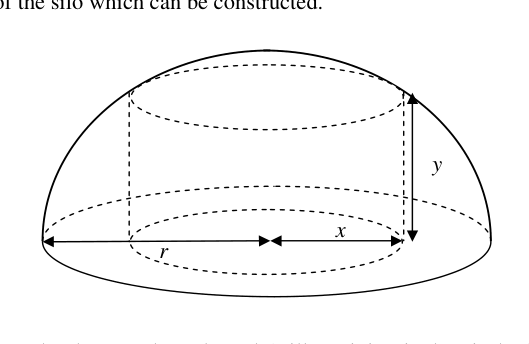
In a futuristic movie, a hemispherical force field dome (an open hemisphere) is created to protect a cylindrical silo under construction to house deadly weapons. The circumference of the top of the silo lies just within the dome as shown in the diagram below. The power supply is such that the radius of the dome generated is fixed at . Let and be the radius and height of the silo respectively.
- (a)
Show that the volume of the silo can be expressed as . Find the exact maximum volume of the silo which can be constructed.
- (b)
A power surge causes the dome to be enlarged (still retaining its hemispherical shape) such that its volume is increasing at a constant rate of . Find the exact rate of increase of surface area of the dome when .
It won't just hand you the answer — it asks where you're stuck.How the checker works
Worked solution
3(a)
1. Establish the relationship between $x$ and $y$ using the geometry of the hemisphere and the silo.
Since the silo stands on the same flat base as the hemisphere and the circumference of its top touches the dome, we can form a right-angled triangle with the radius of the dome (), the radius of the silo (), and the height of the silo ().
By Pythagoras' Theorem:
Given ,
2. Express the volume of the silo in terms of $y$ to show the given formula.
The volume of the cylindrical silo, , is given by:
Substituting :
3. Differentiate the volume with respect to $y$ and find the value of $y$ for stationary points.
To find the maximum volume, we first find :
For stationary points, :
Since (the height must be positive):
4. Use the second derivative test to confirm that this value of $y$ gives a maximum volume.
Find the second derivative :
Substitute :
Since , the volume is a maximum when .
5. Calculate the exact maximum volume.
Substitute and into the volume formula:
3(b)
1. Relate the rate of change of volume to the rate of change of radius and solve for the radius $r$ at the given instant.
Let be the enclosed volume of the hemispherical dome.
Differentiating with respect to time :
Given and :
Since , .
2. Set up the related rate equation for the surface area of the open hemisphere.
Let be the surface area of the open hemisphere (curved surface area).
Differentiating with respect to time :
3. Calculate the exact rate of increase of the surface area.
Substitute and into the rate equation for :
AI analysis — may contain mistakes.
Worked this one out on paper? Snap your steps and Gigle's AI math checker will circle the step where it went wrong.
More questions on this topic
- 1[The volume of a cone of base radius and height is given by .] A manufacturer makes a…
- 2A sector of angle radians and radius is used to form the curved surface of a right circular co…
- 3As part of an Art Project, a student designed a lantern in the shape of an octahedron as shown in the diagram. The frame…
- 4The following diagram shows the dimensions of a trapezoidal prism with fixed volume units, with varia…
- 5[The volume of a right circular cone of radius and height is .] A student makes a printer…