[It is given that a cone with radius , height and slant height has curved surface area .]
- (a)
A drinking cup is manufactured in the shape of a cone. It has a volume of . Show that
where is the curved surface area of the cone.
Use differentiation to find the height cm and radius cm of the cup that will require the least amount of material.
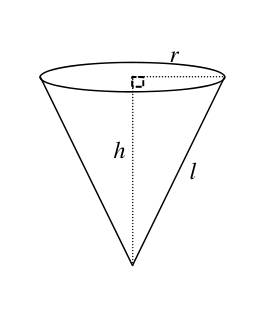
- (b)
Another drinking cup of the same shape is manufactured. At the instant when the depth of water in the drinking cup is cm, the volume cm^3 of the water is given by
The cup is filled and it is discovered that there is a leak at the vertex of the cup and the volume of water in the cone is decreasing at the constant rate of . Calculate,
- (i)
the rate at which the depth is decreasing at the instant when the depth is 2 cm,
- (ii)
the time taken in seconds for the depth to decrease from 6 cm to 3 cm.
- (i)
It won't just hand you the answer — it asks where you're stuck.How the checker works
Worked solution
12(a)
1. Use the formula for the volume of a cone to express $h$ in terms of $r$.
2. Express the square of the curved surface area, $A^2$, in terms of $r$ and $h$.
Using Pythagoras' theorem for the slant height, .
3. Substitute the expression for $h$ to show the given formula for $A^2$.
4. Differentiate $A^2$ with respect to $r$.
Let . To find the least amount of material, we minimise (since ).
Rewrite as .
5. Equate the derivative to zero and solve for $r$.
For a stationary point, :
6. Verify that this value of $r$ gives a minimum area using the second derivative test.
Since , . Thus, (and therefore the curved surface area ) is a minimum.
7. Calculate the corresponding value of $h$.
Therefore, to 3 significant figures, cm and cm.
Proof:
(See working for the derivation of )
Answers:
12(b)(i)
1. Find the derivative of volume $V$ with respect to depth $h$.
2. Set up the connected rate of change equation and substitute the given values.
Using the chain rule, we have:
The volume is decreasing at , so .
Substituting and :
3. Solve for $\frac{dh}{dt}$ and state the rate of decrease.
Since is negative, the depth is decreasing at a rate of (approx. ).
or
12(b)(ii)
1. Calculate the volume of water at the initial depth of $6\text{ cm}$ and final depth of $3\text{ cm}$.
2. Find the total change in volume and use the constant rate of volume decrease to find the time taken.
Since the volume decreases at a constant rate of :
AI analysis — may contain mistakes.
Worked this one out on paper? Snap your steps and Gigle's AI math checker will circle the step where it went wrong.
More questions on this topic
- 1[The volume of a cone of base radius and height is given by .] A manufacturer makes a…
- 2A sector of angle radians and radius is used to form the curved surface of a right circular co…
- 3As part of an Art Project, a student designed a lantern in the shape of an octahedron as shown in the diagram. The frame…
- 4The following diagram shows the dimensions of a trapezoidal prism with fixed volume units, with varia…
- 5[The volume of a right circular cone of radius and height is .] A student makes a printer…