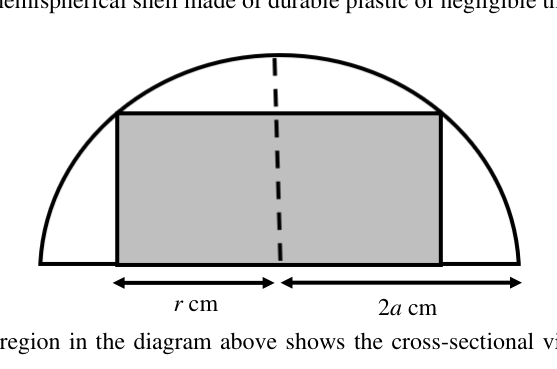
A popular toy company is designing a new water play feature for children. The toy consists of a cylindrical water container that will hold water for various playful activities. This cylindrical container is designed to be inscribed within a fixed, rigid hemispherical shell made of durable plastic of negligible thickness. [Figure: cross-sectional diagram below shows a semicircle of radius with a rectangle (shaded) inscribed inside it. The rectangle is symmetric about the vertical diameter. The half-width from the centre to the left vertical side of the rectangle is labelled . The full base width of the hemisphere is labelled .] The shaded region in the diagram above shows the cross-sectional view of the upright cylindrical container that is inscribed in a hemisphere with fixed radius .
- (a)
If the radius of the cylindrical water container is , show that the volume of the water container is given by .
- (b)
Water is pumped into the container at a rate of while the adjustment is taking place. If , find the exact rate of change of the radius of the container at the instant when the height of the water container is .
- (c)
Using differentiation, find in terms of , the value of which gives a maximum value of . Justify that this value indeed gives a maximum . Hence write down the exact maximum volume of the cylinder in terms of .
- (d)
Sketch the graph showing the volume of the cylinder as the radius of the cylinder varies.
It won't just hand you the answer — it asks where you're stuck.How the checker works
Worked solution
4(a)
1. Express the height of the cylinder using Pythagoras' theorem and substitute it into the volume formula.
Let be the height of the cylindrical container.
From the cross-sectional diagram, the top corner of the rectangle touches the semicircle, forming a right-angled triangle with the radius of the hemisphere as the hypotenuse.
By Pythagoras' theorem:
The volume of the cylinder is given by .
Substituting the expression for , we get:
V = \pi r^2 \sqrt{4a^2 - r^2}\ \text{(shown)}
4(b)
1. Find the radius $r$ of the container at the instant when the height $h = 80\ \text{cm}$.
Since the height of the container is given by , substitute and :
2. Differentiate the volume $V$ with respect to $r$.
From part (a), . Substituting , we have .
Differentiating with respect to using the product and chain rules:
3. Evaluate $\frac{dV}{dr}$ at $r = 60$.
Substitute into the expression for :
4. Use the connected rates of change formula to find $\frac{dr}{dt}$.
By the chain rule relating the rates of change over time:
Given that water is pumped into the container at a rate of , we have . Substituting our known values:
4(c)
1. Differentiate $V$ with respect to $r$ using the product and chain rules.
2. Equate the derivative to zero to find the value of $r$ for the stationary volume.
For a maximum volume, .
Since , the denominator and .
3. Justify that this value of $r$ gives a maximum volume using the first derivative test.
Using the first derivative test to examine the sign of around :
The sign of is determined by the factor because .
- For , we have , so .
- At , we have .
- For , we have , so .
Since the gradient changes from positive to negative, is a maximum when .
4. Calculate the exact maximum volume by substituting the optimal radius into the volume equation.
Substitute into :
, Maximum
4(d)
1. Determine the physical domain and the $r$-axis intercepts of the volume graph.
Since is the radius of the inscribed cylinder within a hemisphere of base radius , the valid physical range for is .
Setting to find the intercepts:
The curve must start at the origin and meet the -axis again at .
2. Incorporate the maximum point from part (c) and describe the shape of the sketch.
From the results found in part (c), the curve has a maximum volume at , with .
Because for all valid and there is exactly one turning point (a maximum), the graph is a smooth, hill-shaped (inverted U) curve connecting to smoothly through the maximum point.
A smooth, inverted U-shaped curve sketched in the first quadrant of the - plane:
- Starting at the origin .
- Ending at the -axis intercept .
- Passing through a labelled local maximum point at .
AI analysis — may contain mistakes.
Worked this one out on paper? Snap your steps and Gigle's AI math checker will circle the step where it went wrong.
More questions on this topic
- 1[The volume of a cone of base radius and height is given by .] A manufacturer makes a…
- 2A sector of angle radians and radius is used to form the curved surface of a right circular co…
- 3As part of an Art Project, a student designed a lantern in the shape of an octahedron as shown in the diagram. The frame…
- 4The following diagram shows the dimensions of a trapezoidal prism with fixed volume units, with varia…
- 5[The volume of a right circular cone of radius and height is .] A student makes a printer…