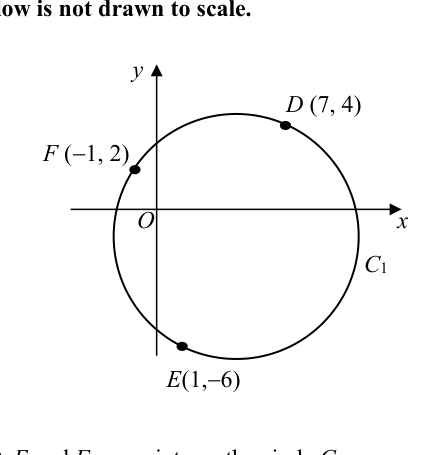
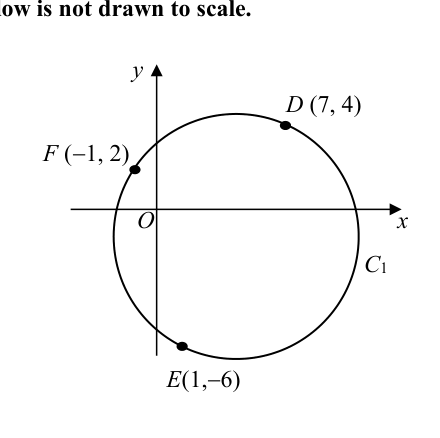
The diagram below is not drawn to scale. In the diagram, D, E and F are points on the circle C1.
- ((a))
Show that DE is the diameter of the circle C1 and hence find the centre of C1.
- ((b))
Find the equation of the circle in the form , where , and are integers.
- ((c))
Given that the circle is a reflection of the circle in the line , find the equation of .
- ((d))
Explain why point (3, 4) lies within only one of the circles and .
It won't just hand you the answer — it asks where you're stuck.How the checker works
Worked solution
11((a))
1. Calculate the gradient of the line segment FD.
Gradient of
2. Calculate the gradient of the line segment FE.
Gradient of
3. Show that FD and FE are perpendicular.
Gradient of Gradient of
Since the product of their gradients is , , which means .
4. Conclude that DE is the diameter using circle properties.
Since and lie on the circle , by the converse of the angle in a semicircle theorem, must be the diameter of .
5. Find the centre of the circle by calculating the midpoint of the diameter DE.
Centre of = Midpoint of
Centre of is
11((b))
1. Find the square of the radius of the circle using the centre from part (a) and point D
From part (a), the centre of is .
Using point , the square of the radius is:
2. Write the equation of the circle in standard form
The equation of the circle is:
3. Expand the equation to the required general form
11((c))
1. Find the centre of circle $C_2$ by reflecting the centre of $C_1$ in the line $x = -2$.
From part (a), the centre of is .
The line of reflection is .
The distance from the -coordinate of the centre to the line of reflection is .
The -coordinate of the reflected centre is .
The -coordinate remains unchanged.
Centre of is .
2. Write the equation of $C_2$ using the new centre and the same radius.
From part (a), the radius squared of is .
Since reflection preserves the size of the circle, the radius of is also .
The equation of is:
Expanding this gives:
or
11((d))
1. Recall or calculate the centre and radius of $C_1$ and $C_2$ from earlier parts
From (a), centre of is and radius .
From (c), is the reflection of in . The centre of is and its radius is also .
2. Calculate the distance from the point (3, 4) to the centre of $C_1$
Let be .
Distance .
Since , lies inside .
3. Calculate the distance from the point (3, 4) to the centre of $C_2$
Distance .
Since , lies outside .
The distance from the centre of to is , which is less than the radius , so it lies inside . The distance from the centre of to is , which is greater than the radius , so it lies outside . Therefore, it lies within only one of the circles.
AI analysis — may contain mistakes.
Worked this one out on paper? Snap your steps and Gigle's AI math checker will circle the step where it went wrong.
More questions on this topic
- 1The curve has equation . Without using a calculator, find the set of values that …
- 2Find the gradient function of the curve . The curve touches the positive -axis at point . Fi…
- 3The radius of a circle increases at a rate of 3 cm s^{-1}. Find, in terms of , the rate of increase of the area whe…
- 4定积分等于 A. B. C. …
- 5已知两定点,,平面内一动点到的距离与到的距离之比为,直线与点的轨迹交于,两点. (…