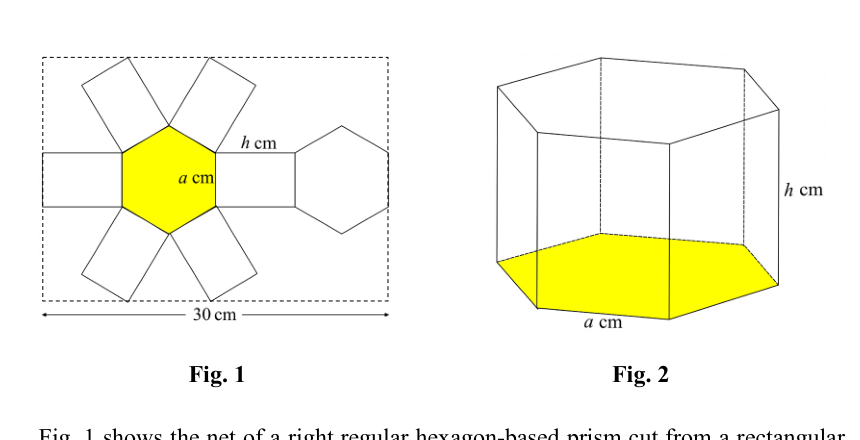
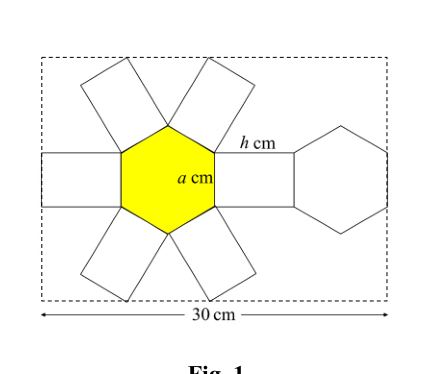
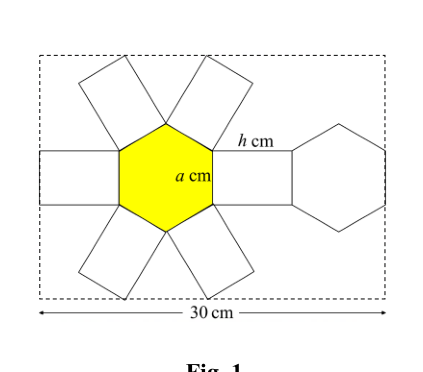
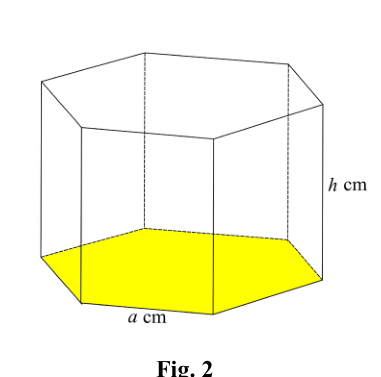
Fig. 1 shows the net of a right regular hexagon-based prism cut from a rectangular cardboard of one side length 30 cm. The net consists of two regular hexagons of side length a cm and six rectangles, each with sides of length a cm and h cm. The net is folded to form a prism which has a hexagonal base of side length a cm and vertical height h cm, as shown in Fig. 2.
- (a)
Show that .
- (b)
Show that the area of the hexagonal base is cm.
- (c)
Use differentiation to find the exact value of the maximum possible volume of the prism and prove that this value is a maximum.
- (d)
Find the ratio of h to a that gives this maximum volume.
- (e)
Sketch the graph showing the volume of the prism as the value of a varies.
It won't just hand you the answer — it asks where you're stuck.How the checker works
Worked solution
12(a)
1. Determine the horizontal width of a regular hexagon.
A regular hexagon of side length can be partitioned into 6 equilateral triangles.
The perpendicular height from the centre of the hexagon to a side is .
The total horizontal distance across the hexagon (between two opposite parallel sides) is twice this height:
2. Formulate the equation using the total horizontal span of the net and simplify.
The horizontal span of the entire net from left to right consists of the left-hand rectangle, the central hexagon, the right-hand rectangle, and the second hexagon.
Given that the rectangular cardboard has a horizontal width of :
Dividing the entire equation by :
(shown)
12(b)
1. Find the area of one of the 6 equilateral triangles that make up the regular hexagon.
A regular hexagon of side can be divided into 6 congruent equilateral triangles of side .
Area of one equilateral triangle =
2. Calculate the total area of the hexagon.
Area of the hexagonal base =
(Shown)
(Shown)
12(c)
1. Formulate the expression for the volume $V$ in terms of $a$.
Using the results from (a) and (b), substitute into the volume formula :
2. Differentiate $V$ with respect to $a$.
3. Find the value of $a$ that gives a stationary point by equating $\frac{\text{d}V}{\text{d}a}$ to zero.
For a stationary point, :
Since the side length , we have:
4. Perform the second derivative test to verify the volume is a maximum.
Substitute :
Since , the volume is a maximum.
5. Substitute the value of $a$ back into the volume equation to find the exact maximum volume.
cm
12(d)
1. Find the values of $a$ and $h$ that give the maximum volume (from part c).
From parts (a) and (b), we have and .
Setting for maximum volume:
Since , we divide by :
Substitute back to find the corresponding height :
2. Calculate the ratio of $h$ to $a$.
The ratio of to is:
Expressed as a ratio, .
12(e)
1. Determine the expression for volume, its intercepts, and the valid domain.
From parts (a) and (b), the volume is given by:
To find the -intercepts, set :
or .
Since length and height must be positive, the realistic domain for the sketch is .
2. Identify the maximum point coordinates.
From part (c), the maximum volume occurs at .
Substitute this back into the volume formula to find the maximum volume:
The maximum point to label on the sketch is .
3. Describe the features of the sketch.
The sketch should be a smooth curve (a portion of a cubic graph with a negative leading coefficient) restricted to the first quadrant.
- It starts from the origin .
- It increases to the turning point .
- It decreases to cross the -axis at where it terminates.
A smooth curve sketched on the (horizontal) and (vertical) axes showing:
- Origin as the starting point.
- A maximum point at .
- An intersection with the -axis at where the curve ends.
AI analysis — may contain mistakes.
Worked this one out on paper? Snap your steps and Gigle's AI math checker will circle the step where it went wrong.
More questions on this topic
- 1[The volume of a cone of base radius and height is given by .] A manufacturer makes a…
- 2A sector of angle radians and radius is used to form the curved surface of a right circular co…
- 3As part of an Art Project, a student designed a lantern in the shape of an octahedron as shown in the diagram. The frame…
- 4The following diagram shows the dimensions of a trapezoidal prism with fixed volume units, with varia…
- 5[The volume of a right circular cone of radius and height is .] A student makes a printer…