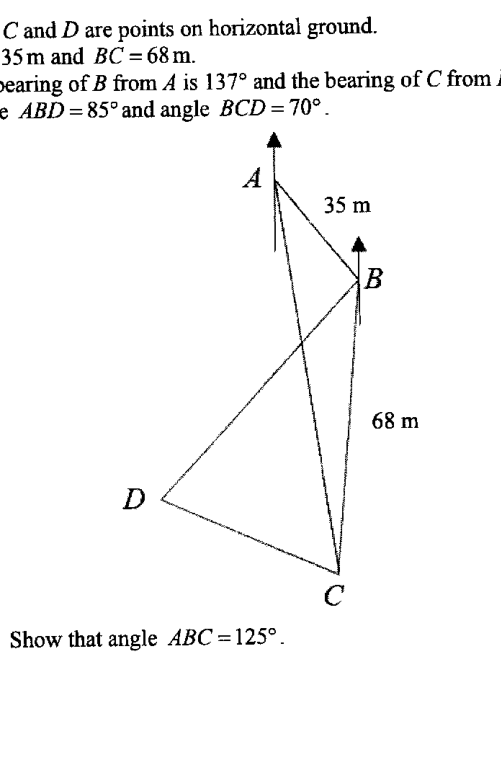
A, B, C and D are points on horizontal ground. AB = 35 m and BC = 68 m. The bearing of B from A is and the bearing of C from B is . Angle ABD = and angle BCD = .
- ((a))
Show that angle ABC = .
Give a reason for each statement you make.
- ((b))
Calculate AC.
Answer ___ m
- ((c))
Calculate DC.
Answer ___ m
- ((d))
A man travels in a straight line from D to C.
X is the position of the man where it is the shortest distance from B during this journey.
Show that BX = 63.9 m.
- ((e))
A drone is hovering vertically above B.
The angle of elevation of the drone from C is .
Calculate the greatest angle of elevation of the drone from a point on DC.Answer ___
It won't just hand you the answer — it asks where you're stuck.How the checker works
Worked solution
5((a))
1. Find the angle between $BA$ and the north line at $B$.
The bearing of from is .
Since the north lines at and are parallel,
Equivalently, the bearing of from is
so the angle between and the north line at is
2. Find the angle between the north line at $B$ and $BC$, then add the two angles.
The bearing of from is .
So the angle between south and is
Hence the angle between the north line at and on the side containing is
Therefore
5((b))
1. Identify the appropriate rule and substitute the two sides with the included angle.
In , , and .
Using the cosine rule,
2. Calculate $AC$ and give the answer in metres.
So, to 3 significant figures,
5((c))
1. Find the angle at $B$ in triangle $BCD$.
From part (a), .
Given ,
2. Use the sine rule to calculate $DC$.
In ,
Using the sine rule,
Since ,
5((d))
1. Identify $BX$ as the perpendicular shortest distance from $B$ to the path $DC$.
Since is the position on where the distance from is shortest,
So triangle is right-angled at . Also,
2. Use the sine ratio to calculate the perpendicular distance $BX$.
In right-angled triangle ,
5((e))
1. Find the height of the drone above B using the angle of elevation from C.
Let the height of the drone above be metres.
Since m and the angle of elevation from is ,
2. Identify the point on DC giving the greatest angle of elevation.
The angle of elevation is greatest when the horizontal distance from is smallest.
From part (d), the shortest distance from to is
3. Calculate the greatest angle of elevation.
Let the greatest angle of elevation be .
AI analysis — may contain mistakes.
Worked this one out on paper? Snap your steps and Gigle's AI math checker will circle the step where it went wrong.
More questions on this topic
- 1已知四边形ABCD,从下列条件中:(1)AB∥CD;(2)BC∥AD;(3)AB=CD;(4)BC=AD;(5)∠A=∠C;(6)∠B=∠D.任取其中两个,可以得出“四边形ABCD是平行四边形”这一结论的情况有( ) A. 4种 B. 9种…
- 2A cuboid has a volume of 250 cm^3, correct to the nearest cubic centimetre. The height of the cuboid is 8.4 cm, correct…
- 3如图,给出了过直线外一点作已知直线的平行线的方法,其依据是( )。 A. 同位角相等,两直线平行 B. 内错角相等,两直线平行 C. 同旁内角互补,两直线平行 D. 两直线平行,同位角相等
- 4In the diagram, POR is a quadrant of a circle with radius 6 cm. OR and PQ are parallel. QR is an arc of a circle with ce…
- 5In the diagram ABCDE is a regular pentagon. BE and BD are straight lines. Find, giving reasons for each answer, angle AB…