In the diagram ABCDE is a regular pentagon. BE and BD are straight lines.
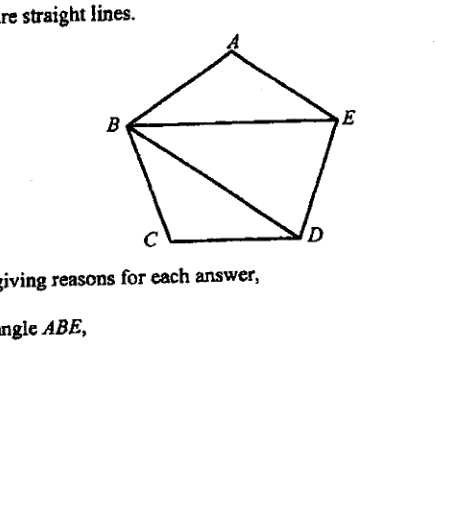
- (a)
Find, giving reasons for each answer,
- (i)
angle ABE.
Answer ___
- (ii)
angle EBD.
Answer ___
- (i)
- (b)
Explain why BE is parallel to CD.
Answer ___
- (c)
The sides AE and CD are produced to meet at X.
- (i)
Calculate angle DEX.
Answer ___ °
- (ii)
Explain why the quadrilateral BDXE is a parallelogram.
Answer ___
- (i)
It won't just hand you the answer — it asks where you're stuck.How the checker works
Worked solution
16(a)(i)
1. Find the angle at $A$ in the regular pentagon.
Since is a regular pentagon, each interior angle is
2. Use triangle $ABE$ to find $\angle ABE$.
In , because all sides of a regular pentagon are equal.
So is isosceles, and
Hence
16(a)(ii)
1. Find the angle between $BE$ and $BD$ at $B$.
In regular pentagon , .
In , , so
.
Hence
.
Using from part (a)(i),
16(b)
1. Compare a pair of alternate interior angles formed by transversal $BD$.
From part (a)(ii), .
In a regular pentagon, diagonal makes by the same base-angle reasoning in isosceles triangle .
Hence .
Therefore, since alternate interior angles are equal.
, so since alternate interior angles are equal.
16(c)(i)
1. Use angles on a straight line at $E$ to find $\angle DEX$.
In a regular pentagon, each interior angle is , so .
Since is produced to , is a straight line.
16(c)(ii)
1. Show that one pair of opposite sides is parallel.
Since lies on produced, , and are collinear.
From part (b), .
Therefore, .
2. Show that the other pair of opposite sides is parallel.
At ,
Since is a regular pentagon, .
Also, , so
From part (c)(i),
Thus , so .
3. Conclude using the definition/property of a parallelogram.
In quadrilateral ,
Since both pairs of opposite sides are parallel, is a parallelogram.
Since lies on produced, is the same straight line as . From part (b), , so . Also, and from part (c)(i), . Hence . Therefore, both pairs of opposite sides of are parallel, so is a parallelogram.
AI analysis — may contain mistakes.
Worked this one out on paper? Snap your steps and Gigle's AI math checker will circle the step where it went wrong.
More questions on this topic
- 1The figure is made up of a regular pentagon ABCDE and a regular hexagon CDFGHI. Find angle BCI. Answer ... ° Determine w…
- 2It is given that …
- 3In the diagram, POR is a quadrant of a circle with radius 6 cm. OR and PQ are parallel. QR is an arc of a circle with ce…
- 4下列命题中,正确的个数是三点确定一个圆; (2)平分弦的直径垂直于弦; (3)相等的圆心角所对的弧相等; (4)正五边形是轴对称图形. A. 个 B. 个 C. 个 D. 个
- 5A circle with centre O has a tangent XY at D. ∠ODC = 70°, ∠BCD = 120° and ∠ODA = 15°. Find ∠CDY. Find ∠DAB. Find ∠OBA. T…