A company manufactures a closed container made of glass as shown in the figure below. The closed container, of negligible thickness is made up of two components. The bottom component is a cylinder of base radius cm and a height of cm. The top component is a hemisphere of radius cm. The company requires the volume of the container to be fixed at . The external surface area of the container is denoted by . The company wants the value of to be as small as possible to reduce the cost of production. [The volume of a sphere of radius is given by and its surface area is given by .]
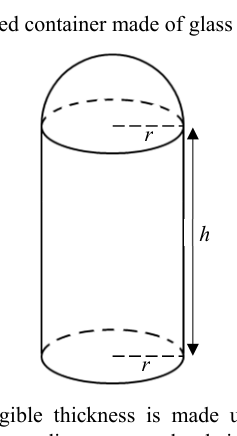
- (a)
Show that .
- (b)
Using differentiation, find the exact value of that gives the minimum value of , proving that is a minimum.
- (c)
Sketch the graph showing the external surface area of the container as the radius of the hemisphere varies, stating the coordinates of the end point of the graph.
- (d)
The company decides to produce the glass container with . To use the container as a decorative piece, the glass container is filled completely with a viscous liquid.
A small crack at the bottom of the container causes the viscous liquid to leak out of the container at a constant rate of per second. Find the rate of decrease of the height of the viscous liquid in the container 14 seconds after the container cracked.
It won't just hand you the answer — it asks where you're stuck.How the checker works
Worked solution
11(a)
1. Write down the equation for the total volume of the container and equate it to $108\pi$.
2. Rearrange the volume equation to make $h$ the subject.
Divide both sides by :
3. Formulate the external surface area, substitute the expression for $h$, and simplify.
Substitute :
11(b)
1. Find the first derivative of $A$ with respect to $r$.
2. Equate the first derivative to zero to find the exact value of $r$.
For minimum ,
3. Find the second derivative of $A$ to determine the nature of the stationary point.
4. Substitute the value of $r$ into the second derivative to confirm it is a minimum.
Substitute into the second derivative:
Since , the value of is a minimum.
11(c)
1. Establish the valid domain for $r$ using the physical constraint that the cylinder's height cannot be negative.
From the volume constraint , we can make the height the subject:
Since the physical container must have a non-negative cylindrical height ():
As for a closed container to exist, the valid domain is .
2. Calculate the exact coordinates of the end point when $r$ is at its maximum.
The graph terminates when (or ).
Substitute this into .
Note that when , we can rewrite the second term as:
Thus, the area simplifies nicely:
Substitute :
The coordinates of the end point are or approximately .
3. Determine the features of the sketch including the asymptote, the minimum point, and the end point.
To sketch the graph accurately:
- Vertical Asymptote: As , , so . The -axis is a vertical asymptote.
- Minimum Point: From part (b), gives a minimum point at , with .
- End Point: The graph ends definitively at the solid point .
The curve must show a smooth, convex (U-shaped) profile dropping from infinity to the minimum, then curving slightly upwards to terminate abruptly at the boundary.
Coordinates of the end point: or approximately to 3 s.f.
Features of the sketched graph:
- Axes: Horizontal axis () and vertical axis .
- Asymptote: The -axis () is a vertical asymptote; the curve approaches as .
- Minimum Point: The curve is U-shaped, descending to a local minimum at with .
- End Point: The curve then ascends and terminates with a solid dot exactly at the end point .
11(d)
1. Determine the position of the liquid level at $t = 14\text{ s}$.
The volume of the liquid leaked after is:
The volume of the hemispherical top is:
Since , the hemisphere has completely emptied. The liquid level is therefore entirely within the cylindrical part of the container.
2. Express the volume of the liquid in the cylinder in terms of its height.
Let be the height of the liquid from the bottom. Since the liquid is in the cylindrical section, its volume is:
3. Differentiate the volume with respect to time to find the rate of decrease of the height.
Differentiating both sides with respect to :
Given that the liquid leaks at a constant rate of , we have :
The rate of decrease of the height is (or to 3 s.f.).
(or )
AI analysis — may contain mistakes.
Worked this one out on paper? Snap your steps and Gigle's AI math checker will circle the step where it went wrong.
More questions on this topic
- 1[The volume of a cone of base radius and height is given by .] A manufacturer makes a…
- 2A sector of angle radians and radius is used to form the curved surface of a right circular co…
- 3As part of an Art Project, a student designed a lantern in the shape of an octahedron as shown in the diagram. The frame…
- 4The following diagram shows the dimensions of a trapezoidal prism with fixed volume units, with varia…
- 5[The volume of a right circular cone of radius and height is .] A student makes a printer…