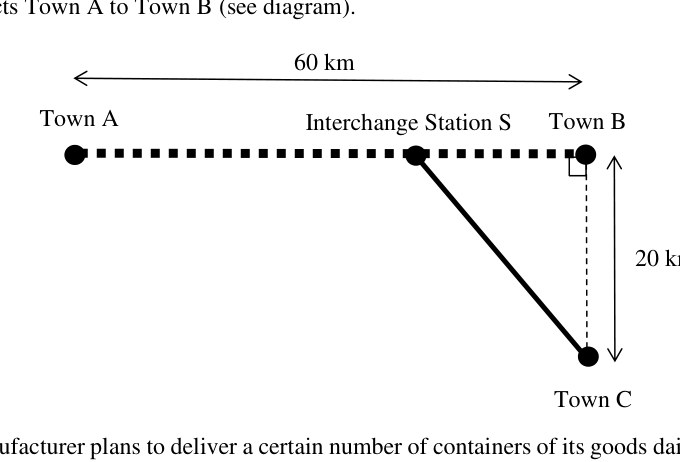
MI PU2 Promo 9758/2019/02/Q1 Town A, Town B and Town C are located in Wakandi Country. The distance between Town A and Town B is 60 km and the distance between Town B and Town C is 20 km. A railroad connects Town A to Town B (see diagram). A manufacturer plans to deliver a certain number of containers of its goods daily from Town A to Town C. To support this plan, the Wakandi government decides to build Interchange Station S and a road connecting this station to Town C (see diagram). Once the road is built, the goods manufacturer can deliver its containers from Town A to Town C by a combination of rail and road via Interchange Station S. The cost to deliver the containers daily by rail is 200perkmandthecosttodeliverthecontainersdailybyroadis200 per km and the cost to deliver the containers daily by road is 300 per km.

  1. ((i))

    Show that the daily total delivery cost, TT, of the containers from Town A to Town C is given by

    T=200x+300x2−120x+4000,T = 200x + 300\sqrt{x^2 - 120x + 4000},

    where xx km is the distance between Town A and Interchange Station S.

  2. ((ii))

    Hence use differentiation to find the value of xx that gives a stationary value of TT, giving your answer correct to 2 decimal places. Show that TT is a minimum for this value of xx.

Work through it with AI →

It won't just hand you the answer — it asks where you're stuck.How the checker works

Worked solution

7((i))

1. Find the distance SB and use Pythagoras' theorem to express the road distance SC in terms of $x$.

Since the distance from A to B is 60 km and AS=xAS = x km,
SB=60−xSB = 60 - x

Using Pythagoras' theorem on the right-angled triangle SBCSBC,
SC2=SB2+BC2SC^2 = SB^2 + BC^2
SC=(60−x)2+202SC = \sqrt{(60 - x)^2 + 20^2}
SC=3600−120x+x2+400SC = \sqrt{3600 - 120x + x^2 + 400}
SC=x2−120x+4000SC = \sqrt{x^2 - 120x + 4000}

2. Calculate the total cost by combining the cost of rail and road delivery.

Cost for rail delivery from A to S =200×AS=200x= 200 \times AS = 200x
Cost for road delivery from S to C =300×SC=300x2−120x+4000= 300 \times SC = 300\sqrt{x^2 - 120x + 4000}

Total daily delivery cost, T=200x+300x2−120x+4000T = 200x + 300\sqrt{x^2 - 120x + 4000} (Shown)

Answer

T = 200x + 300\sqrt{x^2 - 120x + 4000} \text{ (Shown)}

7((ii))

1. Differentiate $T$ with respect to $x$ using the chain rule.

T=200x+300(x2−120x+4000)12T = 200x + 300(x^2 - 120x + 4000)^{\frac{1}{2}}
dTdx=200+300(12)(x2−120x+4000)−12(2x−120)\frac{dT}{dx} = 200 + 300\left(\frac{1}{2}\right)(x^2 - 120x + 4000)^{-\frac{1}{2}}(2x - 120)
dTdx=200+150(2x−120)x2−120x+4000\frac{dT}{dx} = 200 + \frac{150(2x - 120)}{\sqrt{x^2 - 120x + 4000}}
dTdx=200+300(x−60)x2−120x+4000\frac{dT}{dx} = 200 + \frac{300(x - 60)}{\sqrt{x^2 - 120x + 4000}}

2. Equate the derivative to zero and rearrange to isolate the square root term.

For a stationary value, set dTdx=0\frac{dT}{dx} = 0:
200+300(x−60)x2−120x+4000=0200 + \frac{300(x - 60)}{\sqrt{x^2 - 120x + 4000}} = 0
300(x−60)x2−120x+4000=−200\frac{300(x - 60)}{\sqrt{x^2 - 120x + 4000}} = -200
3(x−60)x2−120x+4000=−2\frac{3(x - 60)}{\sqrt{x^2 - 120x + 4000}} = -2
3(x−60)=−2x2−120x+40003(x - 60) = -2\sqrt{x^2 - 120x + 4000}
Note: For this equation to hold, the left-hand side must be negative (since the principal square root is always positive), which implies x<60x < 60.

3. Square both sides, solve the resulting quadratic equation, and reject the extraneous root.

9(x−60)2=4(x2−120x+4000)9(x - 60)^2 = 4(x^2 - 120x + 4000)
9(x2−120x+3600)=4x2−480x+160009(x^2 - 120x + 3600) = 4x^2 - 480x + 16000
9x2−1080x+32400=4x2−480x+160009x^2 - 1080x + 32400 = 4x^2 - 480x + 16000
5x2−600x+16400=05x^2 - 600x + 16400 = 0
x2−120x+3280=0x^2 - 120x + 3280 = 0
Using the quadratic formula:
x=−(−120)±(−120)2−4(1)(3280)2(1)x = \frac{-(-120) \pm \sqrt{(-120)^2 - 4(1)(3280)}}{2(1)}
x=120±14400−131202x = \frac{120 \pm \sqrt{14400 - 13120}}{2}
x=120±12802=60±85x = \frac{120 \pm \sqrt{1280}}{2} = 60 \pm 8\sqrt{5}
Since we established earlier that x<60x < 60, we reject x=60+85x = 60 + 8\sqrt{5}.
x=60−85≈42.111≈42.11 (to 2 d.p.)x = 60 - 8\sqrt{5} \approx 42.111 \approx 42.11 \text{ (to 2 d.p.)}

4. Use the second derivative test to verify that this value of $x$ yields a minimum cost.

d2Tdx2=ddx(200+300x−60x2−120x+4000)\frac{d^2T}{dx^2} = \frac{d}{dx} \left( 200 + 300\frac{x - 60}{\sqrt{x^2 - 120x + 4000}} \right)
Using the quotient rule:
d2Tdx2=300[x2−120x+4000(1)−(x−60)(12(x2−120x+4000)−12(2x−120))x2−120x+4000]\frac{d^2T}{dx^2} = 300 \left[ \frac{\sqrt{x^2 - 120x + 4000}(1) - (x - 60)\left( \frac{1}{2}(x^2 - 120x + 4000)^{-\frac{1}{2}}(2x - 120) \right)}{x^2 - 120x + 4000} \right]
=300[x2−120x+4000−(x−60)2x2−120x+4000x2−120x+4000]= 300 \left[ \frac{\sqrt{x^2 - 120x + 4000} - \frac{(x - 60)^2}{\sqrt{x^2 - 120x + 4000}}}{x^2 - 120x + 4000} \right]
Multiply the numerator and denominator by x2−120x+4000\sqrt{x^2 - 120x + 4000}:
=300[(x2−120x+4000)−(x2−120x+3600)(x2−120x+4000)32]= 300 \left[ \frac{(x^2 - 120x + 4000) - (x^2 - 120x + 3600)}{(x^2 - 120x + 4000)^{\frac{3}{2}}} \right]
=120000(x2−120x+4000)32= \frac{120000}{(x^2 - 120x + 4000)^{\frac{3}{2}}}
Since (x2−120x+4000)=(x−60)2+400>0(x^2 - 120x + 4000) = (x - 60)^2 + 400 > 0, we have d2Tdx2>0\frac{d^2T}{dx^2} > 0 for all real xx.
Thus, TT is a minimum at x≈42.11x \approx 42.11.

Answer

x=42.11x = 42.11

AI analysis — may contain mistakes.

Worked this one out on paper? Snap your steps and Gigle's AI math checker will circle the step where it went wrong.

More questions on this topic

  1. 1[The volume of a cone of base radius rr and height hh is given by V=13πr2hV = \frac{1}{3}\pi r^2 h.] A manufacturer makes a…
  2. 2A sector of angle θ\theta radians and radius 4π cm4\pi\text{ cm} is used to form the curved surface of a right circular co…
  3. 3As part of an Art Project, a student designed a lantern in the shape of an octahedron as shown in the diagram. The frame…
  4. 4The following diagram shows the dimensions of a trapezoidal prism with fixed volume 4k34k\sqrt{3} units3^{3}, with varia…
  5. 5[The volume of a right circular cone of radius rr and height hh is 13πr2h\frac{1}{3}\pi r^2 h.] A student makes a printer…