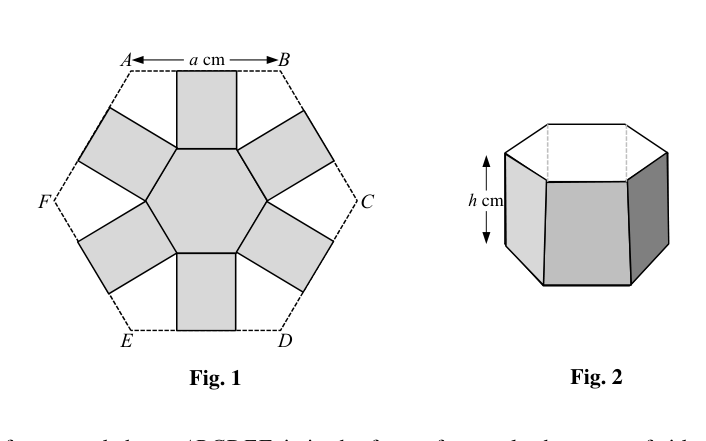
A piece of vanguard sheet, ABCDEFABCDEF, is in the form of a regular hexagon of side a cma\text{ cm}. A kite shape is cut out from each corner to form the shaded shape, as shown in Fig. 1. It is then folded to form the open hexagonal box of height h cmh\text{ cm}, as shown in Fig. 2.

  1. ((i))

    Show that the volume VV of the box in cm3\text{cm}^3 is given by V=23 h(32a−h)2V = 2\sqrt{3}\,h\left(\frac{\sqrt{3}}{2}a - h\right)^2.

  2. ((ii))

    Use differentiation to find, in terms of aa, the value of hh which would result in the volume of the box being maximum.

Work through it with AI →

It won't just hand you the answer — it asks where you're stuck.How the checker works

Worked solution

11((i))

1. Find the length cut off from each corner of the original hexagon's sides.

Let the original regular hexagon be ABCDEFABCDEF with side AB=aAB = a. When the box is unfolded into its net, the top edge of each rectangular side lies on the perimeter of ABCDEFABCDEF. Let the top edge on ABAB have endpoints PP and QQ.
Let VV be the corresponding vertex of the central hexagonal base. The side of the rectangle on the net is PVPV, which is perpendicular to ABAB and has a length equal to the height of the box, hh.
In the right-angled △APV\triangle APV, ∠APV=90∘\angle APV = 90^\circ.
Since the center of the regular hexagon aligns with its vertices, AVAV bisects the 120∘120^\circ interior angle at corner AA. Thus, ∠VAP=120∘2=60∘\angle VAP = \frac{120^\circ}{2} = 60^\circ.
Using trigonometry:
tan⁡60∘=PVAP  ⟹  3=hAP  ⟹  AP=h3\tan 60^\circ = \frac{PV}{AP} \implies \sqrt{3} = \frac{h}{AP} \implies AP = \frac{h}{\sqrt{3}}

2. Express the side length of the central hexagonal base.

By symmetry, the length cut off from the other end of side ABAB is QB=h3QB = \frac{h}{\sqrt{3}}.
The side length xx of the central hexagonal base is equal to the length of the rectangle's top edge PQPQ.
x=AB−AP−QB=a−h3−h3=a−23hx = AB - AP - QB = a - \frac{h}{\sqrt{3}} - \frac{h}{\sqrt{3}} = a - \frac{2}{\sqrt{3}}h

3. Calculate the base area of the box.

The central base is a regular hexagon of side length xx. It can be divided into 66 identical equilateral triangles.
The area of one such equilateral triangle is 12x2sin⁡60∘=34x2\frac{1}{2} x^2 \sin 60^\circ = \frac{\sqrt{3}}{4}x^2.
Base Area=6×34x2=332x2\text{Base Area} = 6 \times \frac{\sqrt{3}}{4}x^2 = \frac{3\sqrt{3}}{2}x^2
Substituting x=a−23hx = a - \frac{2}{\sqrt{3}}h:
Base Area=332(a−23h)2\text{Base Area} = \frac{3\sqrt{3}}{2} \left(a - \frac{2}{\sqrt{3}}h\right)^2

4. Formulate the volume $V$ and algebraically manipulate it to the required form.

The volume VV is given by Base Area×height h\text{Base Area} \times \text{height } h.
V=332h(a−23h)2V = \frac{3\sqrt{3}}{2}h \left(a - \frac{2}{\sqrt{3}}h\right)^2
To match the required expression, factor out 23\frac{2}{\sqrt{3}} from the terms inside the squared bracket:
a−23h=23(32a−h)a - \frac{2}{\sqrt{3}}h = \frac{2}{\sqrt{3}} \left(\frac{\sqrt{3}}{2}a - h\right)
Substitute this back into the volume equation:
V=332h[23(32a−h)]2V = \frac{3\sqrt{3}}{2}h \left[ \frac{2}{\sqrt{3}} \left(\frac{\sqrt{3}}{2}a - h\right) \right]^2
V=332h×43×(32a−h)2V = \frac{3\sqrt{3}}{2}h \times \frac{4}{3} \times \left(\frac{\sqrt{3}}{2}a - h\right)^2
V=23h(32a−h)2(Shown)V = 2\sqrt{3}h \left(\frac{\sqrt{3}}{2}a - h\right)^2 \quad \text{(Shown)}

Answer

V=23h(32a−h)2(Shown)V = 2\sqrt{3}h \left(\frac{\sqrt{3}}{2}a - h\right)^2 \quad \text{(Shown)}

11((ii))

1. Find the first derivative of $V$ with respect to $h$.

V=23h(32a−h)2V = 2\sqrt{3}h\left(\frac{\sqrt{3}}{2}a - h\right)^2
Using the product rule and chain rule:
dVdh=23(32a−h)2+23h[2(32a−h)(−1)]\frac{\mathrm{d}V}{\mathrm{d}h} = 2\sqrt{3}\left(\frac{\sqrt{3}}{2}a - h\right)^2 + 2\sqrt{3}h\left[2\left(\frac{\sqrt{3}}{2}a - h\right)(-1)\right]
dVdh=23(32a−h)[(32a−h)−2h]\frac{\mathrm{d}V}{\mathrm{d}h} = 2\sqrt{3}\left(\frac{\sqrt{3}}{2}a - h\right) \left[ \left(\frac{\sqrt{3}}{2}a - h\right) - 2h \right]
dVdh=23(32a−h)(32a−3h)\frac{\mathrm{d}V}{\mathrm{d}h} = 2\sqrt{3}\left(\frac{\sqrt{3}}{2}a - h\right)\left(\frac{\sqrt{3}}{2}a - 3h\right)

2. Set the first derivative to zero and solve for the stationary values of $h$.

For maximum volume, let dVdh=0\frac{\mathrm{d}V}{\mathrm{d}h} = 0:
23(32a−h)(32a−3h)=02\sqrt{3}\left(\frac{\sqrt{3}}{2}a - h\right)\left(\frac{\sqrt{3}}{2}a - 3h\right) = 0
32a−h=0  ⟹  h=32a\frac{\sqrt{3}}{2}a - h = 0 \implies h = \frac{\sqrt{3}}{2}a
32a−3h=0  ⟹  h=36a\frac{\sqrt{3}}{2}a - 3h = 0 \implies h = \frac{\sqrt{3}}{6}a

3. Use the second derivative test to verify which value of $h$ gives a maximum.

Expand dVdh\frac{\mathrm{d}V}{\mathrm{d}h} to find d2Vdh2\frac{\mathrm{d}^2V}{\mathrm{d}h^2}:
dVdh=23(34a2−23ah+3h2)=332a2−12ah+63h2\frac{\mathrm{d}V}{\mathrm{d}h} = 2\sqrt{3}\left(\frac{3}{4}a^2 - 2\sqrt{3}ah + 3h^2\right) = \frac{3\sqrt{3}}{2}a^2 - 12ah + 6\sqrt{3}h^2
d2Vdh2=−12a+123h\frac{\mathrm{d}^2V}{\mathrm{d}h^2} = -12a + 12\sqrt{3}h

Substitute h=36ah = \frac{\sqrt{3}}{6}a:
d2Vdh2=−12a+123(36a)=−12a+6a=−6a\frac{\mathrm{d}^2V}{\mathrm{d}h^2} = -12a + 12\sqrt{3}\left(\frac{\sqrt{3}}{6}a\right) = -12a + 6a = -6a
Since a>0a > 0, d2Vdh2<0\frac{\mathrm{d}^2V}{\mathrm{d}h^2} < 0, which confirms a maximum volume.
(Note: substituting h=32ah = \frac{\sqrt{3}}{2}a gives d2Vdh2=−12a+18a=6a>0\frac{\mathrm{d}^2V}{\mathrm{d}h^2} = -12a + 18a = 6a > 0, which corresponds to a minimum.)

Answer

h=36ah = \frac{\sqrt{3}}{6}a

AI analysis — may contain mistakes.

Worked this one out on paper? Snap your steps and Gigle's AI math checker will circle the step where it went wrong.

More questions on this topic

  1. 1[The volume of a cone of base radius rr and height hh is given by V=13πr2hV = \frac{1}{3}\pi r^2 h.] A manufacturer makes a…
  2. 2A sector of angle θ\theta radians and radius 4π cm4\pi\text{ cm} is used to form the curved surface of a right circular co…
  3. 3As part of an Art Project, a student designed a lantern in the shape of an octahedron as shown in the diagram. The frame…
  4. 4The following diagram shows the dimensions of a trapezoidal prism with fixed volume 4k34k\sqrt{3} units3^{3}, with varia…
  5. 5[The volume of a right circular cone of radius rr and height hh is 13πr2h\frac{1}{3}\pi r^2 h.] A student makes a printer…