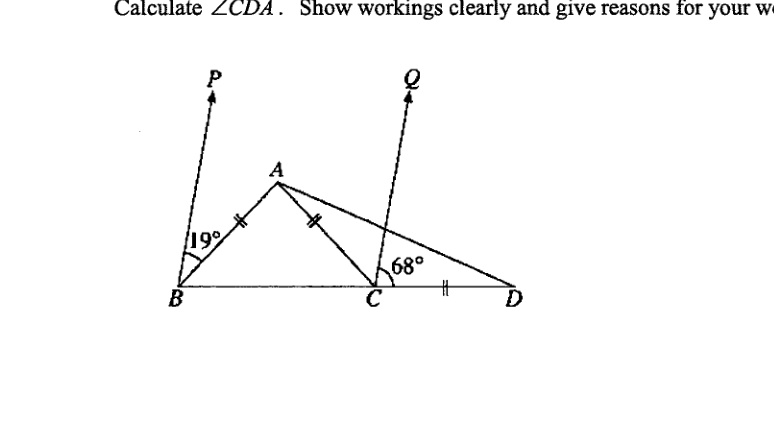
In the diagram, BP is parallel to CQ. AB = AC = CD, ∠ABP = 19° and ∠QCD = 68°.
Calculate ∠CDA. Show workings clearly and give reasons for your workings.
Ans: ___ °
It won't just hand you the answer — it asks where you're stuck.How the checker works
Worked solution
16
1. Find the angle between $BP$ and $BC$ using parallel lines.
Since and is a straight line,
(corresponding angles).
2. Find the base angle of isosceles triangle $ABC$.
Since , triangle is isosceles, so
3. Use triangle $ACD$ to find $\angle CDA$.
Since are collinear,
Since , triangle is isosceles, so
Therefore,
Answer
AI analysis — may contain mistakes.
Worked this one out on paper? Snap your steps and Gigle's AI math checker will circle the step where it went wrong.
More questions on this topic
- 1已知四边形ABCD,从下列条件中:(1)AB∥CD;(2)BC∥AD;(3)AB=CD;(4)BC=AD;(5)∠A=∠C;(6)∠B=∠D.任取其中两个,可以得出“四边形ABCD是平行四边形”这一结论的情况有( ) A. 4种 B. 9种…
- 2A cuboid has a volume of 250 cm^3, correct to the nearest cubic centimetre. The height of the cuboid is 8.4 cm, correct…
- 3如图,给出了过直线外一点作已知直线的平行线的方法,其依据是( )。 A. 同位角相等,两直线平行 B. 内错角相等,两直线平行 C. 同旁内角互补,两直线平行 D. 两直线平行,同位角相等
- 4In the diagram, POR is a quadrant of a circle with radius 6 cm. OR and PQ are parallel. QR is an arc of a circle with ce…
- 5In the diagram ABCDE is a regular pentagon. BE and BD are straight lines. Find, giving reasons for each answer, angle AB…