The diagram shows the graphs of and , where is a positive constant. The graphs intersects at two distinct points and .
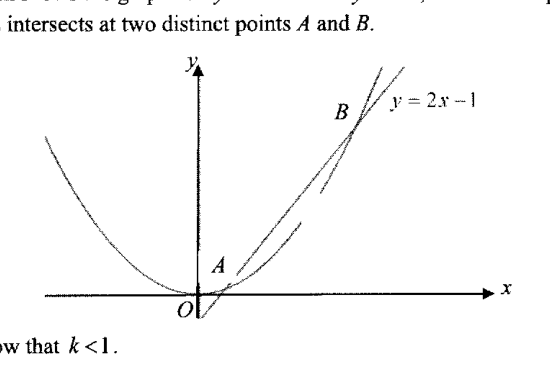
- (i)
Show that .
- (ii)
Describe the relationship between the graphs and for .
It won't just hand you the answer — it asks where you're stuck.How the checker works
Worked solution
1(i)
1. Form a quadratic equation by equating the two given equations
2. Apply the discriminant condition for two distinct real roots
Since the graphs intersect at two distinct points, the quadratic equation has two distinct real roots. Therefore, the discriminant .
3. Solve the inequality to show the required result
(shown)
Shown that .
1(ii)
1. Substitute $k = 1$ and equate the two equations to find the points of intersection
When , the curve is .
Equating the two equations:
2. Solve the quadratic equation or evaluate its discriminant to determine the relationship
Factorising the quadratic equation:
Since there is only one repeated root (), the line intersects the curve at exactly one point.
Therefore, the line is a tangent to the curve .
The line is a tangent to the curve .
AI analysis — may contain mistakes.
Worked this one out on paper? Snap your steps and Gigle's AI math checker will circle the step where it went wrong.
More questions on this topic
- 1The curve has equation . Without using a calculator, find the set of values that …
- 2The equation of a curve is , where is a constant. In the case where , find the set of…
- 3A curve has the equation , where . The normal to the point on the cur…
- 4The radius of a circle increases at a rate of 3 cm s^{-1}. Find, in terms of , the rate of increase of the area whe…
- 5A particle starts from rest from a point and moves in a straight line such that its velocity m/s, is given by …