The following diagram shows the dimensions of a trapezoidal prism with fixed volume units, with variables and . The top surface of the prism, , is an isosceles trapezoid with of length units, of length units, and . The rectangular sides and are perpendicular to both the top surface and the bottom surface , with units.
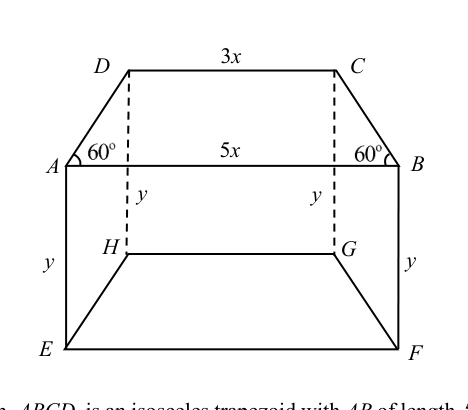
- (a)
Show that the total external surface area of the trapezoidal prism is given by .
- (b)
Using differentiation, find the value of in terms of at which is a minimum.
- (c)
It is given instead that the volume of the prism is 1000 units and its external surface area is 800 units. Find the two possible values of .
It won't just hand you the answer — it asks where you're stuck.How the checker works
Worked solution
2(a)
1. Find the height of the trapezoidal face and the length of its non-parallel sides.
Let be the perpendicular height of the isosceles trapezoid .
Since and , dropping perpendiculars from and to leaves a horizontal segment of in the middle, and two segments of length on either side.
In the right-angled triangle formed at the base,
Since the trapezoid is isosceles, .
2. Express the volume of the prism to find $y$ in terms of $x$ and $k$.
The area of the trapezoidal base is:
The volume of the prism is the base area multiplied by the height :
Given that , we can equate and solve for :
3. Formulate the total external surface area $A$ in terms of $x$ and $y$.
The total external surface area consists of the trapezoidal bases (top and bottom) and the rectangular vertical sides.
The perimeter of the trapezoid is:
The lateral surface area (sum of the rectangular sides) is:
Therefore, the total surface area is:
4. Substitute $y$ into the area equation to obtain the given expression for $A$.
Substitute into the equation for :
A = 8x^2\sqrt{3} + \frac{12k}{x}
2(b)
1. Find the first derivative of $A$ with respect to $x$.
Given ,
2. Set the first derivative to zero to locate the stationary point.
For a minimum area, :
3. Solve for $x$ in terms of $k$.
4. Use the second derivative test to confirm it is a minimum point.
Since physical dimensions must be positive () and the volume is given as units implying , we have:
.
Hence, the area is indeed a minimum at this value of .
2(c)
1. Find the value of $k$ from the given volume and substitute into the expression for surface area.
The volume of the prism is given as . Equating this to :
Substitute and the given external surface area into the expression from part (a):
2. Simplify the equation into a cubic polynomial form.
Rationalise the denominator of the fraction:
Multiply throughout by and rearrange to form a cubic equation:
Divide by 8:
3. Solve the cubic equation using a graphing calculator and identify the valid roots.
Using a graphing calculator to solve , we get:
Since represents a physical length, . Therefore, we reject the negative root.
or (to 3 s.f.)
or
AI analysis — may contain mistakes.
Worked this one out on paper? Snap your steps and Gigle's AI math checker will circle the step where it went wrong.
More questions on this topic
- 1[The volume of a cone of base radius and height is given by .] A manufacturer makes a…
- 2A sector of angle radians and radius is used to form the curved surface of a right circular co…
- 3As part of an Art Project, a student designed a lantern in the shape of an octahedron as shown in the diagram. The frame…
- 4The following diagram shows the dimensions of a trapezoidal prism with fixed volume units, with varia…
- 5[The volume of a right circular cone of radius and height is .] A student makes a printer…