The diagram shows a trapezium with vertices A(6, 8), B, C and D. The sides AB and DC are parallel and angle ABC is . AB passes through the origin O and the length of AB is 15 units. The points C and D lie on the y-axis and x-axis respectively.
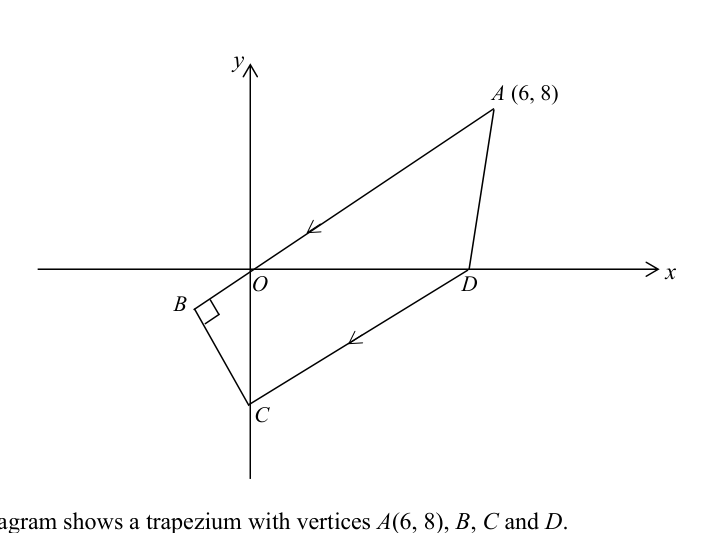
- (a)
Show that the coordinates of B are .
- (b)
Find the coordinates of C and of D.
- (c)
Find the area of the trapezium ABCD.
It won't just hand you the answer — it asks where you're stuck.How the checker works
Worked solution
11(a)
1. Find the length of OA
units
2. Find the length of OB
Since and lies on between and , units.
3. Use similar triangles or vector scaling to find coordinates of B
Since are collinear and is between and , the vector is in the opposite direction to .
.
Alternatively, by similar triangles, the coordinates of are .
Shown
11(b)
1. Find the gradient of the line AB.
Gradient of
2. Find the gradient of the line BC using the perpendicularity condition.
Since , is perpendicular to .
Gradient of
3. Find the equation of line BC and the coordinates of C.
Equation of passing through :
Since lies on the -axis, .
Coordinates of are .
4. Find the gradient of the line DC.
Since is parallel to , they have the same gradient.
Gradient of
5. Find the equation of line DC and the coordinates of D.
Equation of passing through :
Since lies on the -axis, .
Coordinates of are .
,
AI analysis — may contain mistakes.
Worked this one out on paper? Snap your steps and Gigle's AI math checker will circle the step where it went wrong.
More questions on this topic
- 1The curve has equation . Without using a calculator, find the set of values that …
- 2Find the gradient function of the curve . The curve touches the positive -axis at point . Fi…
- 3The radius of a circle increases at a rate of 3 cm s^{-1}. Find, in terms of , the rate of increase of the area whe…
- 4定积分等于 A. B. C. …
- 5已知两定点,,平面内一动点到的距离与到的距离之比为,直线与点的轨迹交于,两点. (…