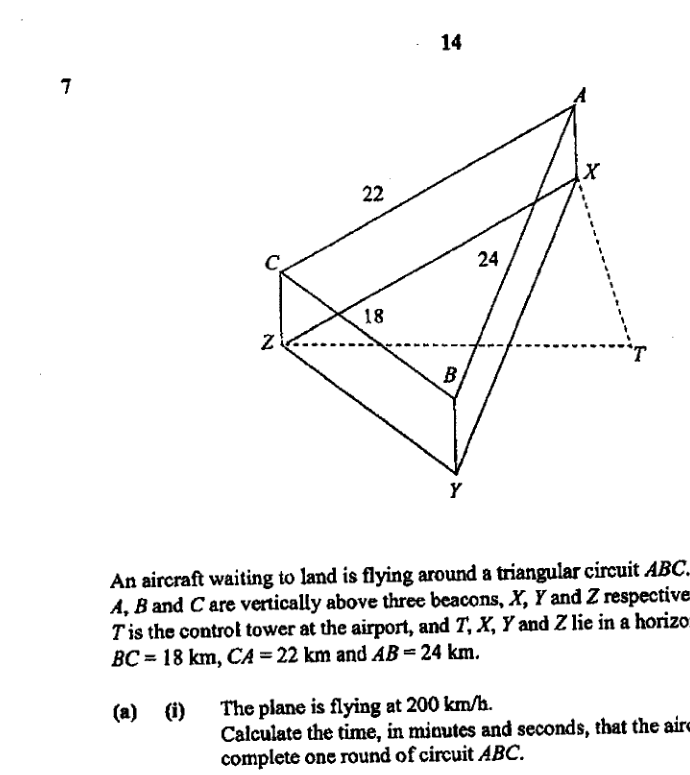
An aircraft waiting to land is flying around a triangular circuit ABC.
A, B and C are vertically above three beacons, X, Y and Z respectively.
T is the control tower at the airport, and T, X, Y and Z lie in a horizontal plane.
BC = 18 km, CA = 22 km and AB = 24 km.
- ((a)(i))
The plane is flying at 200 km/h.
Calculate the time, in minutes and seconds, that the aircraft takes to complete one round of circuit ABC.Answer ... min ... s
- ((a)(ii))
Calculate the largest angle of triangle ABC.
Answer ... °
- ((b))
Z is due west of T.
The bearing of X from Z is 042° and the bearing of X from T is 338°.- ((i))
Find angle ZXT.
Answer ... °
- ((ii))
Calculate the distance of TX.
Answer ... km
- ((i))
It won't just hand you the answer — it asks where you're stuck.How the checker works
Worked solution
7((a)(i))
1. Find the distance travelled in one complete circuit
One round of circuit ABC is the perimeter of triangle ABC.
2. Use speed to calculate the time and convert to minutes and seconds
So the time taken is min s.
min s
7((a)(ii))
1. Identify which angle is the largest
The largest side is km.
Therefore the largest angle is opposite , which is .
2. Apply the cosine rule to find the largest angle
Using the cosine rule for ,
3. Evaluate the angle and round suitably
So the largest angle is to 1 decimal place.
7((b))((i))
1. Find angle XZT using the bearings from Z
Since Z is due west of T, T is due east of Z.
So the bearing of T from Z is .
The bearing of X from Z is .
Hence
2. Find angle ZTX using the bearings from T
Since Z is due west of T, the bearing of Z from T is .
The bearing of X from T is .
Hence
3. Use the angle sum of triangle ZXT
In triangle ZXT,
7((b))((ii))
1. Identify the known side and relevant angles in triangle $ZXT$
Since is vertically above and is vertically above , the horizontal distance
From part (b)(i),
Also, using the bearings,
so the side is opposite , and is opposite .
2. Apply the sine rule to calculate $TX$
By the sine rule,
Hence
km
AI analysis — may contain mistakes.
Worked this one out on paper? Snap your steps and Gigle's AI math checker will circle the step where it went wrong.
More questions on this topic
- 1Mrs Ang runs a small tuition centre for secondary school students. The tables provide information on the cost of running…
- 2The diagram (not drawn to scale) shows the speed-time graph of a vehicle. The vehicle starts from rest and accelerates u…
- 3Hamid borrowed a sum of money for 3 years at an interest rate of 3.5% per annum simple interest to pay for his car. If t…
- 4The diagram shows the positions of a harbour, H, a lighthouse, L, and two buoys P and Q. HPQ is a straight line. The bea…
- 5The diagram below shows the speed-time graph of a bus journey. The bus accelerated from rest at 1.25 m/s^2 to a speed of…