There was 21.6 litres of water altogether in container A and container B. The water level in container A was the same as container B. The base area of container A was 700 cm^2 and the base of container B has dimensions as shown.
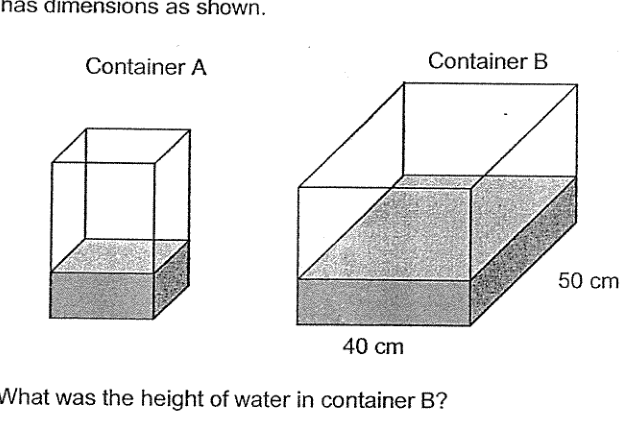
- (a)
What was the height of water in container B?
- (b)
From which container should water be poured out from such that both containers would have the same amount of water? How much water should be poured?
It won't just hand you the answer — it asks where you're stuck.How the checker works
Worked solution
9(a)
1. Convert the total volume of water from litres to cubic centimetres
2. Calculate the base area of container B
3. Find the total base area of both containers
4. Calculate the common height of water in both containers
cm
9(b)
1. Calculate the volume of water currently in container A.
From part (a), the common height .
Volume in A .
2. Calculate the volume of water currently in container B.
Volume in B .
3. Determine the target volume for each container to have the same amount.
Total volume .
Target volume per container .
4. Identify which container to pour from and calculate the amount.
Since , water must be poured out from container B.
Amount to pour .
Container B,
AI analysis — may contain mistakes.
Worked this one out on paper? Snap your steps and Gigle's AI math checker will circle the step where it went wrong.
More questions on this topic
- 1The figure below is made up of 2 squares, ABCD and DEFG. X is a point on GD and Y is a point on DE. BC = 7 cm, FE = 6 cm…
- 2Find the value of . Ans: ___
- 3In a camp, the number of children is of the number of adults. of the children are boys and t…
- 4A can of mushroom soup costs $3.20 and a bundle of 3 cans of mushroom soup costs $8. Diane wants to buy 20 cans of mus…
- 5A group of singers are arranged in 5 rows. There are 7 singers in the second row. Each row has more singers than the…