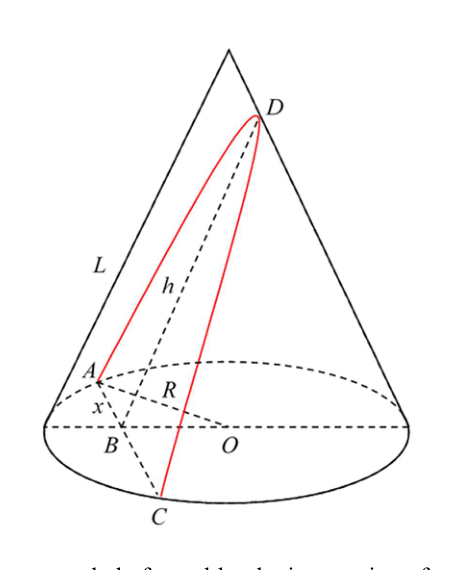
The diagram shows a parabola formed by the intersection of a right circular cone and a plane parallel to the slanted edge of the cone. The cone with the point O at the centre of its base has radius cm and slant length cm, where and are constants. The points A, B, C and D on the plane are such that cm, cm and the area of the region bounded by the parabola and the line is .
- (i)
Show that .
- (ii)
It is given that is a maximum. Use differentiation to find in terms of and .
It won't just hand you the answer — it asks where you're stuck.How the checker works
Worked solution
5(i)
1. Find the distance from the centre of the base to the chord $AC$.
Let be the centre of the circular base. Due to the symmetry of the right circular cone and the plane being parallel to a slanted edge, the chord on the base is perpendicular to the diameter passing through its midpoint .
Triangle is a right-angled triangle with hypotenuse (the radius of the base) and .
By Pythagoras' theorem,
2. Express $h$ in terms of $R$, $L$, and $x$ using similar triangles.
Consider the vertical cross-section of the cone through the diameter passing through . Let the diameter be , with as the midpoint and located between the left endpoint and . Let be the vertex of the cone.
The cross-section is . The slant edges are , and the diameter .
Because the cutting plane is parallel to the slanted edge , the segment on the plane is parallel to .
Therefore, is similar to .
Using the ratio of corresponding sides:
Based on the diagram, is on the same side of as the parallel slanted edge, so the distance from the opposite endpoint to is:
Substitute , , and into the ratio:
3. Substitute $h$ to show the final expression for $S$.
Given that the area of the parabolic region is , substitute the expression obtained for :
5(ii)
1. Differentiate the given expression for $S$ with respect to $x$.
Given ,
2. Equate the derivative to zero to find the maximum point and rearrange the equation.
For maximum , set :
Multiply through by :
3. Solve the algebraic equation for $x$ in terms of $R$.
Squaring both sides:
Since (as it represents a physical length), we divide by :
4. Determine $h$ at the maximum point and calculate the ratio $\frac{h}{x}$.
From , divide by :
Substituting into the expression for :
Finally, compute :
AI analysis — may contain mistakes.
Worked this one out on paper? Snap your steps and Gigle's AI math checker will circle the step where it went wrong.
More questions on this topic
- 1[The volume of a cone of base radius and height is given by .] A manufacturer makes a…
- 2A sector of angle radians and radius is used to form the curved surface of a right circular co…
- 3As part of an Art Project, a student designed a lantern in the shape of an octahedron as shown in the diagram. The frame…
- 4The following diagram shows the dimensions of a trapezoidal prism with fixed volume units, with varia…
- 5[The volume of a right circular cone of radius and height is .] A student makes a printer…