[A sphere of radius has surface area and volume .] A water fountain is to be constructed in the middle of Bishan East Park. It consists of a hemisphere with radius m joined to an open cylinder with radius m and height m (see diagram). The thickness of the fountain is negligible. It is given that the fountain, when filled to the brim, can hold a fixed volume m of water.
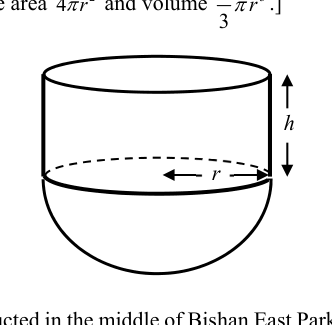
- (a)
The interior of the fountain is to be painted with a layer of special reflecting paint. The cost of painting is $3 per m for the hemispherical surface and $2.50 per m for the cylindrical wall. Show that the total cost of painting, $C, is given by .
- (b)
Using differentiation, find the value of , in terms of , such that is a minimum.
- (c)
Keeping at a minimum, it is now given that .
Find the numerical values of and .
- (d)
When the fountain is filled to the brim, a leak develops at the joint between the cylinder and the hemisphere. Water leaks at a constant rate of 0.002 m per minute. Assuming that water is neither lost nor added to the fountain in any other way, find the rate at which the level of water is decreasing.
It won't just hand you the answer — it asks where you're stuck.How the checker works
Worked solution
11(a)
1. Express the total volume of the fountain and make $h$ the subject of the formula.
The volume of the fountain is the sum of the volume of the hemisphere and the cylinder.
2. Formulate an expression for the total cost of painting the interior surface.
The interior surface to be painted consists of the curved surface of the hemisphere and the curved surface of the cylindrical wall.
Area of hemispherical surface
Area of cylindrical wall
Cost of painting hemispherical surface
Cost of painting cylindrical wall
Total cost,
3. Substitute the expression for $h$ into the cost equation and simplify to obtain the given result.
11(b)
1. Differentiate $C$ with respect to $r$.
Given
2. Set the first derivative to zero and rearrange to solve for $r^3$.
For a stationary value, :
Multiply both sides by :
3. Express $r$ in terms of $k$ and verify the nature of the stationary point using the second derivative test.
To verify it is a minimum, find the second derivative:
Since volume and radius , .
Therefore, is a minimum when .
11(c)
1. Determine the value of $r$ that minimizes $C$ when $k=50$.
For a minimum cost , we use the condition from the previous part:
Given :
2. Set up the volume equation for the fountain.
The total volume consists of the open cylinder and the hemisphere:
Since the fountain holds a fixed volume , we have:
3. Substitute the value of $r$ to solve for $h$.
Substituting and :
Rounding to 3 significant figures:
,
11(d)
1. Determine the radius $r$ of the fountain when $k=50$ (carrying forward the condition for minimum cost from earlier parts).
From part (b), for the cost to be a minimum:
Substitute (given in part (c)):
2. Set up the connected rates of change equation relating the volume of the cylindrical part to the water level.
Since the fountain is filled to the brim and the leak is at the joint below the cylinder, the water level decreases within the cylindrical section first.
Let be the water level in the cylinder. The volume of water in this part is:
Differentiating with respect to time gives:
3. Substitute the given rate of leak and the calculated area to find the rate at which the water level is decreasing.
We are given that the water leaks out at , so .
The rate at which the water level is decreasing is (or to 3 s.f.).
AI analysis — may contain mistakes.
Worked this one out on paper? Snap your steps and Gigle's AI math checker will circle the step where it went wrong.
More questions on this topic
- 1[The volume of a cone of base radius and height is given by .] A manufacturer makes a…
- 2A sector of angle radians and radius is used to form the curved surface of a right circular co…
- 3As part of an Art Project, a student designed a lantern in the shape of an octahedron as shown in the diagram. The frame…
- 4The following diagram shows the dimensions of a trapezoidal prism with fixed volume units, with varia…
- 5[The volume of a right circular cone of radius and height is .] A student makes a printer…