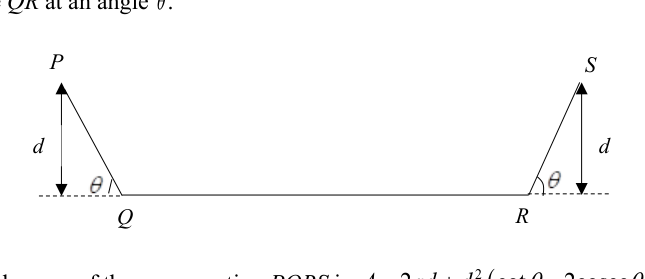
The cross section PQRS of a water passageway of depth d is as shown in the figure below. It is given that PQ+QR+RS=2aPQ+QR+RS=2a and with PQ and RS each inclined to the line QR at an angle θ\theta.

  1. (a)

    Show that the area of the cross-section PQRS is A=2ad+d2(cot⁡θ−2csc⁡θ)A=2ad + d^2(\cot\theta -2\csc\theta).

  2. (b)

    Find, in terms of a and d, the maximum value of A, as θ\theta varies.

Work through it with AI →

It won't just hand you the answer — it asks where you're stuck.How the checker works

Worked solution

3(a)

1. Express the slant lengths $PQ$ and $RS$, and the base $QR$ in terms of $d$, $a$, and $\theta$.

From right-angled trigonometry, the slant height PQ=RS=dsin⁡θ=dcsc⁡θPQ = RS = \frac{d}{\sin\theta} = d\csc\theta.
Given PQ+QR+RS=2aPQ + QR + RS = 2a:
dcsc⁡θ+QR+dcsc⁡θ=2ad\csc\theta + QR + d\csc\theta = 2a
QR=2a−2dcsc⁡θQR = 2a - 2d\csc\theta

2. Express the cross-sectional area as the sum of a central rectangle and two side right-angled triangles.

Area of the central rectangle =QR×d=(2a−2dcsc⁡θ)d= QR \times d = (2a - 2d\csc\theta)d

The horizontal projection (base) of the slant side PQPQ is dtan⁡θ=dcot⁡θ\frac{d}{\tan\theta} = d\cot\theta.
Area of the two identical side right-angled triangles =2×(12×dcot⁡θ×d)=d2cot⁡θ= 2 \times \left( \frac{1}{2} \times d\cot\theta \times d \right) = d^2\cot\theta

3. Sum the areas and factorise to show the final result.

Total Area A=Area of rectangle+Area of trianglesA = \text{Area of rectangle} + \text{Area of triangles}
A=(2a−2dcsc⁡θ)d+d2cot⁡θA = (2a - 2d\csc\theta)d + d^2\cot\theta
A=2ad−2d2csc⁡θ+d2cot⁡θA = 2ad - 2d^2\csc\theta + d^2\cot\theta
A=2ad+d2(cot⁡θ−2csc⁡θ)A = 2ad + d^2(\cot\theta - 2\csc\theta)

Answer

A=2ad+d2(cot⁡θ−2csc⁡θ)A = 2ad + d^2(\cot\theta - 2\csc\theta)

3(b)

1. Differentiate the area function $A$ with respect to $\theta$.

Given A=2ad+d2(cot⁡θ−2csc⁡θ)A = 2ad + d^2(\cot\theta - 2\csc\theta), we differentiate AA with respect to θ\theta:
dAdθ=d2(−csc⁡2θ−2(−csc⁡θcot⁡θ))\frac{dA}{d\theta} = d^2(-\csc^2\theta - 2(-\csc\theta\cot\theta))
dAdθ=d2(2csc⁡θcot⁡θ−csc⁡2θ)\frac{dA}{d\theta} = d^2(2\csc\theta\cot\theta - \csc^2\theta)

2. Set the derivative to zero and solve for $\theta$.

To find the maximum area, set dAdθ=0\frac{dA}{d\theta} = 0. We can factor the derivative:
d2(2csc⁡θcot⁡θ−csc⁡2θ)=0d^2(2\csc\theta\cot\theta - \csc^2\theta) = 0
d2csc⁡2θ(2cos⁡θsin⁡θ⋅sin⁡θ−1)=0d^2\csc^2\theta \left( \frac{2\cos\theta}{\sin\theta} \cdot \sin\theta - 1 \right) = 0
d2csc⁡2θ(2cos⁡θ−1)=0d^2\csc^2\theta (2\cos\theta - 1) = 0
Since 0<θ<π0 < \theta < \pi for an interior angle of the cross-section, csc⁡θ≠0\csc\theta \neq 0.
2cos⁡θ−1=0  ⟹  cos⁡θ=122\cos\theta - 1 = 0 \implies \cos\theta = \frac{1}{2}
θ=π3\theta = \frac{\pi}{3}

3. Verify the nature of the stationary point using the second derivative test.

Using the factored form dAdθ=d2csc⁡2θ(2cos⁡θ−1)\frac{dA}{d\theta} = d^2\csc^2\theta(2\cos\theta - 1), we apply the product rule to find the second derivative:
d2Adθ2=d2[−2csc⁡2θcot⁡θ(2cos⁡θ−1)+csc⁡2θ(−2sin⁡θ)]\frac{d^2A}{d\theta^2} = d^2 \left[ -2\csc^2\theta\cot\theta(2\cos\theta - 1) + \csc^2\theta(-2\sin\theta) \right]
At θ=π3\theta = \frac{\pi}{3}, 2cos⁡θ−1=02\cos\theta - 1 = 0, so the first term vanishes:
d2Adθ2=d2[0+(csc⁡2π3)(−2sin⁡π3)]\frac{d^2A}{d\theta^2} = d^2 \left[ 0 + \left(\csc^2\frac{\pi}{3}\right)\left(-2\sin\frac{\pi}{3}\right) \right]
d2Adθ2=d2(43)(−3)=−433d2\frac{d^2A}{d\theta^2} = d^2 \left( \frac{4}{3} \right) (-\sqrt{3}) = -\frac{4\sqrt{3}}{3}d^2
Since d2>0d^2 > 0, d2Adθ2<0\frac{d^2A}{d\theta^2} < 0, confirming that AA is maximized when θ=π3\theta = \frac{\pi}{3}.

4. Substitute the optimal angle back into the area function to find the maximum value.

Substitute θ=π3\theta = \frac{\pi}{3} into the original equation for AA:
Amax⁡=2ad+d2(cot⁡π3−2csc⁡π3)A_{\max} = 2ad + d^2\left(\cot\frac{\pi}{3} - 2\csc\frac{\pi}{3}\right)
Amax⁡=2ad+d2(13−2(23))A_{\max} = 2ad + d^2\left( \frac{1}{\sqrt{3}} - 2\left(\frac{2}{\sqrt{3}}\right) \right)
Amax⁡=2ad+d2(1−43)A_{\max} = 2ad + d^2\left( \frac{1 - 4}{\sqrt{3}} \right)
Amax⁡=2ad−33d2A_{\max} = 2ad - \frac{3}{\sqrt{3}}d^2
Amax⁡=2ad−3d2A_{\max} = 2ad - \sqrt{3}d^2

Answer

2ad−3d22ad - \sqrt{3}d^2

AI analysis — may contain mistakes.

Worked this one out on paper? Snap your steps and Gigle's AI math checker will circle the step where it went wrong.

More questions on this topic

  1. 1[The volume of a cone of base radius rr and height hh is given by V=13πr2hV = \frac{1}{3}\pi r^2 h.] A manufacturer makes a…
  2. 2A sector of angle θ\theta radians and radius 4π cm4\pi\text{ cm} is used to form the curved surface of a right circular co…
  3. 3As part of an Art Project, a student designed a lantern in the shape of an octahedron as shown in the diagram. The frame…
  4. 4The following diagram shows the dimensions of a trapezoidal prism with fixed volume 4k34k\sqrt{3} units3^{3}, with varia…
  5. 5[The volume of a right circular cone of radius rr and height hh is 13πr2h\frac{1}{3}\pi r^2 h.] A student makes a printer…