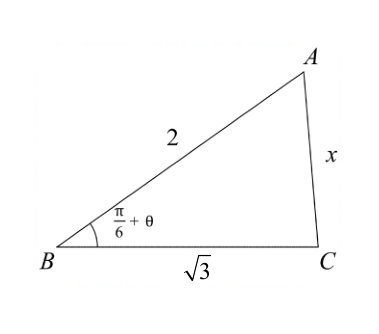
在三角形 ABCABC 中,AB=2AB = 2,BC=3BC = \sqrt{3},AC=xAC = x 且角 ABC=π6+θABC = \frac{\pi}{6} + \theta(见图)。

  1. (a)

    证明 x2=7−6cos⁡θ+23sin⁡θx^{2} = 7 - 6\cos\theta + 2\sqrt{3}\sin\theta。

  2. (b)

    证明 xd2xdθ2+(dxdθ)2=3cos⁡θ−3sin⁡θx\dfrac{d^{2}x}{d\theta^{2}} + \left(\dfrac{dx}{d\theta}\right)^{2} = 3\cos\theta - \sqrt{3}\sin\theta。

  3. (c)

    利用 (b) 部分的结果,求 xx 的麦克劳林展开式,直至并包括 θ3\theta^{3} 项。以最简形式给出系数的精确值。

  4. (d)

    利用 (c) 部分的结果,推导当角 ABCABC 为 35∘35^{\circ} 时 xx 的近似值,答案保留 6 位小数。

先不看答案,让 AI 诊断你卡在哪里?

它不会直接告诉你答案,而是问你卡在哪一步看看 AI 是怎么陪你一步步弄懂这道题的

完整解法

5(a)

1. Apply the Cosine Rule to triangle ABC to express $x^2$ in terms of $\theta$.

x2=22+(3)2−2(2)(3)cos⁡(π6+θ)x^2 = 2^2 + (\sqrt{3})^2 - 2(2)(\sqrt{3})\cos\left(\frac{\pi}{6} + \theta\right)
x2=4+3−43cos⁡(π6+θ)x^2 = 4 + 3 - 4\sqrt{3}\cos\left(\frac{\pi}{6} + \theta\right)
x2=7−43cos⁡(π6+θ)x^2 = 7 - 4\sqrt{3}\cos\left(\frac{\pi}{6} + \theta\right)

2. Use the compound angle formula to expand the cosine term and simplify.

Using cos⁡(A+B)=cos⁡Acos⁡B−sin⁡Asin⁡B\cos(A+B) = \cos A \cos B - \sin A \sin B:
x2=7−43[cos⁡π6cos⁡θ−sin⁡π6sin⁡θ]x^2 = 7 - 4\sqrt{3} \left[ \cos\frac{\pi}{6}\cos\theta - \sin\frac{\pi}{6}\sin\theta \right]
Since cos⁡π6=32\cos\frac{\pi}{6} = \frac{\sqrt{3}}{2} and sin⁡π6=12\sin\frac{\pi}{6} = \frac{1}{2}:
x2=7−43(32cos⁡θ−12sin⁡θ)x^2 = 7 - 4\sqrt{3} \left( \frac{\sqrt{3}}{2}\cos\theta - \frac{1}{2}\sin\theta \right)
x2=7−43(32cos⁡θ)+43(12sin⁡θ)x^2 = 7 - 4\sqrt{3}\left(\frac{\sqrt{3}}{2}\cos\theta\right) + 4\sqrt{3}\left(\frac{1}{2}\sin\theta\right)
x2=7−6cos⁡θ+23sin⁡θx^2 = 7 - 6\cos\theta + 2\sqrt{3}\sin\theta (shown)

答案

x^2 = 7 - 6\cos\theta + 2\sqrt{3}\sin\theta

5(b)

1. Differentiate the result from part (a) implicitly with respect to $\theta$.

From part (a), we have:
x2=7−6cos⁡θ+23sin⁡θx^{2} = 7 - 6\cos\theta + 2\sqrt{3}\sin\theta

Differentiating both sides implicitly with respect to θ\theta:
2xdxdθ=6sin⁡θ+23cos⁡θ2x\frac{dx}{d\theta} = 6\sin\theta + 2\sqrt{3}\cos\theta

2. Simplify and differentiate again using the product rule to obtain the required identity.

Dividing the equation by 2 gives:
xdxdθ=3sin⁡θ+3cos⁡θx\frac{dx}{d\theta} = 3\sin\theta + \sqrt{3}\cos\theta

Differentiating both sides again with respect to θ\theta using the product rule on the left-hand side:
(dxdθ)(dxdθ)+x(d2xdθ2)=3cos⁡θ−3sin⁡θ\left(\frac{dx}{d\theta}\right)\left(\frac{dx}{d\theta}\right) + x\left(\frac{d^{2}x}{d\theta^{2}}\right) = 3\cos\theta - \sqrt{3}\sin\theta

xd2xdθ2+(dxdθ)2=3cos⁡θ−3sin⁡θ(shown)x\frac{d^{2}x}{d\theta^{2}} + \left(\frac{dx}{d\theta}\right)^{2} = 3\cos\theta - \sqrt{3}\sin\theta \quad \text{(shown)}

答案

x\frac{d^{2}x}{d\theta^{2}} + \left(\frac{dx}{d\theta}\right)^{2} = 3\cos\theta - \sqrt{3}\sin\theta \quad \text{(shown)}

5(c)

1. Evaluate $x$, $\frac{dx}{d\theta}$, and $\frac{d^2x}{d\theta^2}$ at $\theta = 0$ using results from earlier parts.

At θ=0\theta = 0, from the expression in part (a):
x2=7−6cos⁡0+23sin⁡0=1x^2 = 7 - 6\cos 0 + 2\sqrt{3}\sin 0 = 1
Since xx is a length, x=1x = 1.

Differentiating the equation in part (a) gives an intermediate result needed for part (b):
2xdxdθ=6sin⁡θ+23cos⁡θ  ⟹  xdxdθ=3sin⁡θ+3cos⁡θ2x\frac{dx}{d\theta} = 6\sin\theta + 2\sqrt{3}\cos\theta \implies x\frac{dx}{d\theta} = 3\sin\theta + \sqrt{3}\cos\theta
At θ=0\theta = 0:
1⋅dxdθ=3(0)+3(1)  ⟹  dxdθ=31 \cdot \frac{dx}{d\theta} = 3(0) + \sqrt{3}(1) \implies \frac{dx}{d\theta} = \sqrt{3}

From the equation proven in part (b):
xd2xdθ2+(dxdθ)2=3cos⁡θ−3sin⁡θx\frac{d^2x}{d\theta^2} + \left(\frac{dx}{d\theta}\right)^2 = 3\cos\theta - \sqrt{3}\sin\theta
At θ=0\theta = 0:
1⋅d2xdθ2+(3)2=3(1)−0  ⟹  d2xdθ2=01 \cdot \frac{d^2x}{d\theta^2} + (\sqrt{3})^2 = 3(1) - 0 \implies \frac{d^2x}{d\theta^2} = 0

2. Differentiate the equation from part (b) with respect to $\theta$ to find an expression for $\frac{d^3x}{d\theta^3}$.

ddθ[xd2xdθ2+(dxdθ)2]=ddθ[3cos⁡θ−3sin⁡θ]\frac{d}{d\theta}\left[x\frac{d^2x}{d\theta^2} + \left(\frac{dx}{d\theta}\right)^2\right] = \frac{d}{d\theta}\left[3\cos\theta - \sqrt{3}\sin\theta\right]
Using the product rule and chain rule:
xd3xdθ3+dxdθd2xdθ2+2dxdθd2xdθ2=−3sin⁡θ−3cos⁡θx\frac{d^3x}{d\theta^3} + \frac{dx}{d\theta}\frac{d^2x}{d\theta^2} + 2\frac{dx}{d\theta}\frac{d^2x}{d\theta^2} = -3\sin\theta - \sqrt{3}\cos\theta
xd3xdθ3+3dxdθd2xdθ2=−3sin⁡θ−3cos⁡θx\frac{d^3x}{d\theta^3} + 3\frac{dx}{d\theta}\frac{d^2x}{d\theta^2} = -3\sin\theta - \sqrt{3}\cos\theta

3. Evaluate $\frac{d^3x}{d\theta^3}$ at $\theta = 0$.

Substitute θ=0\theta = 0 into the differentiated equation:
1⋅d3xdθ3+3(3)(0)=−3(0)−3(1)1 \cdot \frac{d^3x}{d\theta^3} + 3(\sqrt{3})(0) = -3(0) - \sqrt{3}(1)
d3xdθ3=−3\frac{d^3x}{d\theta^3} = -\sqrt{3}

4. Construct the Maclaurin expansion for $x$ up to the term in $\theta^3$.

The Maclaurin series is given by:
x(θ)≈x(0)+x′(0)θ+x′′(0)2!θ2+x′′′(0)3!θ3x(\theta) \approx x(0) + x'(0)\theta + \frac{x''(0)}{2!}\theta^2 + \frac{x'''(0)}{3!}\theta^3
Substituting the values obtained:
x≈1+3θ+02!θ2+−33!θ3x \approx 1 + \sqrt{3}\theta + \frac{0}{2!}\theta^2 + \frac{-\sqrt{3}}{3!}\theta^3
x≈1+3θ−36θ3x \approx 1 + \sqrt{3}\theta - \frac{\sqrt{3}}{6}\theta^3

答案

1+3θ−36θ31 + \sqrt{3}\theta - \frac{\sqrt{3}}{6}\theta^3

5(d)

1. Find the Maclaurin expansion for $x$ up to $\theta^3$ as required from part (c).

Evaluate xx and its derivatives at θ=0\theta = 0:
From (a), x2=7−6cos⁡(0)+23sin⁡(0)=1  ⟹  x(0)=1x^2 = 7 - 6\cos(0) + 2\sqrt{3}\sin(0) = 1 \implies x(0) = 1 (since length x>0x > 0).
Differentiating (a) implicitly: 2xdxdθ=6sin⁡θ+23cos⁡θ2x \frac{dx}{d\theta} = 6\sin\theta + 2\sqrt{3}\cos\theta.
At θ=0\theta = 0: 2(1)dxdθ=23  ⟹  x′(0)=32(1)\frac{dx}{d\theta} = 2\sqrt{3} \implies x'(0) = \sqrt{3}.
From (b), xd2xdθ2+(dxdθ)2=3cos⁡θ−3sin⁡θx\frac{d^{2}x}{d\theta^{2}} + \left(\frac{dx}{d\theta}\right)^{2} = 3\cos\theta - \sqrt{3}\sin\theta.
At θ=0\theta = 0: 1⋅x′′(0)+(3)2=3(1)−0  ⟹  x′′(0)=01 \cdot x''(0) + (\sqrt{3})^2 = 3(1) - 0 \implies x''(0) = 0.
Differentiating (b): xd3xdθ3+3dxdθd2xdθ2=−3sin⁡θ−3cos⁡θx\frac{d^{3}x}{d\theta^{3}} + 3\frac{dx}{d\theta}\frac{d^{2}x}{d\theta^{2}} = -3\sin\theta - \sqrt{3}\cos\theta.
At θ=0\theta = 0: 1⋅x′′′(0)+3(3)(0)=−3  ⟹  x′′′(0)=−31 \cdot x'''(0) + 3(\sqrt{3})(0) = -\sqrt{3} \implies x'''(0) = -\sqrt{3}.

Thus, the Maclaurin series for xx is:
x≈x(0)+x′(0)θ+x′′(0)2!θ2+x′′′(0)3!θ3x \approx x(0) + x'(0)\theta + \frac{x''(0)}{2!}\theta^2 + \frac{x'''(0)}{3!}\theta^3
x≈1+3θ−36θ3x \approx 1 + \sqrt{3}\theta - \frac{\sqrt{3}}{6}\theta^3

2. Determine the value of $\theta$ in radians corresponding to angle $ABC = 35^{\circ}$.

Given angle ABC=π6+θABC = \frac{\pi}{6} + \theta.
Since angle ABC=35∘ABC = 35^{\circ} and π6\frac{\pi}{6} radians is equivalent to 30∘30^{\circ}:
30∘+θ=35∘  ⟹  θ=5∘30^{\circ} + \theta = 35^{\circ} \implies \theta = 5^{\circ}
Convert θ\theta to radians (required for Maclaurin expansions of trigonometric functions):
θ=5π180=π36\theta = \frac{5\pi}{180} = \frac{\pi}{36} radians.

3. Approximate $x$ by substituting the value of $\theta$ into the Maclaurin series.

Substituting θ=π36\theta = \frac{\pi}{36} into the expansion:
x≈1+3(π36)−36(π36)3x \approx 1 + \sqrt{3}\left(\frac{\pi}{36}\right) - \frac{\sqrt{3}}{6}\left(\frac{\pi}{36}\right)^3
x≈1+0.15114995−0.00019186x \approx 1 + 0.15114995 - 0.00019186
x≈1.15095809x \approx 1.15095809
∴x≈1.150958 (correct to 6 d.p.)\therefore x \approx 1.150958 \text{ (correct to 6 d.p.)}

答案

1.1509581.150958

AI 分析,可能出错

用 AI 批改,圈出写错的那一步,并自动将你的薄弱点存入错题本,形成你的错因库。

同一知识点的其他题

  1. 1已知 y=1+tan⁡−12xy = \sqrt{1 + \tan^{-1} 2x},其中 −12<x<12-\frac{1}{2} < x < \frac{1}{2}。证明 yd2ydx2+(dydx)2+8x(1+4x2)2=0.y \frac{\mathrm{d}^2 y}{\mathrm{d}x^2} + \left(\frac{\mathrm{d}y}{\mathrm{d}x}\right)^2 + \frac{8x}{(1 + 4x^2)^2} = 0.…
  2. 2已知 y=tan⁡−115xy = \tan^{-1} \dfrac{1}{5} x,证明 (25+x2)d2ydx2+2xdydx=0\left(25 + x^2\right) \dfrac{d^2 y}{dx^2} + 2x \dfrac{dy}{dx} = 0。 通过对此结果的进一步求导,求…
  3. 3已知 ey=2+ex\text{e}^y = 2 + \text{e}^x。 证明 d2ydx2+(dydx)2=dydx\frac{\text{d}^2y}{\text{d}x^2} + \left(\frac{\text{d}y}{\text{d}x}\right)^2 = \frac{\text{d}y}{\text{d}x}…
  4. 4已知 y=1+tan⁡xy = \sqrt{1+\tan x}。 证明 2y dydx=1+(y2−1)22y\,\dfrac{dy}{dx} = 1 + (y^{2}-1)^{2} 且 y d2ydx2+(dydx)2=2y(y2−1)(dydx)y\,\dfrac{d^{2}y}{dx^{2}} + \left(\dfrac{dy}{dx}\right)^{2} = 2y(y^{2}-1)\left(\dfrac{dy}{dx}\right)…
  5. 5已知 y=sin⁡(ex−1)y = \sin\left(e^x - 1\right)。 证明 d2ydx2=dydx−ye2x\dfrac{d^2 y}{dx^2} = \dfrac{dy}{dx} - ye^{2x}。 由此求出 yy 的麦克劳林级数展开式,保留至包含 x2x^2…