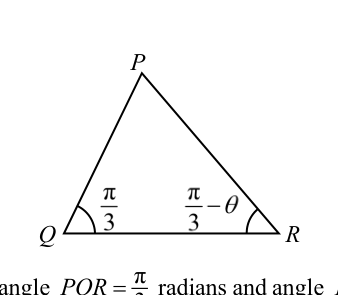
1. Apply the Sine Rule to express the ratio of $PR$ to $PQ$.
By the Sine Rule:P R sin ( π 3 ) = P Q sin ( π 3 − θ ) \frac{PR}{\sin\left(\frac{\pi}{3}\right)} = \frac{PQ}{\sin\left(\frac{\pi}{3} - \theta\right)} s i n ( 3 π ) PR = s i n ( 3 π − θ ) PQ P R P Q = sin ( π 3 ) sin ( π 3 − θ ) \frac{PR}{PQ} = \frac{\sin\left(\frac{\pi}{3}\right)}{\sin\left(\frac{\pi}{3} - \theta\right)} PQ PR = s i n ( 3 π − θ ) s i n ( 3 π )
2. Expand the denominator using the compound angle formula.
sin ( π 3 − θ ) = sin ( π 3 ) cos θ − cos ( π 3 ) sin θ \sin\left(\frac{\pi}{3} - \theta\right) = \sin\left(\frac{\pi}{3}\right)\cos\theta - \cos\left(\frac{\pi}{3}\right)\sin\theta sin ( 3 π − θ ) = sin ( 3 π ) cos θ − cos ( 3 π ) sin θ = 3 2 cos θ − 1 2 sin θ = \frac{\sqrt{3}}{2}\cos\theta - \frac{1}{2}\sin\theta = 2 3 cos θ − 2 1 sin θ
3. Substitute the small angle approximations for sine and cosine.
Since θ \theta θ sin θ ≈ θ \sin\theta \approx \theta sin θ ≈ θ cos θ ≈ 1 − θ 2 2 \cos\theta \approx 1 - \frac{\theta^2}{2} cos θ ≈ 1 − 2 θ 2 sin ( π 3 − θ ) ≈ 3 2 ( 1 − θ 2 2 ) − 1 2 θ \sin\left(\frac{\pi}{3} - \theta\right) \approx \frac{\sqrt{3}}{2}\left(1 - \frac{\theta^2}{2}\right) - \frac{1}{2}\theta sin ( 3 π − θ ) ≈ 2 3 ( 1 − 2 θ 2 ) − 2 1 θ = 3 2 − 1 2 θ − 3 4 θ 2 = \frac{\sqrt{3}}{2} - \frac{1}{2}\theta - \frac{\sqrt{3}}{4}\theta^2 = 2 3 − 2 1 θ − 4 3 θ 2
4. Substitute the denominator back into the ratio and factorise to prepare for binomial expansion.
P R P Q ≈ 3 2 3 2 − 1 2 θ − 3 4 θ 2 \frac{PR}{PQ} \approx \frac{\frac{\sqrt{3}}{2}}{\frac{\sqrt{3}}{2} - \frac{1}{2}\theta - \frac{\sqrt{3}}{4}\theta^2} PQ PR ≈ 2 3 − 2 1 θ − 4 3 θ 2 2 3 3 2 \frac{\sqrt{3}}{2} 2 3 P R P Q ≈ 1 1 − 1 3 θ − 1 2 θ 2 \frac{PR}{PQ} \approx \frac{1}{1 - \frac{1}{\sqrt{3}}\theta - \frac{1}{2}\theta^2} PQ PR ≈ 1 − 3 1 θ − 2 1 θ 2 1 = ( 1 − ( 1 3 θ + 1 2 θ 2 ) ) − 1 = \left(1 - \left(\frac{1}{\sqrt{3}}\theta + \frac{1}{2}\theta^2\right)\right)^{-1} = ( 1 − ( 3 1 θ + 2 1 θ 2 ) ) − 1
5. Apply the binomial expansion up to the $\theta^2$ term.
Using ( 1 − x ) − 1 ≈ 1 + x + x 2 (1 - x)^{-1} \approx 1 + x + x^2 ( 1 − x ) − 1 ≈ 1 + x + x 2 x x x P R P Q ≈ 1 + ( 1 3 θ + 1 2 θ 2 ) + ( 1 3 θ + 1 2 θ 2 ) 2 \frac{PR}{PQ} \approx 1 + \left(\frac{1}{\sqrt{3}}\theta + \frac{1}{2}\theta^2\right) + \left(\frac{1}{\sqrt{3}}\theta + \frac{1}{2}\theta^2\right)^2 PQ PR ≈ 1 + ( 3 1 θ + 2 1 θ 2 ) + ( 3 1 θ + 2 1 θ 2 ) 2 θ 3 \theta^3 θ 3 P R P Q ≈ 1 + 1 3 θ + 1 2 θ 2 + ( 1 3 θ ) 2 \frac{PR}{PQ} \approx 1 + \frac{1}{\sqrt{3}}\theta + \frac{1}{2}\theta^2 + \left(\frac{1}{\sqrt{3}}\theta\right)^2 PQ PR ≈ 1 + 3 1 θ + 2 1 θ 2 + ( 3 1 θ ) 2 = 1 + 3 3 θ + 1 2 θ 2 + 1 3 θ 2 = 1 + \frac{\sqrt{3}}{3}\theta + \frac{1}{2}\theta^2 + \frac{1}{3}\theta^2 = 1 + 3 3 θ + 2 1 θ 2 + 3 1 θ 2 = 1 + 3 3 θ + 5 6 θ 2 = 1 + \frac{\sqrt{3}}{3}\theta + \frac{5}{6}\theta^2 = 1 + 3 3 θ + 6 5 θ 2 α = 3 3 \alpha = \frac{\sqrt{3}}{3} α = 3 3 β = 5 6 \beta = \frac{5}{6} β = 6 5
答案 α = 3 3 , β = 5 6 \alpha = \frac{\sqrt{3}}{3}, \beta = \frac{5}{6} α = 3 3 , β = 6 5