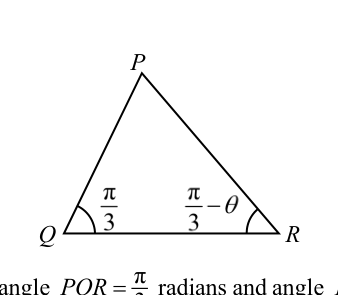
In the triangle PQRPQR, angle PQR=π3PQR = \frac{\pi}{3} radians and angle PRQ=π3−θPRQ = \frac{\pi}{3} - \theta radians, where θ\theta is small enough for θ3\theta^3 and higher powers of θ\theta to be negligible. Show that PRPQ≈1+αθ+βθ2\frac{PR}{PQ} \approx 1 + \alpha\theta + \beta\theta^2, where α\alpha and β\beta are exact real constants to be determined.
Work through it with AI →

It won't just hand you the answer — it asks where you're stuck.How the checker works

Worked solution

2

1. Apply the Sine Rule to express the ratio of $PR$ to $PQ$.

By the Sine Rule:
PRsin⁡(π3)=PQsin⁡(π3−θ)\frac{PR}{\sin\left(\frac{\pi}{3}\right)} = \frac{PQ}{\sin\left(\frac{\pi}{3} - \theta\right)}
PRPQ=sin⁡(π3)sin⁡(π3−θ)\frac{PR}{PQ} = \frac{\sin\left(\frac{\pi}{3}\right)}{\sin\left(\frac{\pi}{3} - \theta\right)}

2. Expand the denominator using the compound angle formula.

sin⁡(π3−θ)=sin⁡(π3)cos⁡θ−cos⁡(π3)sin⁡θ\sin\left(\frac{\pi}{3} - \theta\right) = \sin\left(\frac{\pi}{3}\right)\cos\theta - \cos\left(\frac{\pi}{3}\right)\sin\theta
=32cos⁡θ−12sin⁡θ= \frac{\sqrt{3}}{2}\cos\theta - \frac{1}{2}\sin\theta

3. Substitute the small angle approximations for sine and cosine.

Since θ\theta is small, sin⁡θ≈θ\sin\theta \approx \theta and cos⁡θ≈1−θ22\cos\theta \approx 1 - \frac{\theta^2}{2}.
sin⁡(π3−θ)≈32(1−θ22)−12θ\sin\left(\frac{\pi}{3} - \theta\right) \approx \frac{\sqrt{3}}{2}\left(1 - \frac{\theta^2}{2}\right) - \frac{1}{2}\theta
=32−12θ−34θ2= \frac{\sqrt{3}}{2} - \frac{1}{2}\theta - \frac{\sqrt{3}}{4}\theta^2

4. Substitute the denominator back into the ratio and factorise to prepare for binomial expansion.

PRPQ≈3232−12θ−34θ2\frac{PR}{PQ} \approx \frac{\frac{\sqrt{3}}{2}}{\frac{\sqrt{3}}{2} - \frac{1}{2}\theta - \frac{\sqrt{3}}{4}\theta^2}
Divide the numerator and denominator by 32\frac{\sqrt{3}}{2}:
PRPQ≈11−13θ−12θ2\frac{PR}{PQ} \approx \frac{1}{1 - \frac{1}{\sqrt{3}}\theta - \frac{1}{2}\theta^2}
=(1−(13θ+12θ2))−1= \left(1 - \left(\frac{1}{\sqrt{3}}\theta + \frac{1}{2}\theta^2\right)\right)^{-1}

5. Apply the binomial expansion up to the $\theta^2$ term.

Using (1−x)−1≈1+x+x2(1 - x)^{-1} \approx 1 + x + x^2 for small xx:
PRPQ≈1+(13θ+12θ2)+(13θ+12θ2)2\frac{PR}{PQ} \approx 1 + \left(\frac{1}{\sqrt{3}}\theta + \frac{1}{2}\theta^2\right) + \left(\frac{1}{\sqrt{3}}\theta + \frac{1}{2}\theta^2\right)^2
Expanding and ignoring terms with θ3\theta^3 and higher powers:
PRPQ≈1+13θ+12θ2+(13θ)2\frac{PR}{PQ} \approx 1 + \frac{1}{\sqrt{3}}\theta + \frac{1}{2}\theta^2 + \left(\frac{1}{\sqrt{3}}\theta\right)^2
=1+33θ+12θ2+13θ2= 1 + \frac{\sqrt{3}}{3}\theta + \frac{1}{2}\theta^2 + \frac{1}{3}\theta^2
=1+33θ+56θ2= 1 + \frac{\sqrt{3}}{3}\theta + \frac{5}{6}\theta^2
Comparing coefficients, we obtain α=33\alpha = \frac{\sqrt{3}}{3} and β=56\beta = \frac{5}{6}.

Answer

α=33,β=56\alpha = \frac{\sqrt{3}}{3}, \beta = \frac{5}{6}

AI analysis — may contain mistakes.

Worked this one out on paper? Snap your steps and Gigle's AI math checker will circle the step where it went wrong.

More questions on this topic

  1. 1Given that θ\theta is small, show that sec⁡θ≈1+12θ2\sec\theta \approx 1 + \tfrac{1}{2}\theta^{2}. The diagram below shows a circl…
  2. 2已知α是锐角,且cosα=0.9794,下列各值中,与α最接近的是( ) A. 73°33′ B. 73°27′ C. 11°37′ D. 11°45′
  3. 3Given that θ\theta is small, show that sec⁡θ≈1+12θ2\sec \theta \approx 1 + \tfrac{1}{2}\theta^2. The diagram below shows a circle…
  4. 4In the triangle ABCABC, AB=1AB = 1, BC=4BC = 4 and angle ABC=θABC = \theta radians. Given that θ\theta is a sufficiently small…
  5. 5In a triangle with vertices A, B and C, angle BACBAC is a right-angle and angle ABC=π3−xABC=\frac{\pi}{3}-x. Show that ABAC=1+3tan⁡x3−tan⁡x\dfrac{AB}{AC}=\dfrac{1+\sqrt{3}\tan x}{\sqrt{3}-\tan x}…