The diagram shows two rods and of length 2 m and 5 m respectively, joined together at such that angle . Small rings are attached to and so that can move along the vertical pole and can move along the horizontal pole . The rod makes an angle with . (iii) Given that can be no higher than 3.5 m above , calculate the greatest possible value of .
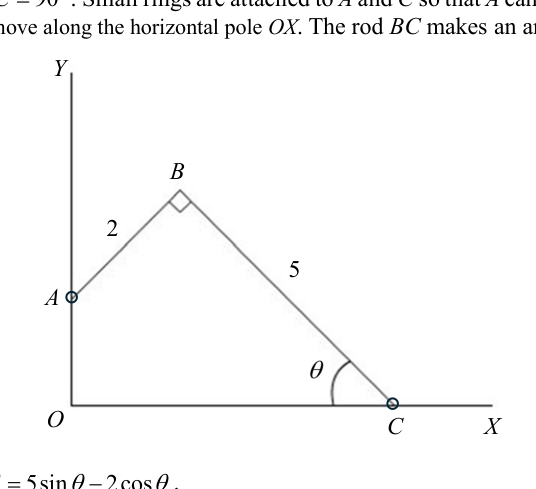
- ((i))
Show that .
- ((ii))
Express in the form where and .
It won't just hand you the answer — it asks where you're stuck.How the checker works
Worked solution
8((i))
1. Find the vertical distance from $B$ to the horizontal axis $OX$.
Let be the foot of the perpendicular from to . In the right-angled triangle , the angle is .
2. Find the vertical distance from $B$ to $A$ and hence find $OA$.
Let be the foot of the perpendicular from to the vertical line . Since and the angle of with the horizontal is , the angle makes with the vertical is .
In the right-angled triangle , the vertical distance is given by:
Since is vertically below , the height of above is:
Shown that .
8((ii))
1. Find the value of $R$
2. Find the value of $\alpha$
(to 1 d.p.)
3. Express $OA$ in the required form
AI analysis — may contain mistakes.
Worked this one out on paper? Snap your steps and Gigle's AI math checker will circle the step where it went wrong.