The diagram above shows a triangle with vertices and is perpendicular to and is parallel to the line . and are the mid-points of and respectively.
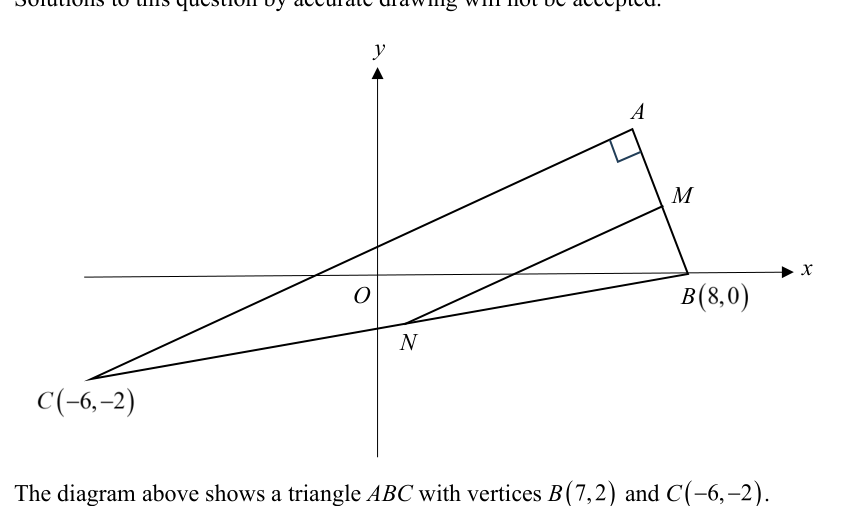
- (a)
Find the coordinates of .
Find the coordinates of .
- (b)
Explain why the quadrilateral ACNM is a trapezium.
- (c)
Find the area of the quadrilateral ACNM.
It won't just hand you the answer — it asks where you're stuck.How the checker works
Worked solution
7(a)
1. Determine the gradient of line $AB$
Since is parallel to , the gradient of , .
2. Find the equation of line $AB$
Using point and :
3. Determine the gradient of line $AC$
Since is perpendicular to , .
.
4. Find the equation of line $AC$
Using point and :
5. Solve the equations simultaneously to find the coordinates of $A$
Equating the two expressions for :
Substitute into :
The coordinates of are .
7(b)
1. Use the Midpoint Theorem to establish parallel lines
In , and are given as the mid-points of sides and respectively. By the Midpoint Theorem, the line segment connecting these mid-points is parallel to the third side, so .
2. Conclude the shape of the quadrilateral
A quadrilateral with at least one pair of parallel opposite sides is a trapezium. Since , quadrilateral is a trapezium.
By the Midpoint Theorem, is parallel to . Since quadrilateral has a pair of parallel sides, it is a trapezium.
7(c)
1. State the coordinates of $A$ (from part a) and find the coordinates of $M$ and $N$.
From part (a), is .
is the mid-point of :
is the mid-point of :
2. Apply the shoelace formula to find the area of quadrilateral $ACNM$.
Using the vertices , , , and in counter-clockwise order:
units
AI analysis — may contain mistakes.
Worked this one out on paper? Snap your steps and Gigle's AI math checker will circle the step where it went wrong.
More questions on this topic
- 1A curve has the equation , where . The normal to the point on the cur…
- 2The normal to the curve at point crosses the -axis at point …
- 3The point lies on the curve for . The normal to the curve at is par…
- 4The figure shows part of the curve . and are two points on the curve. Given that …
- 5The diagram shows part of the curve which crosses the -axis at and the -axis at …