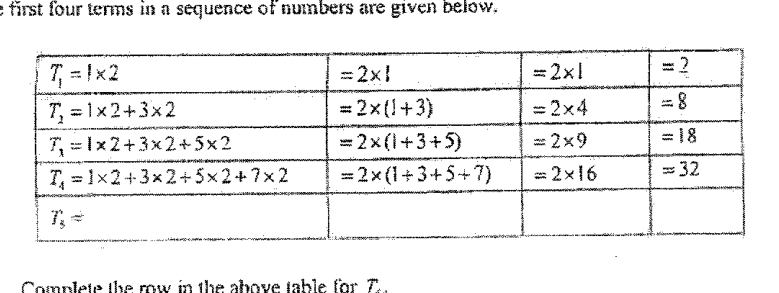
The first four terms in a sequence of numbers are given below.
- (i)
Complete the row in the above table for .
- (ii)
Find an expression, in terms of n, for .
Answer
- (iii)
Evaluate .
Answer
- (iv)
and are consecutive terms in the sequence.
Find and simplify an expression, in terms of p, for .Answer
- (v)
Explain why two consecutive terms of the sequence cannot have a difference of 4.
Answer
- (vi)
The first four terms of another sequence are 8, 18, 32 and 50.
By using (i) and (ii) or otherwise, write down an expression, in terms of n, for the nth term, , of this sequence.Answer
It won't just hand you the answer — it asks where you're stuck.How the checker works
Worked solution
4(i)
1. Extend the pattern to the fifth term and evaluate it in the same table format.
The next odd number after is .
4(ii)
1. Identify the general pattern from the given terms.
From the table,
The sum of the first odd numbers is .
So,
4(iii)
1. Substitute $n=88$ into the nth term formula and evaluate.
From part (ii),
So
4(iv)
1. Write expressions for the two consecutive terms using the nth term formula.
From part (ii),
So
2. Form the required difference between the consecutive terms.
3. Expand and simplify the expression.
4(v)
1. Use the expression for the difference between consecutive terms and justify why it cannot be 4.
From part (iv),
This is always more than a multiple of , so it cannot be equal to .
Since , the difference is always more than a multiple of . Hence it cannot be .
4(vi)
1. Relate the new sequence to the original sequence.
From earlier, the original sequence has nth term .
The new sequence is the original sequence starting from , so its nth term is the original th term.
2. Substitute $n+1$ into the original nth term expression.
AI analysis — may contain mistakes.
Worked this one out on paper? Snap your steps and Gigle's AI math checker will circle the step where it went wrong.
More questions on this topic
- 1Find the 8th term of the sequence 10, 11, 13, 16, 20,..., Answer
- 2The first four terms in a sequence of numbers are where is a constant. Fin…
- 3Diagram 1 shows an equilateral triangle with sides of length 1 unit. An inverted white equilateral triangle with sides o…
- 4Study the pattern below. Write down the values of , and in Figure 11. Answer = ... = ... = ... Wr…
- 5The first four terms in a sequence of numbers are given below. Find . Answer ... Find an expression, in terms of n,…