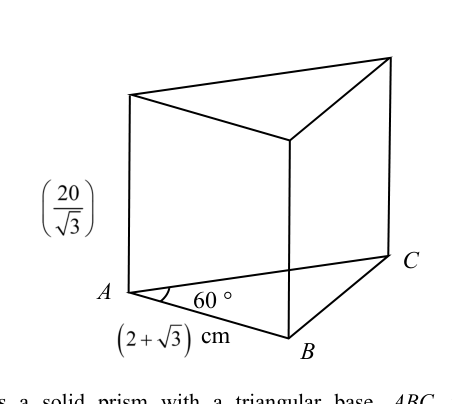
The diagram shows a solid prism with a triangular base, ABCABC, with angle BAC=60∘BAC = 60^\circ and AB=(2+3) cmAB = (2 + \sqrt{3})\text{ cm}. The height of the prism is (203) cm\left(\frac{20}{\sqrt{3}}\right)\text{ cm} and its volume is (25+103) cm3(25 + 10\sqrt{3})\text{ cm}^3. Without using a calculator, express the length of ACAC in the form (a+b3)(a + b\sqrt{3}) where aa and bb are constants.

Work through it with AI →

It won't just hand you the answer — it asks where you're stuck.How the checker works

Worked solution

6

1. Find the area of the triangular base $ABC$ using the volume and height of the prism.

Volume=Base Area×Height\text{Volume} = \text{Base Area} \times \text{Height}
25+103=Area(ABC)×(203)25 + 10\sqrt{3} = \text{Area}(ABC) \times \left(\frac{20}{\sqrt{3}}\right)
Area(ABC)=(25+103)320\text{Area}(ABC) = \frac{(25 + 10\sqrt{3})\sqrt{3}}{20}
Area(ABC)=253+3020=53+64\text{Area}(ABC) = \frac{25\sqrt{3} + 30}{20} = \frac{5\sqrt{3} + 6}{4}

2. Express the area of triangle $ABC$ using the sine formula for area.

Area(ABC)=12×AB×AC×sin⁡(BAC)\text{Area}(ABC) = \frac{1}{2} \times AB \times AC \times \sin(BAC)
Area(ABC)=12(2+3)(AC)sin⁡(60∘)\text{Area}(ABC) = \frac{1}{2}(2 + \sqrt{3})(AC)\sin(60^\circ)
Area(ABC)=12(2+3)(AC)(32)\text{Area}(ABC) = \frac{1}{2}(2 + \sqrt{3})(AC)\left(\frac{\sqrt{3}}{2}\right)
Area(ABC)=3(2+3)4×AC\text{Area}(ABC) = \frac{\sqrt{3}(2 + \sqrt{3})}{4} \times AC
Area(ABC)=23+34×AC\text{Area}(ABC) = \frac{2\sqrt{3} + 3}{4} \times AC

3. Equate the two expressions for the area to solve for $AC$.

23+34×AC=53+64\frac{2\sqrt{3} + 3}{4} \times AC = \frac{5\sqrt{3} + 6}{4}
(23+3)×AC=53+6(2\sqrt{3} + 3) \times AC = 5\sqrt{3} + 6
AC=53+623+3AC = \frac{5\sqrt{3} + 6}{2\sqrt{3} + 3}

4. Rationalise the denominator to express $AC$ in the required form.

AC=6+533+23×3−233−23AC = \frac{6 + 5\sqrt{3}}{3 + 2\sqrt{3}} \times \frac{3 - 2\sqrt{3}}{3 - 2\sqrt{3}}
AC=18−123+153−10(3)32−(23)2AC = \frac{18 - 12\sqrt{3} + 15\sqrt{3} - 10(3)}{3^2 - (2\sqrt{3})^2}
AC=18+33−309−12AC = \frac{18 + 3\sqrt{3} - 30}{9 - 12}
AC=−12+33−3AC = \frac{-12 + 3\sqrt{3}}{-3}

5. Simplify the fraction to get the final answer.

AC=4−3AC = 4 - \sqrt{3}

Answer

4−34 - \sqrt{3}

AI analysis — may contain mistakes.

Worked this one out on paper? Snap your steps and Gigle's AI math checker will circle the step where it went wrong.

More questions on this topic

  1. 1下列式子中,是最简二次根式的是( ). A. 4 \sqrt[]{4} B. 6 \sqrt[]{6} C. 8 \sqrt[]{8} D. 12 \sqrt[]{12}
  2. 2The diagram shows a prism in which its cross-section is a regular hexagon of side (5+3)(5 + \sqrt{3}) cm. Find an expressio…
  3. 3The triangle ABC is such that its area is 16+7102 cm2\dfrac{16 + 7\sqrt{10}}{2}\ \text{cm}^2, the length of AB is (32+5) cm(3\sqrt{2} + \sqrt{5})\ \text{cm}…
  4. 4Given that sin⁡A=−35\sin A = -\frac{3}{5} and cos⁡B=−817\cos B = -\frac{8}{17}, where angle AA and angle BB are in the same quadrant,…
  5. 5In ΔABC\Delta ABC, AC=12 cmAC = 12\text{ cm}, ∠ABC\angle ABC is a right angle, ∠ACB=π6\angle ACB = \frac{\pi}{6} radians and MM is the…