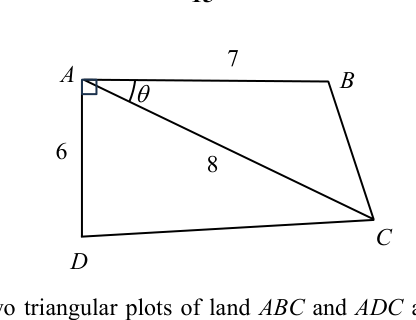
A farmer owns two triangular plots of land ABCABC and ADCADC as shown in the diagram above. It is given that AB=7 mAB = 7\ \text{m}, AC=8 mAC = 8\ \text{m} and AD=6 mAD = 6\ \text{m}, angle BADBAD is a right angle and angle BAC=θBAC = \theta radians.

  1. (a)
    1. (i)

      Show the total area of the two plots of land, A m2A\ \text{m}^2, can be expressed in the form asin⁡θ+bcos⁡θa\sin\theta + b\cos\theta, where aa and bb are integers.

    2. (ii)

      Express AA in the form Rsin⁡(θ+α)R\sin(\theta+\alpha), where R>0R>0 and 0<α<π20 < \alpha < \tfrac{\pi}{2}.

    3. (iii)

      Find the greatest possible value of AA and the value of θ\theta at which this occurs.

  2. (b)

    The farmer would like to grow roses on plot ABCABC and hibiscus on plot ADCADC. Given that he wants the area of plot ABCABC to be twice the area of plot ADCADC, find the value of θ\theta.

Work through it with AI →

It won't just hand you the answer — it asks where you're stuck.How the checker works

Worked solution

9(a)(i)

1. Express the area of triangle $ABC$ in terms of $\theta$.

Area of △ABC=12(AB)(AC)sin⁡(∠BAC)\triangle ABC = \frac{1}{2}(AB)(AC)\sin(\angle BAC)
=12(7)(8)sin⁡θ= \frac{1}{2}(7)(8)\sin\theta
=28sin⁡θ= 28\sin\theta

2. Determine the angle $CAD$ and express the area of triangle $ADC$.

Since ∠BAD=π2\angle BAD = \frac{\pi}{2} and ∠BAC=θ\angle BAC = \theta, we have ∠CAD=π2−θ\angle CAD = \frac{\pi}{2} - \theta.
Area of △ADC=12(AD)(AC)sin⁡(∠CAD)\triangle ADC = \frac{1}{2}(AD)(AC)\sin(\angle CAD)
=12(6)(8)sin⁡(π2−θ)= \frac{1}{2}(6)(8)\sin\left(\frac{\pi}{2} - \theta\right)

3. Simplify the area of triangle $ADC$ and find the total area $A$.

Using the identity sin⁡(π2−θ)=cos⁡θ\sin\left(\frac{\pi}{2} - \theta\right) = \cos\theta,
Area of △ADC=24cos⁡θ\triangle ADC = 24\cos\theta
Total area A=Area of △ABC+Area of △ADCA = \text{Area of } \triangle ABC + \text{Area of } \triangle ADC
A=28sin⁡θ+24cos⁡θA = 28\sin\theta + 24\cos\theta (Shown)

Answer

A=28sin⁡θ+24cos⁡θA = 28\sin\theta + 24\cos\theta

9(a)(ii)

1. Identify the expression for $A$ from part (a)(i)

From (a)(i), A=28sin⁡θ+24cos⁡θA = 28\sin\theta + 24\cos\theta.

2. Find the value of $R$

R=282+242=784+576=1360≈36.878R = \sqrt{28^2 + 24^2} = \sqrt{784 + 576} = \sqrt{1360} \approx 36.878

3. Find the value of $\alpha$

tan⁡α=2428=67\tan\alpha = \frac{24}{28} = \frac{6}{7}
α=tan⁡−1(67)≈0.7086\alpha = \tan^{-1}\left(\frac{6}{7}\right) \approx 0.7086 radians

4. State the final expression

A=36.9sin⁡(θ+0.709)A = 36.9\sin(\theta + 0.709) (to 3 s.f.)

Answer

A=36.9sin⁡(θ+0.709)A = 36.9\sin(\theta + 0.709)

9(a)(iii)

1. State the greatest possible value of $A$ using the $R$ value from part (a)(ii)

From (a)(i) and (a)(ii), A=28sin⁡θ+24cos⁡θ=1360sin⁡(θ+0.7086)A = 28\sin\theta + 24\cos\theta = \sqrt{1360}\sin(\theta + 0.7086).
The greatest possible value of AA is RR.
Greatest A=1360≈36.9 m2\text{Greatest } A = \sqrt{1360} \approx 36.9\ \text{m}^2

2. Set up the equation to find the corresponding $\theta$

The maximum value occurs when sin⁡(θ+0.7086)=1\sin(\theta + 0.7086) = 1.
θ+0.7086=π2\theta + 0.7086 = \frac{\pi}{2}

3. Solve for $\theta$

θ=π2−0.70862θ≈0.862 radians\theta = \frac{\pi}{2} - 0.70862 \theta \approx 0.862\ \text{radians}

Answer

Greatest value of A=36.9 m2A = 36.9\ \text{m}^2, θ=0.862 radians\theta = 0.862\ \text{radians}

9(b)

1. Express the areas of triangles $ABC$ and $ADC$ in terms of $\theta$

Area of ABC=12(7)(8)sin⁡θ=28sin⁡θABC = \frac{1}{2}(7)(8)\sin\theta = 28\sin\theta

Angle DAC=π2−θDAC = \frac{\pi}{2} - \theta
Area of ADC=12(6)(8)sin⁡(π2−θ)=24cos⁡θADC = \frac{1}{2}(6)(8)\sin\left(\frac{\pi}{2} - \theta\right) = 24\cos\theta

2. Set up the equation based on the given condition

Area of ABC=2×Area of ADCABC = 2 \times \text{Area of } ADC
28sin⁡θ=2(24cos⁡θ)28\sin\theta = 2(24\cos\theta)
28sin⁡θ=48cos⁡θ28\sin\theta = 48\cos\theta

3. Solve the trigonometric equation for $\theta$

sin⁡θcos⁡θ=4828\frac{\sin\theta}{\cos\theta} = \frac{48}{28}
tan⁡θ=127\tan\theta = \frac{12}{7}
θ=tan⁡−1(127)≈1.0432≈1.04 radians\theta = \tan^{-1}\left(\frac{12}{7}\right) \approx 1.0432 \approx 1.04 \text{ radians}

Answer

1.041.04 radians

AI analysis — may contain mistakes.

Worked this one out on paper? Snap your steps and Gigle's AI math checker will circle the step where it went wrong.

More questions on this topic

  1. 1Solve the equation 2cot⁡22x=1−5sin⁡2x2 \cot^2 2x = 1 - \frac{5}{\sin 2x} for −180∘≤x≤180∘-180^\circ \le x \le 180^\circ.
  2. 2已知sin⁡(α+π12)=55\sin (α+ \dfrac {π}{12} )= \dfrac { \sqrt {5}}{5},则sin⁡(π3−2α)=(    )\sin ( \dfrac {π}{3} -2α)= (\:\:\:\:) A. 45 \dfrac {4}{5}…
  3. 38.8.设△ABC\triangle ABC的内角AA,BB,CC所对的边分别为aa,bb,cc,若bcos⁡C+ccos⁡B=asin⁡Ab\cos C+c\cos B=a\sin A,则△ABC\triangle ABC的形状为…
  4. 4Prove that sin⁡3xsec⁡2x+sin⁡x=tan⁡xsec⁡x\sin^{3} x\sec^{2} x + \sin x = \tan x\sec x. Solve the equation sin⁡3xsec⁡2x+sin⁡x=5\sin^{3} x\sec^{2} x + \sin x = 5 for 0≤x≤360∘0 \le x \le 360^\circ…
  5. 5Given that cos⁡x=−45\cos x = -\frac{4}{5} and tan⁡x>0\tan x > 0, find sin⁡2x\sin 2x, cos⁡x2\cos \frac{x}{2}.