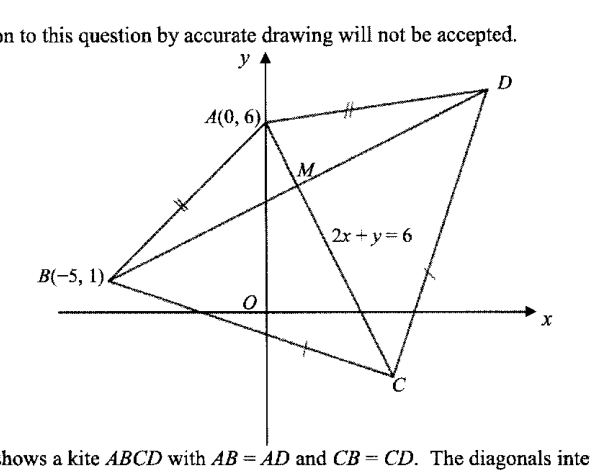
Solution to this question by accurate drawing will not be accepted. The diagram shows a kite ABCDABCD with AB=ADAB = AD and CB=CDCB = CD. The diagonals intersect at MM. It is given that the coordinates of AA and BB are (0,6)(0, 6) and (−5,1)(-5, 1) respectively and the equation of ACAC is 2x+y=62x + y = 6. Find Given further that the area of the triangle ABDABD is 13\frac{1}{3} of the area of the triangle CBDCBD,

  1. (i)

    the equation of BDBD.

  2. (ii)

    the coordinates of MM and of DD.

  3. (iii)

    find the coordinates of CC,

  4. (iv)

    find the area of the kite ABCDABCD.

Work through it with AI →

It won't just hand you the answer — it asks where you're stuck.How the checker works

Worked solution

9(i)

1. Find the gradient of the diagonal AC

The equation of ACAC is 2x+y=62x + y = 6, which can be written as y=−2x+6y = -2x + 6.
The gradient of ACAC, mAC=−2m_{AC} = -2.

2. Find the gradient of the diagonal BD

In a kite, the diagonals intersect at right angles. Therefore, BDBD is perpendicular to ACAC.
mBD=−1mAC=−1−2=12m_{BD} = -\frac{1}{m_{AC}} = -\frac{1}{-2} = \frac{1}{2}.

3. Find the equation of BD

The line BDBD passes through B(−5,1)B(-5, 1) with gradient 12\frac{1}{2}.
y−1=12(x−(−5))y - 1 = \frac{1}{2}(x - (-5))
y−1=12x+52y - 1 = \frac{1}{2}x + \frac{5}{2}
y=12x+72y = \frac{1}{2}x + \frac{7}{2}

Answer

y=12x+312y = \frac{1}{2}x + 3\frac{1}{2}

9(ii)

1. Find the equation of $BD$ (from part (i))

The gradient of ACAC (2x+y=6  ⟹  y=−2x+62x + y = 6 \implies y = -2x + 6) is −2-2.
Since the diagonals of a kite are perpendicular, the gradient of BDBD is 12\frac{1}{2}.
Equation of BDBD passing through B(−5,1)B(-5, 1):
y−1=12(x−(−5))y - 1 = \frac{1}{2}(x - (-5))
y=12x+72y = \frac{1}{2}x + \frac{7}{2}

2. Solve simultaneously to find the coordinates of $M$

Substitute y=−2x+6y = -2x + 6 into the equation of BDBD:
−2x+6=12x+72-2x + 6 = \frac{1}{2}x + \frac{7}{2}
52x=52\frac{5}{2}x = \frac{5}{2}
x=1x = 1
Substitute x=1x = 1 into y=−2x+6y = -2x + 6:
y=−2(1)+6=4y = -2(1) + 6 = 4
Therefore, MM is (1,4)(1, 4).

3. Use the properties of a kite to relate $M$ to $B$ and $D$

In kite ABCDABCD with AB=ADAB = AD and CB=CDCB = CD, the diagonal ACAC is the perpendicular bisector of BDBD.
Thus, MM is the midpoint of BDBD.

4. Find the coordinates of $D$ using the midpoint formula

Let the coordinates of DD be (x,y)(x, y).
(−5+x2,1+y2)=(1,4)\left( \frac{-5 + x}{2}, \frac{1 + y}{2} \right) = (1, 4)
−5+x2=1  ⟹  −5+x=2  ⟹  x=7\frac{-5 + x}{2} = 1 \implies -5 + x = 2 \implies x = 7
1+y2=4  ⟹  1+y=8  ⟹  y=7\frac{1 + y}{2} = 4 \implies 1 + y = 8 \implies y = 7
Therefore, DD is (7,7)(7, 7).

Answer

M(1,4)M(1, 4), D(7,7)D(7, 7)

9(iii)

1. Relate the areas of the triangles to the lengths of the segments on the diagonal $AC$.

The area of △ABD=12×BD×AM\triangle ABD = \frac{1}{2} \times BD \times AM and the area of △CBD=12×BD×CM\triangle CBD = \frac{1}{2} \times BD \times CM.
Since Area of △ABD=13×\triangle ABD = \frac{1}{3} \times Area of △CBD\triangle CBD, we have:
12×BD×AM=13(12×BD×CM)\frac{1}{2} \times BD \times AM = \frac{1}{3} \left( \frac{1}{2} \times BD \times CM \right)
AM=13CM  ⟹  CM=3AMAM = \frac{1}{3} CM \implies CM = 3AM

2. Find the coordinates of $M$ from earlier parts.

From earlier parts, the equation of BDBD is y=12x+72y = \frac{1}{2}x + \frac{7}{2}.
Solving simultaneously with ACAC (2x+y=62x + y = 6):
2x+12x+72=6  ⟹  52x=52  ⟹  x=12x + \frac{1}{2}x + \frac{7}{2} = 6 \implies \frac{5}{2}x = \frac{5}{2} \implies x = 1
y=4y = 4
So M=(1,4)M = (1, 4).

3. Use the ratio of lengths to find the coordinates of $C$.

Since A,M,CA, M, C are collinear in that order, the vector MC⃗=3AM⃗\vec{MC} = 3\vec{AM}.
AM⃗=(1−04−6)=(1−2)\vec{AM} = \begin{pmatrix} 1 - 0 \\ 4 - 6 \end{pmatrix} = \begin{pmatrix} 1 \\ -2 \end{pmatrix}
MC⃗=3(1−2)=(3−6)\vec{MC} = 3 \begin{pmatrix} 1 \\ -2 \end{pmatrix} = \begin{pmatrix} 3 \\ -6 \end{pmatrix}
OC⃗=OM⃗+MC⃗=(14)+(3−6)=(4−2)\vec{OC} = \vec{OM} + \vec{MC} = \begin{pmatrix} 1 \\ 4 \end{pmatrix} + \begin{pmatrix} 3 \\ -6 \end{pmatrix} = \begin{pmatrix} 4 \\ -2 \end{pmatrix}
The coordinates of CC are (4,−2)(4, -2).

Answer

(4,−2)(4, -2)

9(iv)

1. Recall the coordinates of the vertices of the kite from earlier parts

From earlier parts, the coordinates of the vertices are A(0,6)A(0, 6), B(−5,1)B(-5, 1), C(4,−2)C(4, -2), and D(7,7)D(7, 7).

2. Apply the shoelace formula to find the area of the kite $ABCD$

Area=12∣0−547061−276∣=12∣(0(1)+(−5)(−2)+4(7)+7(6))−(6(−5)+1(4)+(−2)(7)+7(0))∣=12∣(0+10+28+42)−(−30+4−14+0)∣=12∣80−(−40)∣=12(120)=60\begin{aligned} \text{Area} &= \frac{1}{2} \left| \begin{matrix} 0 & -5 & 4 & 7 & 0 \\ 6 & 1 & -2 & 7 & 6 \end{matrix} \right| \\ &= \frac{1}{2} | (0(1) + (-5)(-2) + 4(7) + 7(6)) - (6(-5) + 1(4) + (-2)(7) + 7(0)) | \\ &= \frac{1}{2} | (0 + 10 + 28 + 42) - (-30 + 4 - 14 + 0) | \\ &= \frac{1}{2} | 80 - (-40) | \\ &= \frac{1}{2} (120) \\ &= 60 \end{aligned}

Answer

6060 units2^2

AI analysis — may contain mistakes.

Worked this one out on paper? Snap your steps and Gigle's AI math checker will circle the step where it went wrong.

More questions on this topic

  1. 1A curve has the equation y=2x−33x+4y = \frac{2x - 3}{3x + 4}, where x≠−43x \ne -\frac{4}{3}. The normal to the point PP on the cur…
  2. 2The normal to the curve y=2tan⁡3x−1y = 2\tan 3x - 1 at point P(π3,−1)P\left(\frac{\pi}{3}, -1\right) crosses the yy-axis at point AA…
  3. 3The point PP lies on the curve y=ln⁡(x+1x−1)y = \ln\left(\frac{x+1}{x-1}\right) for x>1x > 1. The normal to the curve at PP is par…
  4. 4The figure shows part of the curve y=g(x)y = g(x). (2,8)(2, 8) and (6,1)(6, 1) are two points on the curve. Given that ∫26y dx=32\int_{2}^{6} y \text{ } dx = 32…
  5. 5The diagram shows part of the curve y=3e−12x−6y = 3e^{-\frac{1}{2}x} - 6 which crosses the xx-axis at PP and the yy-axis at QQ…