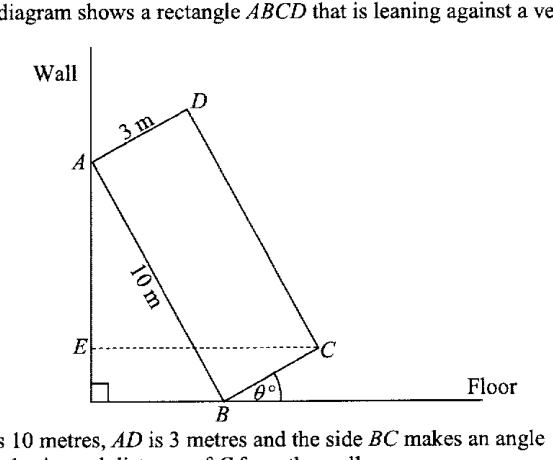
The diagram shows a rectangle that is leaning against a vertical wall.
is 10 metres, is 3 metres and the side makes an angle with the floor.
is horizontal distance of from the wall.
The rectangle will remain leaning against the wall provided lies between 7.5 metres and 9.5 metres.
- (i)
Show that can be expressed in the form , where and are constants to be found.
- (ii)
Express in the form where and is an acute angle.
- (iii)
Find the range of values of for the rectangle to remain leaning against the wall.
It won't just hand you the answer — it asks where you're stuck.How the checker works
Worked solution
11(i)
1. Find the horizontal distance from the wall to point B.
Let the corner where the wall meets the floor be . In the right-angled triangle , the angle and the angle that makes with the floor are complementary because and the floor is a straight line.
Therefore, .
The horizontal distance is given by:
2. Find the horizontal distance from B to C and sum them to find EC.
The horizontal distance from to is the projection of onto the horizontal floor.
Since is a rectangle, m.
Horizontal projection of .
The total horizontal distance from the wall to is the sum of the horizontal distance to and the horizontal projection of :
Comparing with , we have and .
,
11(ii)
1. Identify the expression for $EC$ from part (i) and set up the R-formula equation
From part (i), .
Let .
2. Find the value of $R$
Comparing coefficients:
3. Find the value of $\alpha$
(to 1 d.p.)
4. State the final expression
11(iii)
1. Set up the inequality using the condition given and the result from part (ii).
From part (ii), .
Given ,
2. Solve for the lower bound of $\theta$.
3. Solve for the upper bound of $\theta$.
4. State the final range of values for $\theta$.
AI analysis — may contain mistakes.
Worked this one out on paper? Snap your steps and Gigle's AI math checker will circle the step where it went wrong.