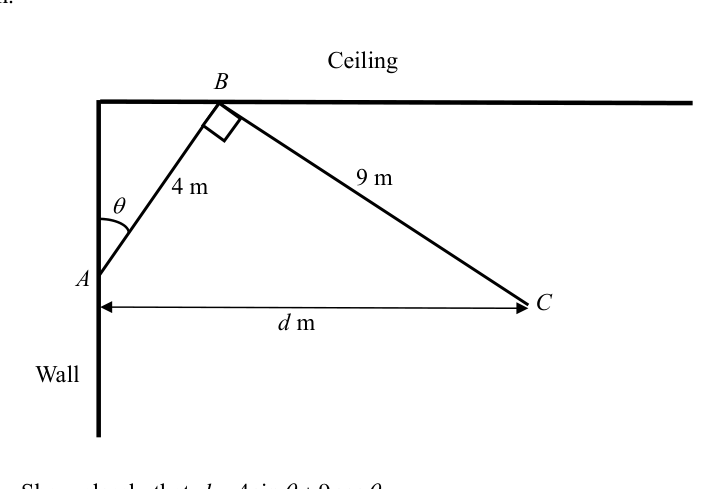
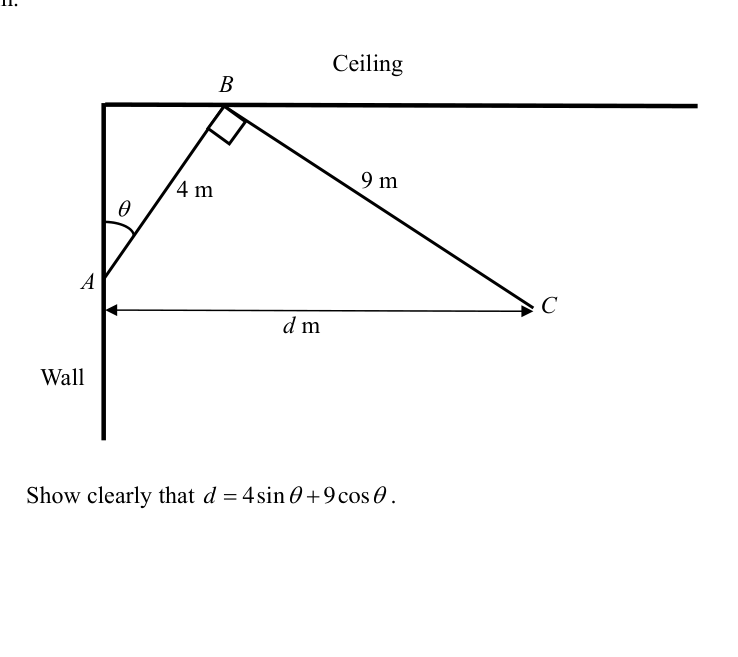
The diagram above shows two rods ABAB and BCBC of length 4 m and 9 m respectively and ∠ABC=90∘\angle ABC = 90^\circ. Rollers are fixed at points AA and BB such that AA is able to move along the wall and BB is able to move along the ceiling. The horizontal distance of CC from the vertical wall is dd m.

  1. ((a))

    Show clearly that d=4sin⁡θ+9cos⁡θd = 4\sin\theta + 9\cos\theta.

  2. ((b))

    Express dd in the form Rcos⁡(θ−α)R\cos(\theta-\alpha) where R>0R>0 and 0∘<α<90∘0^\circ<\alpha<90^\circ.

  3. ((c))

    Find the value of θ\theta for which d=6 md=6\ \text{m}.

  4. ((d))

    Find the maximum value of dd and the corresponding value of θ\theta.

Work through it with AI →

It won't just hand you the answer — it asks where you're stuck.How the checker works

Worked solution

9((a))

1. Define horizontal distances from the wall using right-angled triangles

Let the horizontal distance from the wall to BB be x1x_1 and the horizontal distance from BB to CC be x2x_2. Then d=x1+x2d = x_1 + x_2.

2. Express $x_1$ in terms of $\theta$

In the right-angled triangle formed by AA, BB, and the wall, the angle at AA is θ\theta. The side opposite to θ\theta is x1x_1.
sin⁡θ=x14  ⟹  x1=4sin⁡θ\sin\theta = \frac{x_1}{4} \implies x_1 = 4\sin\theta

3. Determine the relevant angle for the second triangle

Draw a vertical line down from BB. The angle between ABAB and the vertical is θ\theta (alternate interior angles). Since ∠ABC=90∘\angle ABC = 90^\circ, the angle between BCBC and the horizontal is θ\theta.

4. Express $x_2$ in terms of $\theta$ and find $d$

In the right-angled triangle formed by BB, CC, and the horizontal/vertical lines, the horizontal side x2x_2 is adjacent to the angle θ\theta (if we use the angle with the horizontal) or opposite to 90∘−θ90^\circ - \theta.
cos⁡θ=x29  ⟹  x2=9cos⁡θ\cos\theta = \frac{x_2}{9} \implies x_2 = 9\cos\theta
Therefore, d=x1+x2=4sin⁡θ+9cos⁡θd = x_1 + x_2 = 4\sin\theta + 9\cos\theta (Shown).

Answer

Shown

9((b))

1. Expand $R\cos(\theta-\alpha)$ and equate coefficients with the expression for $d$

From part (a), d=9cos⁡θ+4sin⁡θd = 9\cos\theta + 4\sin\theta.
Rcos⁡(θ−α)=Rcos⁡θcos⁡α+Rsin⁡θsin⁡αR\cos(\theta-\alpha) = R\cos\theta\cos\alpha + R\sin\theta\sin\alpha
Comparing coefficients:
Rcos⁡α=9R\cos\alpha = 9
Rsin⁡α=4R\sin\alpha = 4

2. Calculate the value of $R$

R=92+42R = \sqrt{9^2 + 4^2}
R=81+16=97≈9.85R = \sqrt{81 + 16} = \sqrt{97} \approx 9.85

3. Calculate the value of $\alpha$

tan⁡α=49\tan\alpha = \frac{4}{9}
α=tan⁡−1(49)≈23.962∘≈24.0∘\alpha = \tan^{-1}\left(\frac{4}{9}\right) \approx 23.962^\circ \approx 24.0^\circ (to 1 d.p.)

4. State the final expression

d=97cos⁡(θ−24.0∘)d = \sqrt{97}\cos(\theta - 24.0^\circ)

Answer

97cos⁡(θ−24.0∘)\sqrt{97}\cos(\theta - 24.0^\circ)

9((c))

1. Express $d$ using the $R$-formula from part (b) and set up the equation

From part (b), d=4sin⁡θ+9cos⁡θ=Rcos⁡(θ−α)d = 4\sin\theta + 9\cos\theta = R\cos(\theta - \alpha).
R=42+92=97R = \sqrt{4^2 + 9^2} = \sqrt{97}
tan⁡α=49  ⟹  α≈23.962∘\tan\alpha = \frac{4}{9} \implies \alpha \approx 23.962^\circ
So, 97cos⁡(θ−23.962∘)=6\sqrt{97}\cos(\theta - 23.962^\circ) = 6

2. Solve the trigonometric equation for $\theta$

cos⁡(θ−23.962∘)=697\cos(\theta - 23.962^\circ) = \frac{6}{\sqrt{97}}
θ−23.962∘=cos⁡−1(697)\theta - 23.962^\circ = \cos^{-1}\left(\frac{6}{\sqrt{97}}\right)
θ−23.962∘≈52.468∘\theta - 23.962^\circ \approx 52.468^\circ
θ=52.468∘+23.962∘=76.430∘≈76.4∘\theta = 52.468^\circ + 23.962^\circ = 76.430^\circ \approx 76.4^\circ (to 1 d.p.)

Answer

76.4∘76.4^\circ

9((d))

1. State the maximum value of $d$ using the $R$ value from part (b)

From part (b), d=97cos⁡(θ−23.962∘)d = \sqrt{97}\cos(\theta - 23.962^\circ).
The maximum value of cos⁡(θ−23.962∘)\cos(\theta - 23.962^\circ) is 11.
Maximum d=97≈9.85d = \sqrt{97} \approx 9.85 m

2. Find the corresponding value of $\theta$

For maximum dd, cos⁡(θ−23.962∘)=1\cos(\theta - 23.962^\circ) = 1
θ−23.962∘=0∘\theta - 23.962^\circ = 0^\circ
θ=23.962∘≈24.0∘\theta = 23.962^\circ \approx 24.0^\circ

Answer

Maximum d=97d = \sqrt{97} m (or 9.859.85 m), θ=24.0∘\theta = 24.0^\circ

AI analysis — may contain mistakes.

Worked this one out on paper? Snap your steps and Gigle's AI math checker will circle the step where it went wrong.

More questions on this topic

  1. 1Solve the equation 2cot⁡22x=1−5sin⁡2x2 \cot^2 2x = 1 - \frac{5}{\sin 2x} for −180∘≤x≤180∘-180^\circ \le x \le 180^\circ.
  2. 2已知sin⁡(α+π12)=55\sin (α+ \dfrac {π}{12} )= \dfrac { \sqrt {5}}{5},则sin⁡(π3−2α)=(    )\sin ( \dfrac {π}{3} -2α)= (\:\:\:\:) A. 45 \dfrac {4}{5}…
  3. 38.8.设△ABC\triangle ABC的内角AA,BB,CC所对的边分别为aa,bb,cc,若bcos⁡C+ccos⁡B=asin⁡Ab\cos C+c\cos B=a\sin A,则△ABC\triangle ABC的形状为…
  4. 4Prove that sin⁡3xsec⁡2x+sin⁡x=tan⁡xsec⁡x\sin^{3} x\sec^{2} x + \sin x = \tan x\sec x. Solve the equation sin⁡3xsec⁡2x+sin⁡x=5\sin^{3} x\sec^{2} x + \sin x = 5 for 0≤x≤360∘0 \le x \le 360^\circ…
  5. 5Given that cos⁡x=−45\cos x = -\frac{4}{5} and tan⁡x>0\tan x > 0, find sin⁡2x\sin 2x, cos⁡x2\cos \frac{x}{2}.