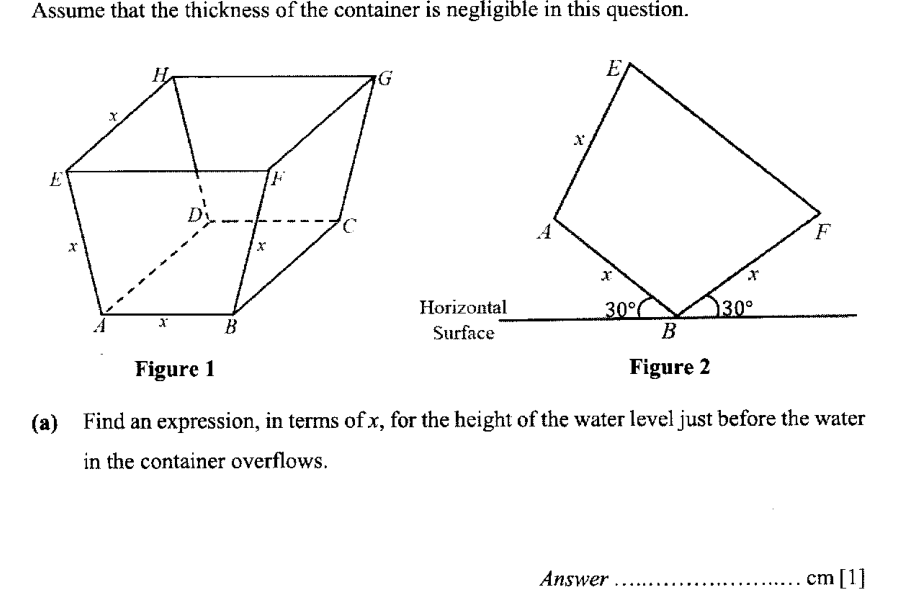
Figure 1 shows an open container in the form of an isosceles trapezoidal prism with square base of sides , where is a constant. The faces and are perpendicular to the base . The container is then tilted along such that the face and the base make an angle of each with the horizontal surface, as shown in Figure 2. Water is then filled into this empty container at a constant rate of . Assume that the thickness of the container is negligible in this question.
- (a)
Find an expression, in terms of , for the height of the water level just before the water in the container overflows.
Answer ... cm
- (b)
Find the time it takes to first fill this container to the height found in part (a), giving your answer to the nearest second.
Answer ... seconds
It won't just hand you the answer — it asks where you're stuck.How the checker works
Worked solution
20(a)
1. Identify the lowest point of the container's opening from which water will overflow.
The container is open at the top face . When tilted, the water will overflow from the lowest point on the rim . Since the container is tilted along , the edge is horizontal and lower than . Thus, water overflows over the edge .
2. Calculate the vertical height of the edge $FG$ above the horizontal surface.
The face makes an angle of with the horizontal. The length of is (since is an isosceles trapezoid and , by symmetry ).
The height of (and ) above the horizontal surface at is given by:
20(b)
1. Find the cross-sectional area of the water (triangle ABF)
Just before overflowing, the horizontal water surface passes through and , both at height (from part (a)). The water cross-section is the isosceles triangle with and included angle .
Using the surface as base with height , where :
(Equivalently .)
2. Find the volume of water in the container
The container is a prism of depth , so the volume of water is the cross-sectional area multiplied by the depth:
3. Find the filling time and convert to seconds
Water is added at a constant rate of , so
Converting to seconds:
seconds (since time min s)
AI analysis — may contain mistakes.
Worked this one out on paper? Snap your steps and Gigle's AI math checker will circle the step where it went wrong.