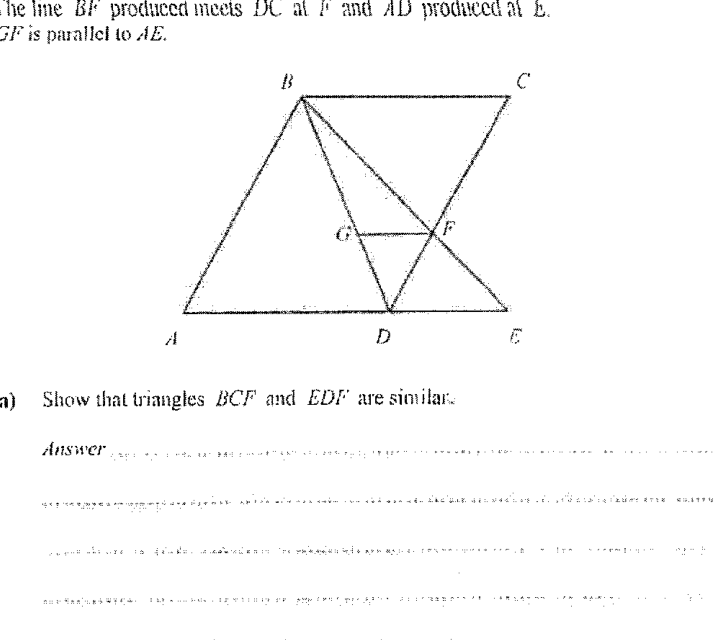
ABCD is a parallelogram and G is a point on BD. The line BF produced meets DC at F and AD produced at E. GF is parallel to AE.
- (a)
Show that triangles BCF and EDF are similar.
- (b)
Name a triangle that is similar to triangle BDE.
- (c)
Given that AD = 2DE, find
- (i)
Find .
- (ii)
Find .
- (iii)
Find .
- (i)
It won't just hand you the answer — it asks where you're stuck.How the checker works
Worked solution
9(a)
1. Identify one pair of equal corresponding angles using parallel lines.
In parallelogram , . Since lies on produced, is along .
Also, lies on , so and are on the same straight line.
Hence,
because and is collinear with .
2. Identify a second pair of equal angles and conclude similarity.
Since are collinear and are collinear,
as vertically opposite angles.
Therefore, two pairs of corresponding angles are equal, so by AA similarity,
Since and , . Also, are collinear and are collinear, so . Therefore, by AA similarity,
9(b)
1. Name the similar triangle using corresponding angles from parallel lines.
Since and lies on , corresponding angles are equal:
Also, , , are collinear and , , are collinear, so
Hence, by AA similarity,
Therefore, a triangle similar to is .
, so the triangle is .
9(c)(i)
1. Use corresponding sides of similar triangles to find the ratio $CF:DF$, then relate it to $AB$.
From part (a), .
Corresponding sides give
Since is a parallelogram, and .
Given , we have .
Hence
so .
Since are collinear,
But , so
Therefore
9(c)(ii)
1. Find the scale factor from $\triangle BDE$ to $\triangle BGF$.
From part (a), .
Since and in a parallelogram,
Hence
So
and therefore
2. Use $GF \parallel AE$ to relate $GF$ to $DE$, then convert to $AE$.
Since and is on the same straight line as ,
Thus
So
Also,
Therefore
9(c)(iii)
1. Express the base of the parallelogram in terms of $DE$.
Since , and is a parallelogram,
2. Use the earlier result for $DF$ to express $DF$ in terms of $DE$.
From part (c)(i),
Since ,
3. Compare the areas using common perpendicular height.
The perpendicular height of from to is the same as the perpendicular height of parallelogram to base , since lies on and .
Hence,
But this uses base directly. Equivalently, using the height to compared with the parallelogram height requires the angle between and ; the valid area comparison is instead obtained from similarity with and the whole parallelogram decomposition. Since and , let . Then and .
Taking as horizontal and the height of the parallelogram as , lies on , so the vertical height of is . Thus
while
Therefore,
AI analysis — may contain mistakes.
Worked this one out on paper? Snap your steps and Gigle's AI math checker will circle the step where it went wrong.
More questions on this topic
- 1In the diagram, there are two right-angled triangles ΔABD and ΔCEB such that AD = 12 cm, BD = 15 cm and BE = 20 cm. Find…
- 2A cuboid has a volume of 250 cm^3, correct to the nearest cubic centimetre. The height of the cuboid is 8.4 cm, correct…
- 3The points A, B, C, D and E are shown in the diagram below such that ABC and AED are straight lines and BE = …
- 4In the diagram, triangle XYZ is similar to triangle UXS. Given that cm, cm and cm…
- 5The diagram below shows a gift souvenir formed by joining the plane face of a solid hemisphere of radius 3 cm and a soli…